
In roles with many different companies, I have overseen drug and alcohol programs and employee testing (called a Designated Employer Representative, or DER). The regulation of illicit substances or even prescribed drugs can be complex for most organizations, depending on what they do and where they work.
In my home state, recreational marijuana use is legal. However, this is regulated state-by-state (Figure 1). Many states abide by the federal standard for substance abuse, which still includes marijuana, and federal law requires testing for drugs of concern in certain professions, such as commercial drivers and airline pilots. Some states allow it only as medication, requiring a medical card to purchase. Others allow testing only in certain situations (such as New York and California). Some specific tasks considered safety sensitive may also require testing.
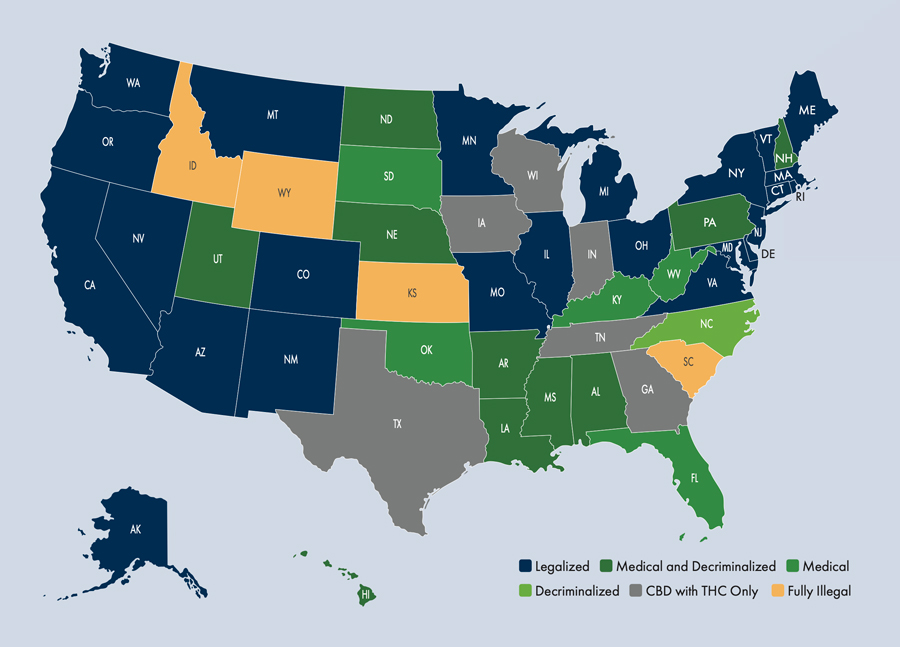
With recreational or medical marijuana use being legalized in many states across the United States, workplaces should review their health and safety or human resources policies regarding alcohol and drug use—and if the workplace does not have a policy, it’s high time to create one.
THE IMPORTANCE OF A DRUG AND ALCOHOL POLICY
What if your job is considered safety-sensitive, such as working with live-line voltages, and a coworker shows up for their shift smelling like a distillery? Or if you’re a supervisor and an employee calls to tell you their driving license was suspended over the weekend, and they’ll be unable to show up for work without a ride? What exactly are employers, supervisors, and coworkers supposed to do when someone they are depending on in their workplace is clearly under the influence of alcohol or drugs? It’s a sensitive subject that affects many.
According to the Substance Abuse and Mental Health Services Administration (SAMHSA), an agency in the Department of Health and Human Services, illegal and illicit drug use is increasing and becoming a growing workplace hazard to worker safety.
AN ISSUE OF SAFETY
Impaired workers can cause serious injury or damage to themselves, fellow employees, or expensive components or equipment. Developing a comprehensive workplace drug and alcohol policy along with a testing procedure is essential for any workplace that has people working with hazards or equipment that would make the employee considered safety sensitive. Resources like www.samhsa.gov/workplace can help organizations’ policy makers develop such a program.
Once such a program is developed, notification and training of all employees is essential. It is suggested that a third-party company be contracted to assist with random selections, testing, and analysis. These companies can buffer a workplace from potential lawsuits that may occur should an employee be terminated from employment for a positive drug or alcohol test.
Managers who will be responsible for administering any program should go through additional training on how to manage it. There may be reasonable suspicion or post-accident drug and alcohol testing training, or training on how to give proper notice to an employee should they be selected for a random test.
Employees should also be regularly reminded that some prescription or even over-the-counter drugs may affect their performance. Certain cough medicines, pain medications, and many others may have detrimental effects. The company should appoint a DER to not only maintain the records (which must be kept confidential) of drug testing, but also to be a resource when it comes to questions regarding these drugs.
FIT FOR WORK VS. THE HANGOVER EFFECT
Statistics show that when it comes to alcohol and other drugs, we cannot underestimate the influence of our behavior while off the job. Many incidents occur the morning after when blood alcohol levels may still be high. When a worker is hungover, and the senses are dulled from the ill effects of too much alcohol or drugs in the system, it’s the prime time for workplace incidents to occur, especially if that worker operates machinery or equipment in a safety-sensitive industry such as ours.
Research has found there is a correlation between the frequency of being hungover at work and other workplace events, such as feeling sick at work, sleeping on the job, and having problems with tasks or coworkers. It has been shown that employees with substance abuse issues may frequently become tardy or have increased missed days of work (sick, vacation, or just never clocked in). This can become an operational issue for managers, as they must continue backfilling positions to ensure the work is completed on time.
In one study, the hangover effect was demonstrated by pilots tested in flight simulators. There was still evidence of impairment 14 hours after pilots reached blood alcohol concentrations (BACs) of between 0.10% and 0.12%, and pilots were still significantly impaired eight hours after reaching a BAC of 0.10%. This study shows that impairment can continue well after substance use ends and may also lead to increased employee absences.
The following are some of the statistics on substance use in the U.S. as of 2025:
ALCOHOL USE
- Overall Drinking Rates. Only 54% of American adults say they drink alcohol, with 44% describing themselves as total abstainers.
- Monthly Use. According to federal data from the National Survey on Drug Use and Health (NSDUH), roughly 129.1 million Americans aged 12 and older (about 44%) reported using alcohol in the past month.
- Binge Drinking. Among those reporting past-month alcohol use, 56.8 million (44.0%) reported binge drinking, representing a decline down to roughly 19.5% of the total U.S. population aged 12 and older.
- Health Perceptions. Concern over health risks surged; 66% of 18- to 34-year-olds and 50% of 35- to 54-year-olds view moderate drinking as bad for health.
ILLICIT DRUG USE
- Past-Year Use. This rose from 62.0 million people (22.2%) in 2021 to 69.8 million people (24%) by 2025.
- Most Common Substance. Marijuana remains the most widely used illicit drug, with over 61.5 million past-year users in the U.S.
- Youth Trends. Declines were reported among adolescents regarding tobacco, alcohol, binge drinking, marijuana, and overall illicit drug use.
- Increases. Past-year illicit drug use, hallucinogen use, and marijuana use/disorder showed overall increases across the broader population compared to 2021 baselines.
FENTANYL AND OPIOID MISUSE
- Past-Year Use. Approximately 0.3% (768,000 people) reported use in the past year.
- Overall Opioid Misuse. About 2.4% of the population aged 12 or older (about 7.1 million people) misused opioids in the past year.
- Downward Trend. Overall opioid misuse showed a decline compared to previous years, dropping from 9.1 million (3.2%) in 2021 down to 7.1 million in 2025.
SUBSTANCE USE DISORDERS
Past-Year Use. Around 15.3% of people aged 12 or older (about 44.6 million individuals) experienced an SUD in the past year. This rate shows a decrease from 16.7% in 2021.
Treatment Trends. Fewer than 1 in 5 people (16.0%) who needed substance use treatment actually received it in the past year.
CONCLUSION
Every individual in the workplace has a personal responsibility to ensure their own safety and the safety of others. Part of that responsibility is to encourage and help someone with an alcohol or drug problem seek assistance through an employee assistance service or a supervisor. If that individual is putting themselves or others in danger, you have a responsibility to report that individual to a supervisor or leader. The adage “You are your brother’s keeper” is accurate in this case. The employee may not only be preventing injury to their coworker but also preventing injury to themselves or others.
Based on usage statistics and constantly evolving legislation, the guiding principles of alcohol and drug policies continue to include a shared responsibility for safety, an understanding of how behavior on and off the job affects safety, and balancing safety and privacy interests.
REFERENCES
- DISA. “Marijuana & THC Legality by State.” Updated September 1, 2026. disa.com/marijuana-legality-by-state/.
- Substance Abuse and Mental Health Services Administration. “Release of the 2026 NSDUH: Using Data to Drive the Great American Recovery.” August 5, 2026. www.samhsa.gov/blog/release-2025-nsduh-using-data-to-drive-great-american-recovery.
- Yesavage, Jerome A., and Von O. Leirer. “Hangover Effects on Aircraft Pilots 14 Hours after Alcohol Ingestion: A Preliminary Report.” American Journal of Psychiatry 143, no. 12 (1986): 1546–1550. doi.org/10.1176/ajp.143.12.1546.

Paul Chamberlain has been the Safety Manager for Asplundh Engineering Services, LLC, and formerly Asplundh Electrical Testing, LLC, since 2009. He has been in the environmental health and safety field since 1998, working for various companies and in various industries. He received a BS from Massachusetts Maritime Academy.