

I have spent many months researching how, as an equipment insurer, to enhance our understanding of underwriting risk by improving the assessment of electrical risk at medium- and high-voltage facilities through predictive analytics.
The answer I found was partial discharge (PD) testing that uses touchless acoustical methods with intrinsic AI capability. Partial discharge is a localized voltage discharge within an insulating medium, often caused by aging, electrical stress, or environmental conditions. It can manifest as surface discharge along insulator surfaces due to contaminants or as internal discharge within insulation material such as cable insulation jackets, often in voids or imperfections, and is caused by moisture and contaminant ingress. This usually appears as treeing, a type of PD in solid dielectrics, such as cable insulation materials, originating from a defect and propagating in a tree-like structure.
PD testing provides an additional method to predict potential issues/failures before they occur. I have seen this phenomenon in several recent substation visits. Alongside a good dissolved gas analysis (DGA) program, PD testing offers an avenue to better and earlier decision-making. Plan the work and work the plan.
PD testing is an effective predictive maintenance technology in medium- and high-voltage substations. The attractive part of PD technology includes AI’s ability to provide a comprehensive view of the medium- or high-voltage asset before it becomes a hot spot. Once that switch or piece of switchgear goes hot, the probability of failure increases tremendously. Now it becomes a reactive maintenance issue and unwanted outage time. Using a predictive approach, such as PD testing, enables the utility or end user to plan accordingly most of the time and take care of the issue well in advance of potential failure. Based on my extensive field experience investigating catastrophic losses, I have synthesized some critical examples and takeaways regarding failure analysis and risk mitigation.
CATASTROPHIC TRANSFORMER FAILURE
This occurred at a substation near an airport, resulting in significant disruption to the power supply and considerable financial losses, including widespread business interruption. The root cause was identified as a preventable failure. Transformers rarely fail without warning. The failed transformer was a 132-kV/11-kV, 40-MVA unit that formed part of the airport’s high-voltage electrical distribution network. The substation was responsible for supplying power to the airport’s terminals, runways, and other critical infrastructure. The transformer had undergone standard maintenance and inspections, but on the day of the incident, a series of events led to the transformer’s failure.
A fault occurred on the 11-kV system, causing a significant increase in current flow through the transformer. The protection and control system responded by tripping the circuit breaker, but the transformer had already suffered significant internal insulation breakdown, which resulted in an explosion and fire that caused extensive damage to the substation and nearby equipment. The investigation into the transformer failure revealed that the root cause was a combination of several factors:
- Inadequate maintenance. Although regular maintenance had been performed, it was found that the maintenance activities were not thorough enough to identify and address a growing issue with the transformer’s insulation system, including the bushings.
- Inadequate inspection. The inspections performed on the transformer did not include a thorough evaluation of the insulation system, which was found to be deteriorating over time. The transformer had not undergone a thorough condition assessment, including manual DGA and acoustical PD testing.
The investigation and analysis of the transformer failure revealed several key lessons that can be applied to prevent similar incidents in the future:
- Regular and thorough maintenance. Regular maintenance activities should be thorough and include a detailed evaluation of the transformer’s insulation system. Regular manual DGA and acoustical/ultrasound PD testing at a minimum would help prevent such a loss from occurring again. Listen to the undetectable whispers before you audibly hear the screaming.
- Predictive Maintenance. A predictive maintenance program (manual on-line PD) should be considered to detect potential issues with transformers before they become major problems. Manual PD testing at a minimum may have helped minimize or prevent this loss as well.
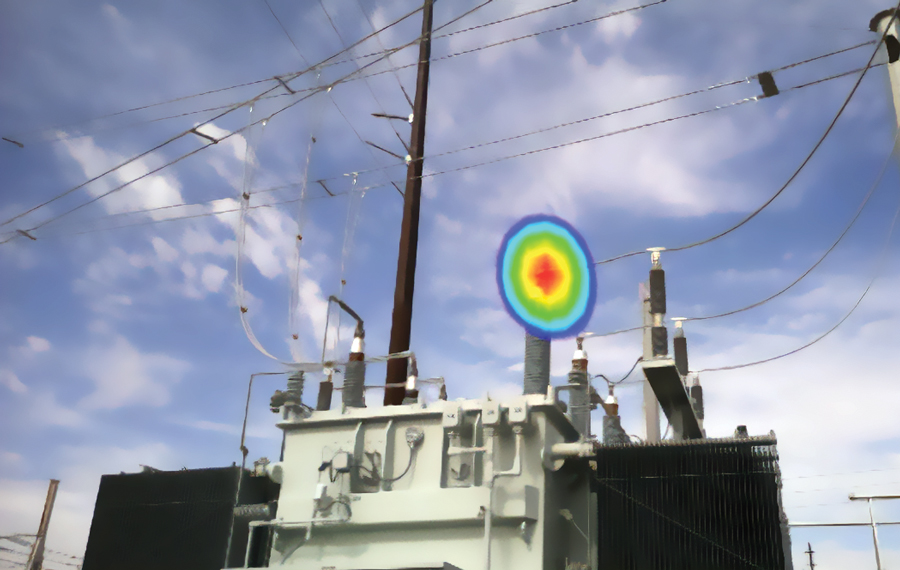
IMAGE COURTESY OF FLIR
TRANSFORMER FAILURE DUE TO PD
A 2,000-kVA, dry-type transformer failed due to PD on the 13.2-kV primary coil insulation. The failure was due to a damaged ventilation louver on an outdoor transformer enclosure, as the open louver repeatedly allowed water and snow to enter during inclement weather. The moisture, high humidity, and dirt contamination caused the primary coil insulation to break down due to PD. Surface PD tracking and electrical treeing damage were visible on all three primary coil windings and insulation. The surface PD eventually spanned the insulation system to the grounded support steel within the enclosure. The progressive damage to the insulation resulted in arcing ground faults that destroyed the winding insulation and melted the aluminum primary coil windings.
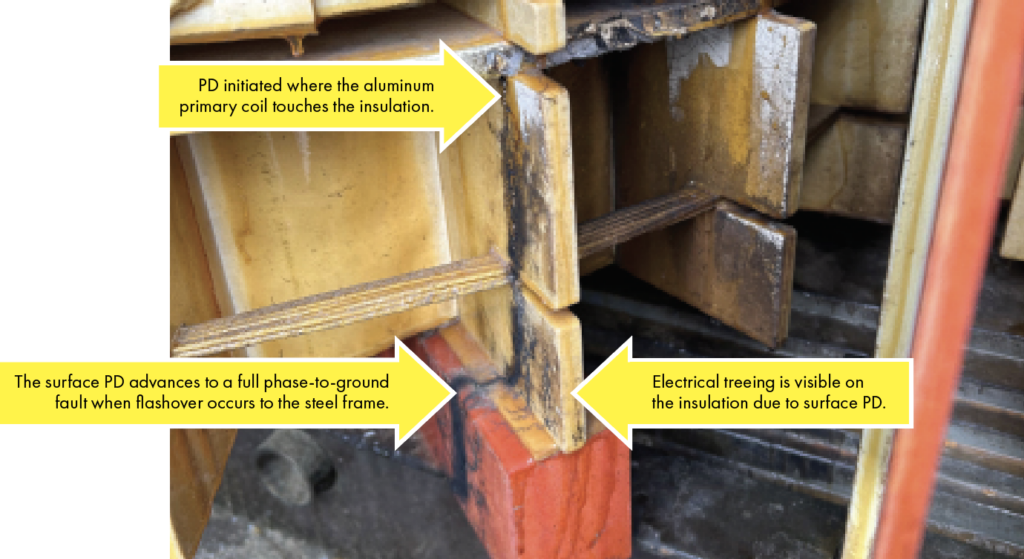
Periodic, on-line PD testing or manual acoustical imaging equipment would have detected the slowly developing surface tracking.
A review of the damage found that:
- Visual inspection of the roof-mounted transformer enclosure would have detected the damaged ventilation louver.
- Repair or replacement of the bent louver would have prevented water and humidity from soaking into the primary winding insulation and reduced the PD inception voltage.
- Having an NFPA 70B-compliant electrical preventive maintenance program for the roof-mounted transformers would have required periodic visual and electrical inspections.
- Periodic cleaning of dirt from the transformer interior would have reduced the likelihood of surface PD or tracking.
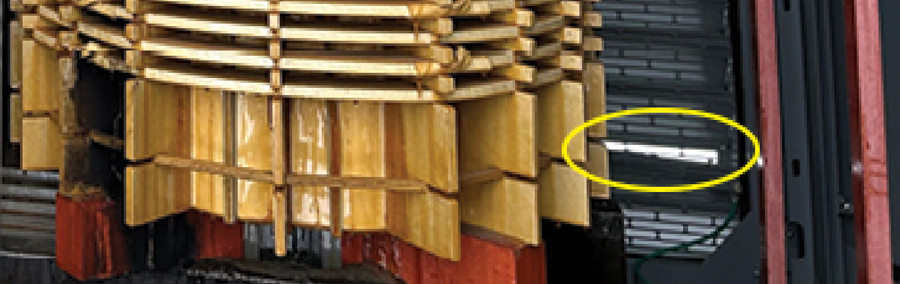
The internal view of the transformer shows a direct entry point for water and moisture. This is especially true during wind-driven storm conditions.
ACOUSTIC PD USE CASES IN SUBSTATION EQUIPMENT
- Condition-based maintenance. Acoustic PD imaging can be used to detect and prioritize maintenance activities for substation equipment, reducing the likelihood of unexpected failures and minimizing downtime.
- Fault detection and location. The technique can help identify and locate faults in substation equipment, such as transformers, switchgear, and bushings, allowing for targeted maintenance and repair.
- Insulation condition assessment. Acoustic PD imaging can assess the condition of insulation materials in substation equipment, enabling utilities to predict and prevent equipment failures.
- Commissioning and testing. The technique can be used to verify the integrity of new substation equipment during commissioning and testing, ensuring that it is functioning correctly and safely.
- Predictive maintenance. By analyzing acoustic PD data, utilities can predict when maintenance is required, reducing the need for scheduled outages and minimizing the risk of equipment failure.
BENEFITS OF ACOUSTIC PD IMAGING IN POWER-DENSE MODERN AI DATA CENTERS
- Increased uptime. By detecting and addressing partial discharges, data centers can minimize the risk of equipment failure and maintain high levels of uptime.
- Reduced maintenance costs. Condition-based maintenance and predictive maintenance enabled by acoustic PD imaging can reduce maintenance costs and minimize downtime.
- Improved safety. The technique can help identify and mitigate potential safety risks associated with partial discharges, such as electrical shocks and fires.
- Real-time monitoring. Acoustic PD imaging can provide real-time, touchless monitoring of substation equipment and power systems, enabling swift response to potential issues and minimizing downtime.
- Integration with other diagnostic techniques. Acoustic PD imaging can be integrated with other diagnostic techniques, such as thermal imaging, vibration analysis, and DGA, to provide a comprehensive understanding of substation equipment and power systems.
In summary, acoustic PD imaging is a valuable diagnostic technique for detecting and locating partial discharges in substation equipment. By leveraging AI and machine learning intrinsic to the PD imager, data centers and utilities can analyze acoustic PD data to predict and prevent equipment failures, optimize operational efficiency, and maintain high levels of uptime.

Vincenzo Pagliuca is a Principal Electrical Engineer for the Hartford Steam Boiler Inspection and Insurance Company. He received his BS in electrical engineering from the University of Hartford in Connecticut. Pagliuca has 30 years of electrical engineering experience, including 10 years of utility transmission experience with Eversource Energy, and motion control and robotics experience with Gerber Scientific and Schneider Electric.