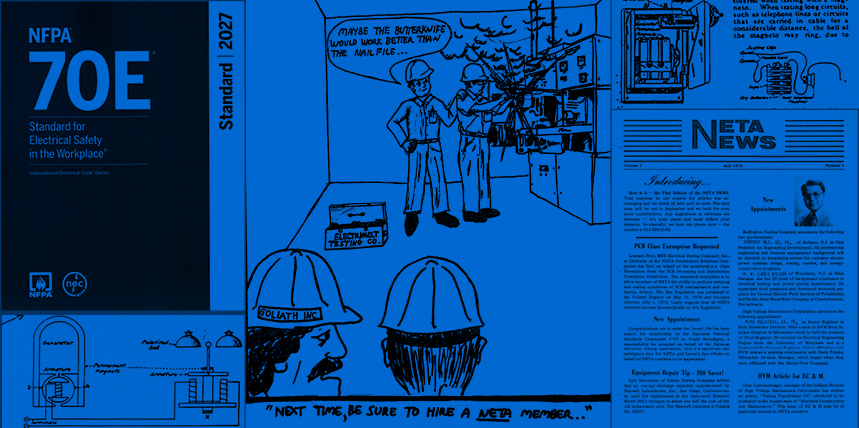
Often attributed* to Mark Twain, the phrase “History does not repeat itself, but it rhymes” seemed appropriate as we look back on our electrical journeys. The 2027 edition of NFPA 70E was recently approved, with an effective date of May 6, 2026, and we are excited about the improvements and enhancements to this very important electrical safety work practices standard.
We highlight a few of the more significant changes in this issue, and a few more changes will be featured in future columns and writings. But speaking of history…
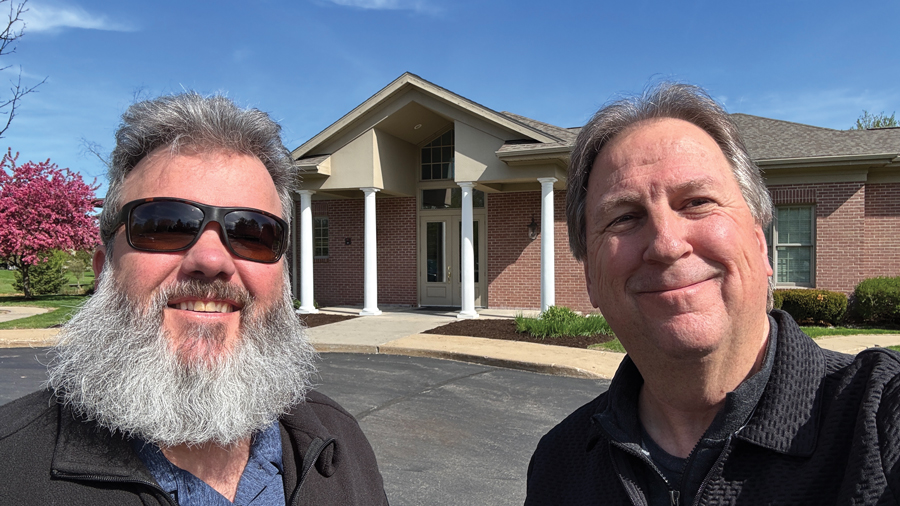
What struck me about the Mark Twain quote ties to a recent visit to NETA’s corporate office in Portage, Michigan. There is a lot of history with NETA and its many volunteers in the electrical industry, and this was very evident as we reviewed some of the archived materials found on the shelves.
As an association that has had long-standing input and participation in the development and publishing of standards and work practices in the electrical testing, maintenance, and safety arena, it was evident to me through some of the newsletters, articles, and documents found at NETA that we have, through the course of time, made a difference. So let’s take a quick trip down memory lane…
*There is no substantive evidence that Twain made this remark, but he first received credit in 1970, many years
after his death.
The earliest strong match appeared in 1965 within an essay by psychoanalyst Theodor Reik titled “The Unreachables.”
The phrasing was a bit longer, but the meaning was the same:
“There are recurring cycles, ups and downs, but the course of events is essentially the same, with small variations. It has been said that history repeats itself. This is perhaps not quite correct; it merely rhymes.”
BACK THEN…
A precursor to NETA World was NETA News, which first appeared in July 1979.
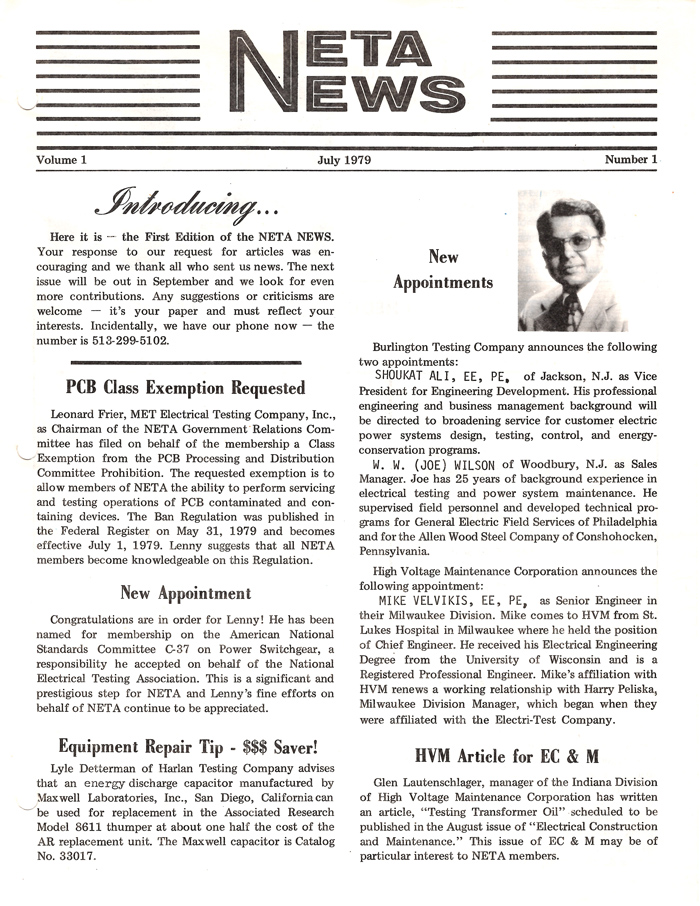
In the October 1979 issue of NETA News, the following segment was published:
Maintenance Testing Specs Out Soon
Ernie Showalter, Roundhouse Electric and Engineering Company, and his Technical Committee are making good progress on the NETA Maintenance Testing Specifications. He expects to have a rough draft ready for presentation to the membership by the November [1979] meeting. If any members have in-house specs they feel would be applicable, please forward them to Ernie as soon as possible.
As we look at the historical generation of NETA’s original maintenance testing specification in 1979, which led us to the current standard, ANSI/NETA MTS, Standard for Maintenance Testing Specifications for Electrical Power Equipment and Systems, it’s interesting to note that the first edition of NFPA 70E, Standard for Electrical Safety Requirements for Employee Workplaces, was also published in 1979 and included only Part I, Installation Safety Requirements.
Two consequential industry documents growing along parallel paths, it seems…
In the 2027 Edition of NFPA 70E: Section 110.3(C):
Speaking of electrical equipment maintenance, a new informational note was added in Section 110.3(C) Condition of Maintenance, which states:
Informational Note: See Informative Annex S for guidance on assessing the condition of maintenance.
This new informational note points to Annex S and NFPA 70B for condition of maintenance and ties work-practice risk decisions to the overall maintenance condition of electrical equipment.
These types of connections between equipment condition and maintenance enhance safety and reduce risk for personnel interacting with the equipment. We have been preaching it for years—you must understand equipment condition to analyze and mitigate the risk!
MORE BACK THEN…
In the October 1979 NETA News, the following segment was also published:
NETA Safety Committee Requests Membership’s Assistance
Lyle Detterman, Safety Committee Chairman, with the assistance of Mr. Bob Harrigan, Northeast Electrical Testing, has prepared a preliminary copy of the NETA Safety Guidelines publication. Lyle is distributing a copy to all NETA members requesting comments and/or suggested changes.
Lyle is requesting that each member respond to him before the November membership meeting. Every member’s cooperation in helping to complete this important document will be appreciated.
Looking back at history, the NETA Maintenance Testing Specification, NETA Safety Guidelines, and the newly formed NFPA 70E standard were all evolving nicely. This is evidenced by the following article in the December 1979 edition of NETA News:
NFPA 70E Shaping Up
NFPA 70E, Electrical Safety Requirements for Employee [sic] Work Places, which was initiated at the request of the electrical industry when it became obvious that OSHA would not be able to adopt the 1975 or any further additions of the code, is anticipated to consist of four parts. The first part that has now been proposed by OSHA has the title Design Safety Standards for Electrical Systems; Part Two will be Safety Related Work Practices; Part Three will be Safety Related Maintenance Requirements; Part Four, Safety Requirements for Special Equipment. The NFPA Committee on which NETA is represented by JOHN MOORE, ELECTRO-TEST, INC., is now working on Part Two, and it is anticipated that the document will be proposed for adoption at the 1980 annual meeting of the National Fire Protection Association.
In the 2027 Edition of 70E (General)
Just as the NETA Safety Guidelines have evolved over the years, so has NFPA 70E. Many of the changes to the 2027 edition of 70E were editorial in nature. This was done to align with the revised Manual of Style for NFPA Technical Committee documents and the NEC Style Manual. For example, we had to separate paragraphs with multiple requirements into subsections or lists, and added titles to sections and subsections. The titles of several articles and sections were also revised for clarity.
MORE BACK THEN…
The Winter 1984 edition of NETA News had the following segment:
Flame-Proof Jackets Available from NETA
NETA has acquired a certifiable flame-proof jacket for the field technician. Antiflash Corp. produces material called Panotex 310 with the following characteristics:
- Will not ignite, hold a flame, or hold a flame afterglow (definition of “flame-proof”)
- Resists temperatures up to 960 degrees Centigrade (1760 degrees Fahrenheit.
- Dry cleans well; washes as wool
- Made from Pam/chlorofiber/acrylic/wool
- Resistant to splash from all common industrial acids – such as Hydrochloric, Sulfuric, Phosphoric, and Nitric
- Resistant to gasoline and acetone
- Comfortable to wear, long-lasting, quality-made
- Colorfast and attractive
Panotex 310 is not a chemical treatment of an existing fabric but is custom-made by Coats & Clark of London for the technician subject to a flame/flash environment. Antiflash has made a wind-breaker jacket especially for NETA. It has a zip-out liner and sells for $55. Qualified members may have the NETA emblem embroidered on the jacket. Orders must be in by January 21. Cover-alls, fabric, and other articles of clothing are also available. Contact the NETA office for details.
In the 2027 Edition of 70E: 130.7(C)(14)(b)
Personal protective equipment has improved quite a bit over the past several decades, and while the early days were about flame-proofing and non-melting, we now really understand the needs (and differences) for arc-rated clothing for electrical workers.
Section 130.7(C)(14)(b) was changed and the PPE conformity assessment revised, as the option to solely use a supplier’s Declaration of Conformity to demonstrate compliance of arc-rated PPE was removed. This raises confidence in PPE compliance, and the section now states:
130.7 Personal and Other Protective Equipment.
(14) Standards for PPE.
(b) Conformity Assessment. All suppliers or manufacturers of PPE shall demonstrate conformity with an applicable product standard by using one of the following methods:
(1) Self-declaration under a registered quality management system and product testing by an accredited laboratory and a Supplier’s Declaration of Conformity
(2) Certification by an accredited independent third-party certification organization. Exception: PPE that has been marked with a supplier or manufacturer’s self-declared level of conformity prior to the effective date of this edition of the standard shall be permitted.
Informational Note No. 1: See H.4 and ANSI/ISEA 125, American National Standard for Conformity Assessment of Safety and Personal Protective Equipment, for examples of a process for conformity assessment to an applicable product standard.
Informational Note No. 2: See ISO 17065, Conformity Assessment — Requirements for bodies certifying products, processes, and services, for an example of a process to accredit independent third-party certification organizations.
In the 2027 Edition of 70E: 130.2(A)(2)
I mentioned that Dan and I recently visited NETA’s corporate office in Portage, Michigan, and whether it’s visiting the NETA office, doing energized electrical work, or SCUBA diving, you should always do so with a buddy. (When SCUBA diving, keep a dive knife with you so you can stick your buddy with it if any sharks come around.)
But arguably the most significant change to the 2027 edition of NFPA 70E is a new section, Section 130.2(A)(2). It requires an additional person if an employee is working alone when that worker is at risk of electrical injury because they are performing [justified] energized electrical work. (Key word: justified…because remember—always turn it off if you can!)
After completing your energized electrical work permit, performing a risk assessment, and determining the required PPE, you will need to go over all of this with the additional person. The rationale is that an additional person can provide immediate emergency response to the worker in the event of an incident or injury.
The additional person must be trained in contact release methods and must remain outside of the restricted approach boundary or arc flash boundary (whichever is greater) and must observe the work being performed. Another key aspect: Make sure you are both qualified to perform the required task(s)!
This change garnered a lot of discussion during the revision cycle, but when you look at the hazards involved with energized electrical work, it makes a lot of sense to do the work with an additional person.
SUMMARY
We learn from each other in the field, we learn from each other in industry, and we learn from the subject matter experts who work tirelessly to improve the use and applicability of the 70E standard at each revision cycle. Be sure to get your copy of the new standard at www.nfpa.org.
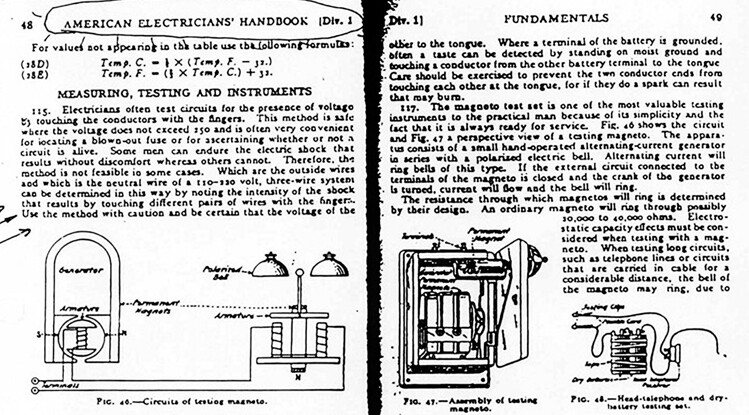
And finally…speaking of history, one of my favorite historical readings is in Section 115 of the American Electricians’ Handbook, under the subtitle Measuring, Testing, and Instruments, which states (emphasis added in bold):
Electricians often test circuits for the presence of voltage by touching the conductors with the fingers. This method is safe where the voltage does not exceed 250 and is often very convenient for locating a blown-out fuse or for ascertaining whether or not a circuit is alive. Some men can endure the electric shock that results without discomfort whereas others cannot.
If you did that today, the only part of history that might rhyme would be the curse words flying out of your mouth when you did it. (Don’t try this at home, kids!)
Bottom line: Get the new 2027 NFPA 70E, study and embrace the changes, and be safe out there.
And hey, be the smartest person in the room and turn it off – would ya? #testbeforetouch