
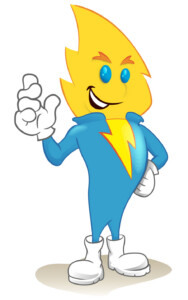
OK, let’s be honest. When you pull NFPA 70E off the shelf, it’s not exactly something you look forward to reading for entertainment. Yes, it matters. (It matters a lot!) But it’s not built to grab your attention or stick with you. And that’s not a knock on the standard. Consensus standards like NFPA 70E serve a clear purpose: to “…provide a practical safe working area for employees relative to the hazards arising from the use of electricity.” (Section 90.2 Purpose).
Disclaimer
“All mascot names are trademarks of their respective owners and are used here for informational purposes only.”
The problem is this: Knowing the 70E standard and all its rules and guidance…and remembering it in the moment…are two very different things.
Here’s a thought: It seems like one of the ways we could capture the attention of our technicians and engineers and drive better engagement would be by using mascots and recognizable characters that people can connect with.
USING MASCOTS TO DRIVE ENGAGEMENT
There are several recognizable mascots out there, including NFPA’s mascot “Sparky the Fire Dog®” or the U.S. Forest Service’s mascot “Smokey Bear.” Side note: Officially, it’s not “Smokey the Bear.” It’s just “Smokey Bear.”
But what about mascots directly related to electricity or the hazards of electricity? Sadly, we have drifted away from most of them, even those that were front and center in our industry over the last several years and even decades. The electric cooperatives are the most active with mascot usage, but the others? Not so much.
Why is that? Great question. The electrical power industry used mascots heavily when electricity was new and poorly understood because it helped humanize something invisible, took away some of the fear around using electricity, and importantly, taught us safe behaviors when around or near electricity. And that’s a big deal!
But it seems the electrical power industry abandoned them years ago as we became more technical, more regulated, and get this… “more comfortable.” How many times have we heard complacency named as a root cause of an incident?)
Think a little mascot engagement could have helped a few of those incidents where the workers were too comfortable with their task? My guess is that it could have helped a few.
ENDURING MASCOTS
To emphasize the point of mascot and recognizable character importance, look at the NFPA and the U.S. Forest Service. They have doubled down on the use of their well-known mascots, Sparky and Smokey, with massive public recognition campaigns and communication, and we have a connection to them. The electrical power industry? Not so much.
It’s not to say the electrical mascots are not still around, but let’s take a look at a few of them:
Reddy Kilowatt®
Arguably, the King Daddy of electrical mascots and the first on the scene, Reddy Kilowatt just turned 100-years-old this year. Created in 1926 by Ashton Collins Sr., a general commercial manager for Alabama Power Co. (APC) in Birmingham, Alabama, Reddy entered the electric utility market on March 14, 1926, for Alabama Power to promote electricity to its customers. Happy Centenarian Birthday, Reddy!
Reddy solved a real problem by being designed as a “humanized version of electricity” with lightning bolts for limbs, a bulb nose, and plug ears. Back then, electricity was new, widely misunderstood, and honestly…a little scary. But Reddy gave it a face, and “Your Electric Servant” became the message.
He showed up in appliance ads, safety campaigns, bill inserts, and school materials. Ashton Collins understood that: “People don’t buy electrons—they buy what they understand,” he said. And Reddy helped to bridge that gap.
Maybe we should vote Reddy back into office and get him more involved with the industry!
Willie Wiredhand®
Willie Wiredhand has an interesting story in his journey into the world of electricity, which coincided with one of the biggest shifts in U.S. infrastructure. By the 1930s, cities had power, but 90% of the farms did not, and this infrastructure gap led to the passing of the Rural Electrification Act (REA) in 1936, as part of Franklin Delano Roosevelt’s New Deal.
The REA provided for the creation of federal low-cost loans to non-profit rural electric cooperatives, enabling electricity access for millions of rural Americans. This was transformative to agriculture by bringing electric power to farms, homes, and communities.
Seeing a need for education, the co-ops wanted Reddy, but they were told no. Reddy’s license for use was controlled by investor-owned utilities, and they refused to share him with co-ops.
So the co-ops, sponsored by the National Rural Electric Cooperative Association (NRECA), built their own identity, created by Andrew McLay in the early 1950s. With plug legs, a wire body, a socket head, and lineman gloves….enter stage right: one Willie Wiredhand!
And his name wasn’t random: “Wired hand” was a play on “hired hand” (farm labor), and the messaging was that he was “the never-tiring, always available hired hand to help the nation’s farmers.”
Reddy vs. Willie: The Lawsuit!
As soon as Willie was created, the originator of Reddy Kilowatt, Ashton Collins, sued NRECA, stating he was “the originator and owner of figures symbolizing the use of electric energy.”
He wasn’t successful in his lawsuit (filed in South Carolina), and on appeal, the three judges from the U.S. Court of Appeals Fourth Circuit unanimously ruled that the lower court’s decision held, dismissing the complaint on January 7, 1957.
The NRECA successfully countersued for its legal fees, and Willie Wiredhand was granted his own trademark by the U.S. Patent Office in 1957. Good job, Willie!
Mr. Ouch®
Though not a mascot, here’s an interesting story on the creation of a hazard symbol or pictorial warning sign originally developed to warn children about the dangers of electricity in and around padmount transformers. To do so, the National Electrical Manufacturers Association (NEMA) created the Mr. Ouch symbol.
NEMA even has a standard written around it, NEMA TP 80049-2025 (formerly NEMA 260), Safety Labels for Pad-Mounted Switchgear and Transformers Sited in Public Areas.
The Foreword of the standard states, in part:
In early January 1981, several member companies of the NEMA Transformer Section indicated a strong desire to reduce the number of accidents involving children coming into contact with the active elements of pad-mounted transformers located in public areas.
The Executive Committee charged a Task Force to develop a safety label that would warn small children away from an open pad-mount and simultaneously elicit an adult’s attention to contact the owner of the pad-mount to remove the hazard.
Mr. Ouch is designed as an “anthropomorphized electrical arc,” appearing as a snarling, octopus-like creature with lightning tentacles tossing a child backward.
OK, I had to look it up, too. According to Merriam-Webster, “anthropomorphize” means to attribute human form, personality, or characteristics to nonhuman things, such as animals, plants, or material objects. Regardless, it’s a very effective non-verbal graphical representation of the hazards of electricity. Think about that.
AUTHOR’S FINAL NOTES
So why write an article about electrical mascots? A couple of reasons, actually. First and foremost, if we can do anything to improve worker safety and retention of knowledge for safe work practices, then we’ll call that a win. Introducing a mascot into your electrical safety program might just do that.
But be careful about using copyrighted symbols and assets. For the Spring 2026 edition of NETA World, in the article titled “The Most Dangerous Electrical Task You Do Every Day,” we had intended to use a photo of Willie Wirehand for the lead photo. It was a small bobblehead figurine of Willie that I owned, and I had taken a photo of him with an old meter in the background. But after researching copyright rules, we couldn’t get permission to use the photo. However, that rejection inspired me to think about the value of using mascots for electrical safety knowledge and education…. so here we are.
Second, remember that these characters are tools. They help us tackle real challenges, such as getting NFPA 70E to stick, helping us to keep pace with this transformational industry growth we are currently experiencing, and reinforcing the basics of electrical safety. Reddy and Willie didn’t complicate the message—they made it simple—and that’s why it worked.
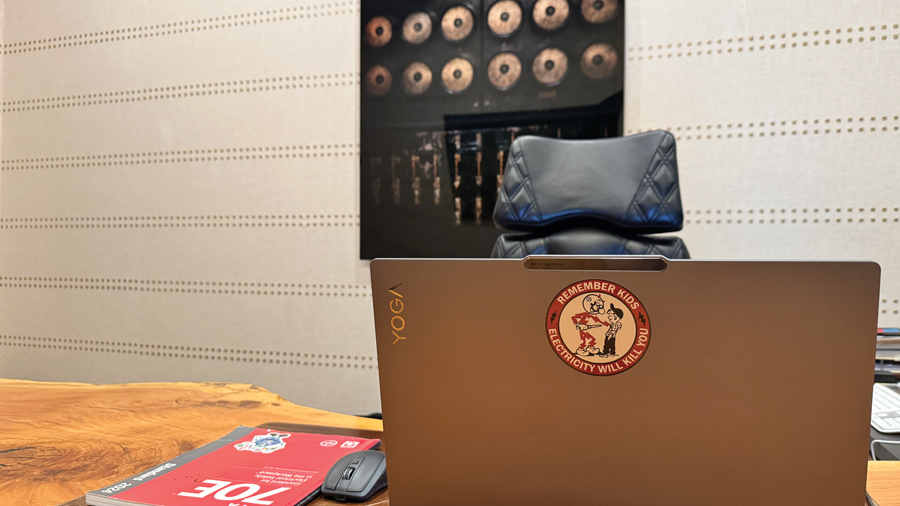
By the way, here’s a photo of my laptop in my home office. But don’t blame me for any issues with the mascot decal! I got it on Etsy.
So…listen to Reddy, Willie, Sparky, Smokey, Mr. Ouch, and the rest of the cast of characters….and “Test Before Touch,” because ”Remember, kids, ‘Electricity Will Kill You.’”
Be safe out there.
RESOURCES
Learn more about Sparky the Fire Dog® here:
https://www.nfpa.org/about-nfpa/about-sparky-the-fire-dog.
Learn more about Smokey Bear here: https://smokeybear.com/smokeys-story.
The image and likeness of Smokey Bear is a Congressional trademark protected by federal law and is not in the public domain.
Learn more about Reddy Kilowatt® from Xcel Energy here:
https://stories.xcelenergy.com/stories/The-face-of-electricity–Celebrating-98-years-of-Reddy-Kilowatt.
Learn more about Willie Wiredhand® brand usage from NRECA here:
https://www.cooperative.com/programs-services/communications/brand-and-usage-guides/Documents/Willie_Wiredhand_StyleGuide.pdf.

Ron Widup has worked in the electrical power testing and maintenance industry for more than 45 years. He serves as Chief Technical Marketing Officer for Vector Power in Plano, Texas. Ron has been an active member of several NFPA technical committees, including NFPA 70E, NFPA 70B, NFPA 790/791, and NEC CMP-11. He serves on the InterNational Electrical Testing Association (NETA) Board of Directors and the NETA Standards Review Council. He is also Chairman of IEEE P902, IEEE Recommended Practice for Maintenance and Operational Safety of Electrical Power Distribution Systems in Industrial and Commercial Facilities. Ron currently serves as Chairman of the Texas State Technical College (TSTC) System Board of Regents. His credentials include NETA Certified Level 4 Senior Test Technician, State of Texas Journeyman Electrician, NFPA Certified Electrical Safety Compliance Professional (CESCP), and Senior Member of IEEE.