
In October 2025, the American Heart Association (AHA) released the first full revision of its Guidelines for Cardiopulmonary Resuscitation (CPR) and Emergency Cardiovascular Care (ECC) since 2020. The AHA maintains that cardiac arrest claims more lives globally than colorectal cancer, breast cancer, prostate cancer, influenza, pneumonia, auto accidents, HIV, firearms, and house fires combined.
Cardiac arrest is an immediate occurrence, triggered by an electrical malfunction in the heart that causes an irregular heartbeat (arrhythmia). When the heart stops beating, blood is not pumped to the brain, lungs, and other organs. Seconds later, a person becomes unresponsive and stops breathing. Death occurs quickly if the person does not receive immediate CPR.
A heart attack, on the other hand, is a circulation problem when blood to the heart is stopped by a blocked artery. If the artery is not opened quickly, the part of the heart nourished by the artery begins to die. Symptoms of a heart attack may be immediate, but they more often begin slowly and persist for hours, days, or weeks. Symptoms include chest pain or discomfort, cold sweats, shortness of breath, nausea, and vomiting. For women, symptoms can also include back and jaw pain. If you are experiencing these symptoms, even if you are not sure it is a heart attack, seek medical help immediately.
KEY RISK FACTORS FOR ELECTRICAL WORKERS
Electrical shock, which can cause immediate, life-threatening cardiac arrest, is the obvious concern in the electrical testing industry when considering causes for cardiac arrest. However, other factors are also associated with this career. For example, physical strain and stresscaused by heavy lifting, awkward positions, and job pressures contribute to higher rates of cardiovascular issues.
An unfavorable lifestyle brought aboutbyinconsistent schedules can lead to unhealthy eating and a lack of exercise. Environmental exposures such as inhaling fumes or particulates from old buildings can cause lung damage, affecting overall health.
The best way to mitigate some of these risks is to follow standard safety protocols.Always use proper personal protective equipment (PPE) to prevent electric shock, burns, and falls. Focus on healthy eating, stay hydrated, and maintain a consistent exercise routine. Manage stress by taking breaks, stretching, and finding ways to decompress. Schedule annual physicals with your doctor. Finally, be aware of warning signs like chest pain, shortness of breath, and irregular heartbeats, and seek medical help immediately.
CARDIOPULMONARY RESUSCITATION
According to the AHA, about 350,000 cardiac arrests occur outside the hospital each year in the United States, with a survival rate of less than 10%. CPR is a lifesaving technique involving chest compressions that is useful in many emergencies, including cardiac arrest, where someone’s breathing or heartbeat has stopped.
When the heart stops, the absence of oxygenated blood can cause irreparable brain damage in just a few minutes. Death can occur within 8 to 10 minutes; therefore, time is critical when you’re helping an unconscious person who isn’t breathing.
The reality, however, is that far too few Americans know how to perform CPR or first aid. When people experience cardiac arrests in public or in their homes, there is often simply no one around who knows how to help them.
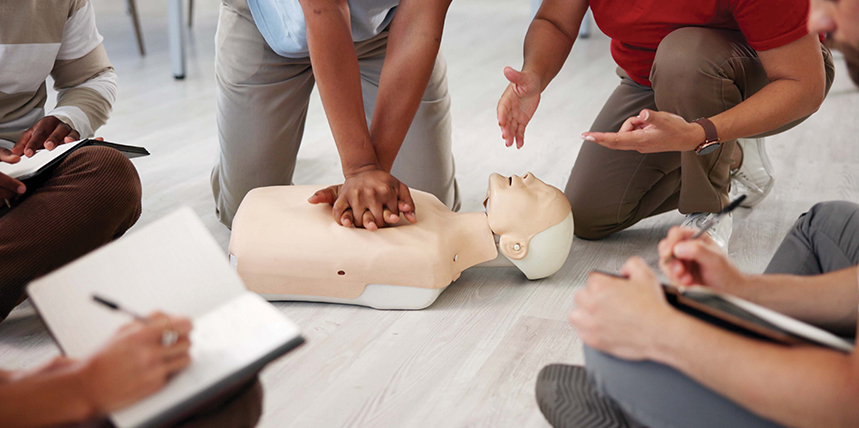
CPR training equips people who are not medical professionals with the skills to act in cardiac emergencies, keeping blood and oxygen flowing until paramedics arrive, thereby bridging the time gap in the AHA’s chain of survival.
Knowing how to perform CPR empowers bystanders to save the lives of family, friends, or strangers in any location. Initiating CPR right away will increase a person’s survival time until advanced medical care arrives and can take over.
According to Gayle Keagy, Firefighter, EMT, and CPR Instructor, “CPR is highly effective, doubling or tripling survival chances when started immediately after cardiac arrest.” This is especially true outside of a hospital. Keagy continues, “Survival rates for out-of-hospital cardiac events are around 10% to 13%, but effective bystander CPR can dramatically boost this rate. Some studies show nearly two times better (11% to 23%) survival chance.” In fact, some studies indicate that bystander CPR within two minutes can increase survival chances by 80%.
Each minute of delay in providing CPR reduces survival chances by about 10%. Keagy further notes, “Brain damage can occur in minutes due to the lack of oxygen,” in the following time frames:
- 0–4 minutes: not likely to develop brain damage
- 4–6 minutes: possibility of brain damage
- 6–10 minutes: high probability of brain damage
- More than 19 minutes: high likelihood of brain death or severe, irreversible damage.
BY THE NUMBERS: KEY FACTORS INFLUENCING SURVIVAL
- Approximately 70% of out-of-hospital cardiac arrests occur in private homes. Knowing CPR skills means you are most likely to save a family member or friend.
- Starting quickly doubles or triples survival chances.
- When CPR is combined with an AED, survival rates can jump from roughly 9% (CPR alone) to 38% or higher if a shock is delivered.
- For every minute that passes without CPR or defibrillation, the chance of survival can drop by 10%.
AUTOMATED EXTERNAL DEFIBRILLATOR
An automated external defibrillator (AED) can be used to help those experiencing sudden cardiac arrest. According to Mitch Shapiro, owner of Shapiro Fire Protection and Chief of the Warminster, Pennsylvania, fire department, “Modern AEDs are designed for laypeople. They are a powerful, yet easy-to-use, tool that analyzes a heart’s rhythm and, if necessary, delivers an electrical shock to re-establish an effective rhythm.”
Shapiro knows this firsthand. While watching his son’s basketball game, he saw the team’s coach collapse. He started CPR and remembered seeing an AED in the hallway. While another bystander continued CPR, Shapiro grabbed the AED. He applied the leads, and the device delivered two shocks, returning the heart to a normal rhythm. The coach was transported to the hospital and made a full recovery.
Unfortunately, the number of patients treated with an AED applied by a bystander remains low, occurring in only 10% of public cardiac arrest incidents. However, of those people with cardiac arrest who receive a shock from an AED in the first minute, 9 out of 10 survive.
WHAT DO OSHA AND NFPA SAY?
The basic purpose of OSHA and NFPA standards is to ensure that adequate first aid is available in the critical minutes between the occurrence of an injury and the arrival of professional care for the injured employee.
OSHA
In 29 CFR 1910.151(b), OSHA clarifies that it does not mandate CPR or first aid training for all office employees as a blanket rule. What OSHA does require, for general industry, which includes most offices, is this: If you do not have an infirmary, clinic, or hospital “in near proximity,” then “a person or persons shall be adequately trained to render first aid.”
OSHA’s interpretation letters have explained how it typically enforces “near proximity.” For workplaces where serious injuries are possible (falls, suffocation, electrocution, amputation, etc.), OSHA has interpreted near proximity to mean emergency care available within about three to four minutes if you’re relying on outside responders rather than trained employees on-site.
For lower-hazard workplaces like offices, OSHA says a somewhat longer response time—up to about 15 minutes—may be reasonable, because the likelihood of severe injuries is less. OSHA also emphasizes that employers should confirm EMS availability if relying on off-site responders, bearing in mind that EMS response times can average 8 to12 minutes depending on the region. OSHA’s baseline requirement is for prompt first aid to be available, not mass certification.
The good news is that many offices choose to train a reasonable number, if not all, of employees per shift or floor. Another consideration is that your need for trained first-aid responders increases if your office is remote or you cannot realistically get EMS help quickly.
NFPA
NFPA 70E, Standard for Electrical Safety in the Workplace, 110.4(C) states:
Employees responsible for responding to a medical emergency shall be trained in first aid and emergency procedures, as well as in the use of an AED, if the employer’s response plan includes such a device.
Training shall occur at the frequency that satisfies the requirements of the certifying body.
NFPA further states that:
…employers shall verify at least annually that the employee training required by 110.4(C) is current.
CONCLUSION
An employer must ensure prompt first aid treatment for injured employees, either by providing a trained first aid provider at the worksite or by ensuring that emergency treatment services are within reasonable proximity.
Immediate bystander intervention is the crucial first link in the chain of survival. Being first aid or CPR-certified empowers people to act quickly with confidence, and ongoing training reduces hesitation and panic in high-stress situations, allowing decisive action.
To find a CPR course near you and to learn these lifesaving skills, visit www.cpr.heart.org.
REFERENCES
American Heart Association. Guidelines for Cardiopulmonary Resuscitation (CPR) and Emergency Cardiovascular Care (ECC), 2025.
Occupational Safety and Health Administration. OSHA 29 CFR 1910.151, Medical Services and First Aid, 1998.
Occupational Safety and Health Administration. Interpretation Letters, 2007.
National Fire Protection Association. NFPA 70E–2024, Standard for Electrical Safety in the Workplace (110.4(C)).

Charlie Simpson has been a Safety Manager for Asplundh Electrical Testing, LLC since 2006. He has been a first responder for 35 years, including 12 years working as a state-certified fire suppression instructor.