
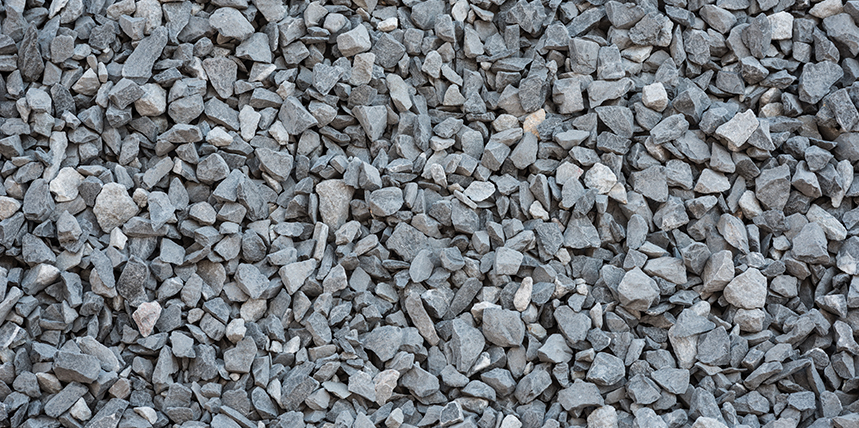
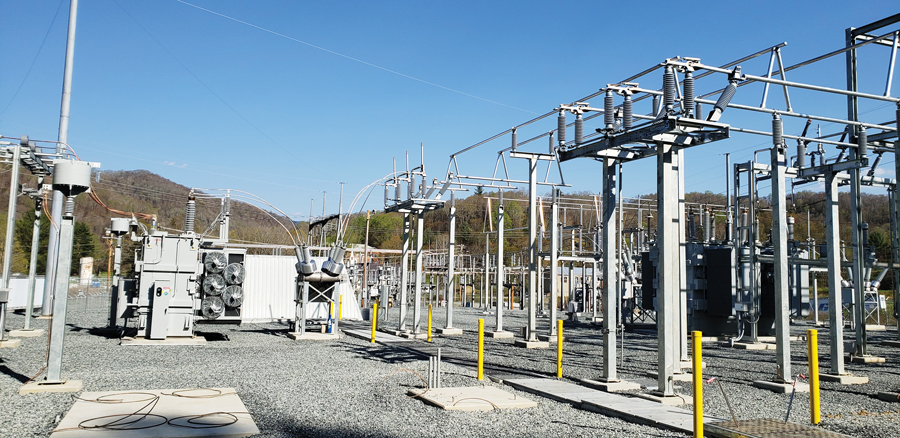
Substation design typically calls for two to six inches of aggregate (crushed rock) as a top layer upon completion of construction. This layer serves several purposes, including improved vehicle access, reduced erosion, and suppression of vegetation. Another significant function of this layer is to provide personnel safety by increasing the allowed (maximum permissible) touch and step potential values versus native soil. When the aggregate becomes a critical part of the site’s safety, knowledge of the aggregate’s composition and properties is required.
ROCK MATTERS
In June 2023, the IEEE PES Substations Committee released a technical report titled Testing and Application of Crushed Aggregate for Use as a Resistive Substation Surface Layer, which has been incorporated into the new IEEE Std. 81-2025. This guideline provides a deep dive into all the factors regarding aggregate application. One of the main questions raised is whether the aggregate used at a site has a known resistivity. In our experience, the answer is no. Utilities typically use a locally available aggregate for which the resistivity is untested and unknown.
Along with the unknown resistivity value of the aggregate, additional site factors come into play, including compaction, erosion, contamination from native soil, organic matter, and vegetation, along with environmental considerations such as temperature, moisture, herbicides, and salt treatment. All these components play a role in the resistivity and effectiveness of the site’s rock layer. Once the aggregate has been compromised, a site can become unsafe for personnel if it’s not remediated. We’ve been in hundreds of existing substations and have rarely found the aggregate maintained to the required depth or condition.
CHALLENGES WITH ROCK
Limestone aggregate is used frequently as it is readily available, but limestone resistivity is lower than granite. Surprisingly, river rock is as high or higher than granite in resistivity (based on our lab test results). However, since it is a round rock, it isn’t easy to walk or drive on, making it a less-than-ideal choice. It is critical to thoroughly wash the chosen aggregate to remove all fines, adhered clay, and silt. Washed rock raises the front-end cost but improves (increases) its resistivity and performance in the field. AASHTO #57 (¾ inch to 1 inch in size) is the most commonly specified rock size for use in substations.
From our experience, the biggest challenge for new substations is ensuring that the contractor lays down the right thickness of clean aggregate inside and outside the station. For the substation exterior, a design specification typically calls for four-inch or larger rock three to six feet around the perimeter of the substation fence. This provides better erosion control and makes it more difficult for a person or animal to approach the fence.
SAFETY FIRST
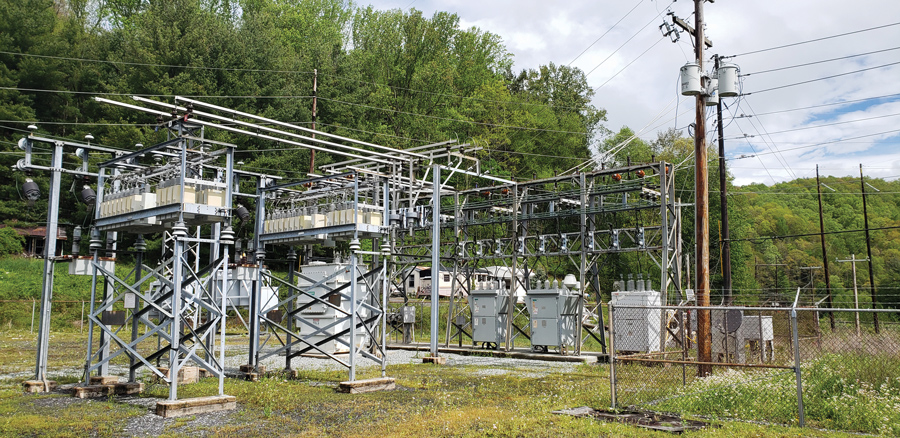
An ideal substation design intends to have the grounding system stand on its own with minimal assistance from outside grounding sources. Years ago, this was easier to achieve when line-to-ground fault currents were lower. However, this goal is more challenging as electrical systems have become more robust.
Today, during the design process, we depend more and more on exterior ground sources, transmission line overhead shield wires (OHS), and distribution neutrals to lower the system ground impedance by providing alternate paths for the fault current to return to its source. This lowered system ground impedance will, in turn, lower the resultant site ground potential rise (GPR). The substation will still require installation of a highly resistant aggregate layer to increase the safety factor, i.e., the allowable touch and step voltages.
TESTING ROCK RESISTIVITY
In November 2025, the IEEE PES Substations Committee released IEEE Std. 81-2025, IEEE Guide for Measuring Earth Resistivity, Ground Impedance, and Surface Potentials of a Grounding System. Per this newest version of IEEE 81 Section 11, Annex E, and Annex F, we now have guidelines for testing the aggregate resistivity of substations. This is significant because most ground grid designs default to a crushed aggregate resistivity of 2,000–3,000 ohm-meters (Ω-m), which is likely a conservative assumption that results in over-engineering the ground grid. Testing the aggregate resistivity will allow a more accurate design of the ground grid. Conversely, lower assumed aggregate values can result in measured touch potentials exceeding the overly conservative calculated permissible values.
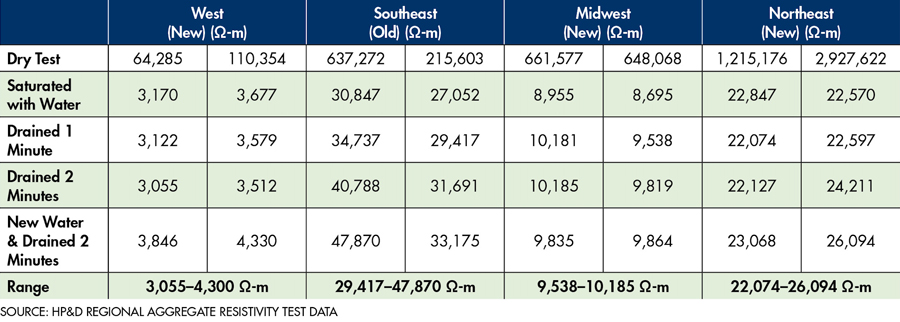
IEEE Std. 80-2013, IEEE Guide for Safety in AC Substation Grounding,outlines “typical surface material resistivities,” but our testing has revealed that the data is incomplete and may not be indicative of aggregate values nationwide. As shown in Table 1, regional samples vary widely; hence, it is necessary to test your aggregate not only per region but also per site, as many factors can affect aggregate resistivity and, therefore, substation safety. Not all utilities in a region may be using the same type of stone, so the values shown in the table are for a specific region, utility, and site.
ROCK STEADY
Ideally, aggregate resistivity testing should be conducted during the design process to ensure a cost-effective yet safe aggregate layer; however, this may not be possible or practical. To verify that the aggregate resistivity meets design criteria during the new substation commissioning, the aggregate should be tested according to IEEE Std. 81-2025.
Maintenance is essential for all substations. Using aggregate as a top layer is one of the most effective and cost-efficient methods to enhance safety. If a utility incorporates an aggregate top layer as part of a substation’s safety design, it must implement a rigorous inspection and maintenance program. Retesting the resistivity of the aggregate every five years is recommended to ensure that the site continues to meet the design safety criteria for touch and step voltages, and additional aggregate will likely be necessary.

Jacob Rioux is a Grounding Specialist at Hood Patterson & Dewar, Inc. With a background in substation design and testing, Rioux provides substation and facility grounding system testing and safety analysis. He also performs soil resistivity testing and grounding system design for new construction. His client base includes electric utilities and industrial and commercial facilities. He provides grounding articles, training, and presentations for conferences and clients nationwide. Rioux has a BS in mechanical engineering technology with a minor in electrical engineering technology from the University of Maine.