
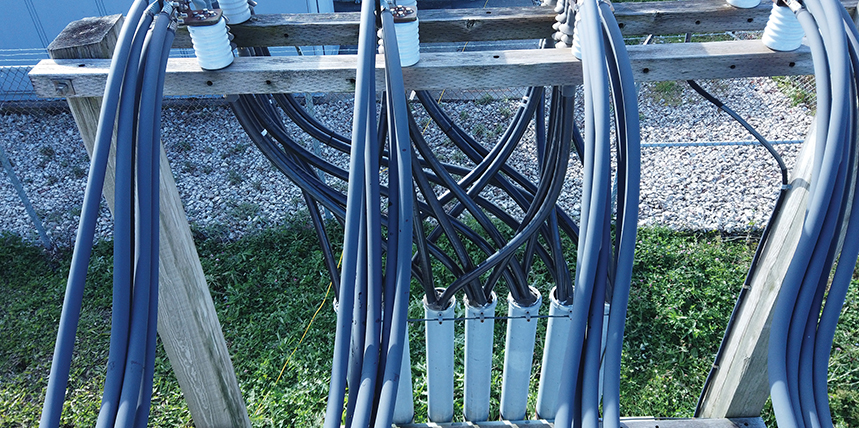
Medium- and high-voltage cables are among the most vital electrical assets in modern power systems, delivering electricity to millions of households year-round. Yet, when it comes to diagnostic testing during commissioning or maintenance, many cables remain untouched with modern diagnostic tools.[1]
Dielectric frequency response (DFR), a well-known diagnostic technique in the transformer and oil-filled cable industries, measures dielectric losses over a broad frequency range and evaluates the moisture content of oil-paper insulation. Important insights, such as aging condition, water treeing, and thermal aging, can be obtained by using the same technology on medium- and high-voltage XLPE cables. By tracking the insulation state of cables over time, from commissioning to mid-age, DFR provides a supplementary method.
A more sensitive evaluation of insulation aging is made possible by the technology’s capacity to measure the dissipation factor and capacitance discretely over a broad frequency range (from 1 mHz to 1 kHz) in an off-line setting. This enables asset owners to schedule interventions before issues arise. When compared to VLF tan-delta testing, which only provides measurements over one frequency, DFR’s wide frequency sweep provides meaningful insights that help distinguish between various aging effects and emphasize the impact of accessories.
This can be further divided into three categories: bulk insulation state, thermal aging, and water intrusion in the insulation. The location of these flaws can subsequently be determined by using localizing methods such as partial discharge. Performing a frequency domain spectroscopy (FDS) test first provides clearer partial discharge results that can help the asset owner determine whether the focus should be on bulk insulation, thermal degradation, or water ingress.
This article presents a case study demonstrating the application of DFR for commissioning and maintenance diagnostics on critical medium-voltage cables, highlighting its advantages, limitations, and role in a comprehensive asset management strategy.
DFR METHODOLOGY
Frequency domain spectroscopy (FDS), also known as dielectric frequency response (DFR), is a low-voltage diagnostic technique used to evaluate the dielectric behavior of high-voltage insulation. A small sinusoidal excitation—typically 200 V peak-to-peak—is applied over a wide frequency range from the millihertz to kilohertz regions. The resulting current is measured to characterize polarization and conduction phenomena within the insulation. Under an applied AC field, dielectric polarization arises from electronic, atomic, dipolar, and interfacial mechanisms, each associated with distinct relaxation times. The measured current response in the frequency domain is expressed as:
Where U(ω) represents the applied sinusoidal voltage, I(ω) is the measured response current, and C(ω) denotes the complex capacitance of the insulation system. The complex capacitance is generally formulated as:
Where C0 is the geometric capacitance, ε´(ω) is the real component of permittivity reflecting energy storage, ε´´(ω) is the imaginary component associated with dipolar relaxation losses, σ0 denotes the DC conductivity of the insulation, and ε0 is the vacuum permittivity. The dielectric dissipation factor, or loss tangent, which serves as an indicator of dielectric losses relative to energy storage, is obtained as:
This demonstrates that low-frequency losses are dominated by conduction, whereas higher frequencies reflect dipolar and interfacial polarization. In XLPE insulation, moisture significantly affects the dielectric response, increasing low-frequency tan delta due to enhanced orientation and interfacial polarization. This sensitivity allows DFR to detect moisture ingress, thermal and electrical aging, and semiconductor degradation with high precision. By spreading physical phenomena across the frequency axis, DFR enables reliable condition assessment of MV/HV polymeric cable systems.
FACTORS AFFECTING XLPE INSULATION HEALTH
Cross-linked polyethylene (XLPE) is the preferred insulation for MV and HV power cables due to its high dielectric strength, thermal stability, and efficient manufacturability.[5][6][18] However, the long-term reliability of XLPE is strongly influenced by electrical, thermal, mechanical, moisture-related, and environmental stresses, each of which progressively alters its microstructure and degrades dielectric performance.
Electrical Stress
Electrical overstress is one of the most dominant aging mechanisms in XLPE. Field enhancement at imperfections—including contaminants, voids, rough semicon interfaces, and installation defects—initiates partial discharges (PD). Each PD event induces localized heating and bond scission, gradually forming electrical trees that propagate toward failure. Tan delta increases disproportionately with voltage as conduction paths develop inside treed regions.
Thermal Stress
Thermal loading accelerates chemical and mechanical deterioration in XLPE. Operation near the rated conductor temperature (90°C) or continuous load cycling induces non-uniform expansion between the conductor, XLPE, and semicon layers. This thermal mismatch causes interfacial shear stress, leading to micro-void formation and PD initiation sites. Elevated temperatures also enhance charge injection. Thermal loading accelerates chemical and mechanical deterioration in XLPE insulation. Operation near rated conductor temperatures or repeated load cycling induces differential thermal expansion between the conductor, XLPE insulation, and semiconductive layers. This mismatch generates interfacial shear stress, which promotes micro-void formation and creates conditions favorable for partial discharge inception.[7]
Mechanical Stress
Mechanical loading during installation, operation, or ground movement induces residual stresses and micro-cracks that serve as PD and moisture-entry sites. Thermal-mechanical fatigue is intensified by differential expansion between conductor and insulation. Li et al. reported that optimized 70L–30H polyethylene blends maintain 10–15% higher modulus at 120°C than XLPE, improving fatigue resistance.[19] Experimental investigations have demonstrated that thermal cycling in MV cable joints produces significant variations in interfacial pressure between XLPE insulation and elastomeric materials. Such pressure variations persist after repeated temperature cycles and contribute to the formation of voids and weak spots at material interfaces, thereby increasing susceptibility to partial discharge activity.[14]
Environmental and Chemical Factors
UV radiation causes surface oxidation and chain scission in exposed XLPE.[2] Chemical pollutants, acidic soils, and heavy-metal ions accelerate hydrolysis, oxidation, and stress cracking.[17] High humidity (>85%) increases surface leakage and corrosion in joints, altering dielectric response.[11] Long-term environmental aging lowers crystallinity, increases amorphous content, and produces more polar defects, causing DFR spectra to show elevated low-frequency tan delta due to enhanced conduction and interfacial polarization.[2][6][8]
VLF TAN-DELTA TEST LIMITATIONS
VLF tan-delta testing is widely used to evaluate the condition of extruded MV cable insulation, such as XLPE and EPR, but several inherent limitations affect diagnostic interpretation.
- Because VLF operates near 0.1 Hz—far below the 50/60-Hz service frequency—the dielectric response becomes dominated by slow polarization, depolarization, ionic conduction, and space-charge effects, often inflating tan delta relative to operational conditions.[12]
- Field measurements are also highly sensitive to temperature, humidity, and surface moisture, since cables rarely reach thermal equilibrium during testing.[11][12][14]
- Thermal-cycling studies demonstrate that rising temperature alters interfacial pressure in joints due to differential expansion between the semiconductive and insulating layers.[11]
- Aged insulation may further exhibit nonlinear voltage-dependent tan delta behavior due to space-charge accumulation and localized field distortion.[5] [6][14]
- Because 0.1-Hz testing requires long stabilization times, measurements are sensitive to polarization drift and leakage currents.[4][12]
- In long cable circuits, total capacitance may exceed VLF equipment capability, reducing achievable test voltage and accuracy.[1][10][15]
INTERPRETING FDS RESULTS FOR MV CABLES
The DFR master curve framework provides a structured method to interpret dielectric-loss behavior across multiple decades of frequency. Each master curve represents a characteristic tan δ(f) response associated with a specific insulation condition—unaged, thermally aged, moisture-degraded, or accessory-influenced. This approach was formalized in the wide-band FDS study by Naderian Jahromi et al.[3] that analyzed more than two decades of published XLPE dielectric measurements by Werelius,[2] Hvidsten,[4] Drapeau,[5] Banerjee,[6] and Liu. Their work demonstrated that different aging mechanisms dominate at different frequencies, enabling a zone-based categorization scheme for MV XLPE cable diagnostics.

The XLPE insulation response can therefore be segmented into five diagnostic frequency zones (Figure 1), each corresponding to a dominant physical mechanism and distinct degradation behavior (Table 1). This zonal segmentation allows utilities to evaluate tan delta trends with respect to the underlying aging process rather than relying solely on a single-point VLF tan delta at 0.1 Hz.
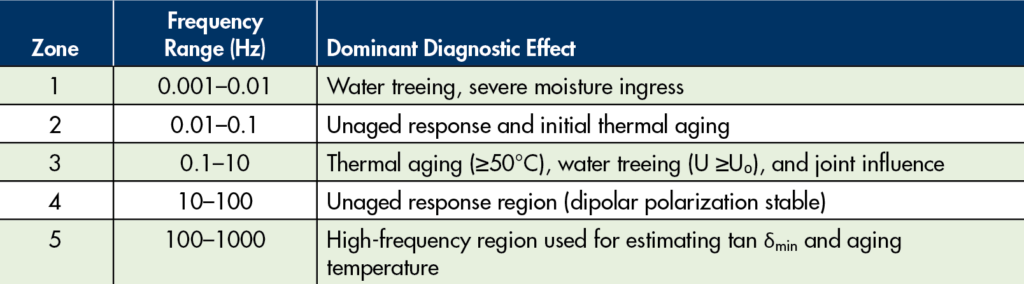
Table 1: Frequency Zone for DFR Interpretation
CASE STUDY: COMPARATIVE INTERPRETATION OF DFR SIGNATURES FOR MV XLPE CABLE
This case study presents a zone-by-zone comparison of frequency domain spectroscopy (FDS/DFR) measurements performed on an aged medium-voltage cable termination (Figure 2). Cable terminations and splices contain multilayer structures that significantly influence electric-field distribution, and non-uniform fields over time can accelerate degradation and lead to insulation failure. Prior research shows that improper workmanship, incorrect stress-cone positioning, knife cuts, and contaminants frequently cause weak points in terminations, resulting in elevated electric stress, partial discharge, and premature aging.[7][5] Thermal degradation is another major contributor, especially when accessories experience localized heating or are improperly installed, as commonly reported in field-aged heat-shrink terminations.[18]

To replicate these real-world ageing conditions, a deliberate pinhole was created just before the mastic/stress-control tube (Figure 3), allowing controlled moisture ingress into the XLPE–semicon interface—an approach consistent with established methodologies where artificial voids or holes are introduced to simulate moisture-driven deterioration in cable insulation systems.[7]

Additionally, the cable jacket was intentionally ruptured, and another pinhole with moisture ingress was introduced (Figure 4) to reproduce field-aged insulation behavior.

When the actual DFR curve is mapped onto this framework (Figure 5), several termination-specific observations become clear. At ultra-low frequencies (<10 mHz), the measured tan delta reaches approximately 4–5%, far higher than what is typically expected for a well-sealed, dry termination. This behavior strongly suggests moisture presence inside the termination enclosure or migrating along the XLPE surface, causing ionic conduction and interfacial polarization.
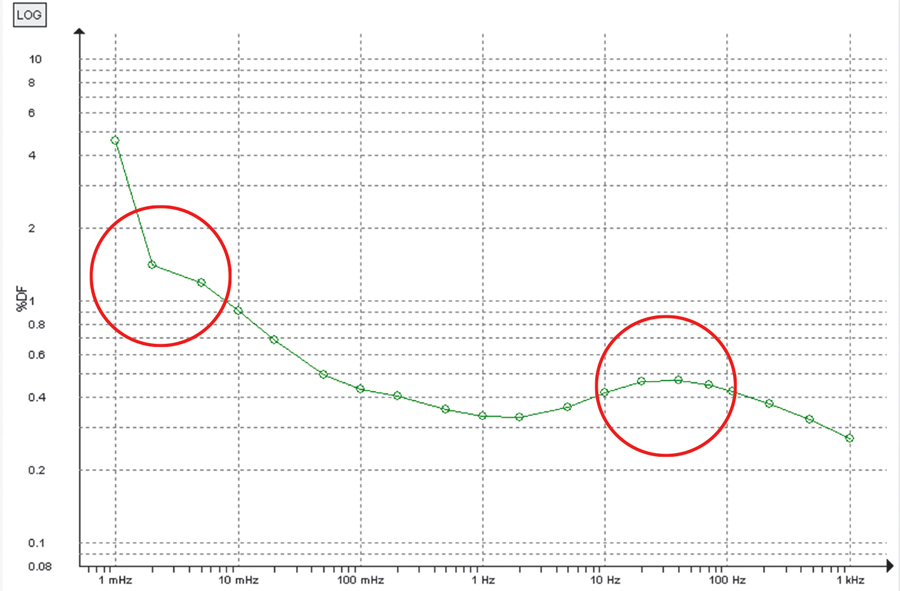
In the 10–100 mHz range (Zone 2), the curve steadily declines but remains elevated, indicating a combination of thermal and moisture-driven dielectric relaxation. The slope observed in this region resembles laboratory data from thermally stressed termination samples, where warming of the stress-control tube and semicon layers increased low-frequency losses.
Mid-frequency behavior (0.1–10 Hz) shows a defined tan delta minimum around 0.3–0.4%. Comparing mid-frequency with the master curve[3] clearly shows a normal curve with a minimum difference, proving that the cable and termination have not experienced any high temperature above 50.
At higher frequencies (100–1,000 Hz), the upward trend in the DFR curve corresponds to thermal activation and semicon resistivity effects typically observed in cable terminations. Installation-related defects—such as improper wrapping of the yellow stress-control tape, incorrect semicon cutbacks, conductor-interface heating, and overheating of the heat-shrink tube—create localized regions of elevated electrical stress.
Furthermore, semiconductive layers exhibit strong temperature-dependent resistivity behavior, with resistivity rising significantly as temperature increases.[9] Because stress-control tubing and semicon materials are more temperature-sensitive than bulk XLPE, even moderate heating steepens the high-frequency conduction slope, a phenomenon consistent with the positive temperature coefficient (PTC) behavior observed in semicon shields.[9] This aligns with research showing that terminations often fail due to a combination of workmanship errors and thermally activated interface defects, which amplify dielectric losses across the frequency spectrum.[7]
In summary, the DFR curve indicates that the termination exhibits moisture ingress and early-stage moisture ingress near the XLPE/stress-cone interface, accompanied by thermal effects and moderate interface aging, while the bulk XLPE remains functional.
CONCLUSION
This study demonstrates that frequency domain spectroscopy (FDS) or dielectric frequency response (DFR) provides a significantly deeper and more discriminative assessment of MV XLPE cable insulation compared to traditional single-frequency tan delta measurements. By examining the dielectric response across several frequencies, the method separates the dominant aging mechanisms—thermal degradation, moisture diffusion, electrical stress, water-tree formation, and accessory-related influences—into distinct spectral zones with identifiable signatures. The development of master curves for unaged, thermally aged, water-treed, and joint-influenced conditions enables a structured interpretation framework that utilities can apply consistently in field diagnostics.
Importantly, this study reinforces the practical diagnostic value of FDS for cable-system asset management. The zone-based interpretation scheme allows engineers to:
- Isolate accessory-related anomalies from bulk insulation aging
- Distinguish reversible temperature effects from irreversible degradation
- Assess the progression of water-treeing long before breakdown strength is critically reduced
This enables more accurate condition classification, improved prioritization of cable replacement or rejuvenation, and the potential to significantly reduce in-service failure rates—outcomes that mirror utility case studies reported in the literature.
Overall, frequency-swept dielectric response emerges as a powerful, non-destructive tool for evaluating MV XLPE cable health. As measurement equipment continues to advance—and as more field data is incorporated into refined master curves—FDS is poised to become an integral element of predictive maintenance strategies across modern distribution networks.
REFERENCES
- A. N. Jahromi, P.K. Pattabi, and S. Lo. “Advanced Diagnostic Testing of Medium Voltage Utility Cable Systems,” in CIGRE, Toronto, Canada, 2021.
- P. Werelius. “Development and Application of High Voltage Dielectric Spectroscopy for Diagnosis of Medium Voltage XLPE Cables,” Department of Electrical Engineering, Division of Electrotechnical Design, Royal Institute of Technology (KTH), Stockholm, Sweden, 2001.
- A. N. Jahromi, P. Pattabi, J. Densley, and L. Lamarre. “Medium Voltage XLPE Cable Condition Assessment Using Frequency Domain Spectroscopy,” IEEE Electrical Insulation Magazine, Vol. 36, pp. 9–18, 2020.
- S. Hvidsten and E. Benjaminsen. “Diagnostic Testing of MV XLPE Cables with Low Density of Water Trees,” in IEEE Int. Symp. on Electrical Insulation (ISEI), Boston, MA, USA, 2002.
- J. F. Drapeau. “Diagnostic of Underground Cable Systems Based on the Combination of Time Domain Dielectric Spectroscopy (TDDS) and VLF Tan Delta,” in Proc. Jicable, 2019.
- S. Banerjee, D. Rouison, J. Bornath. and J. F. Drapeau. “Low Frequency Dielectric Spectroscopy Applications to Aged Medium-Voltage Power Cable Diagnostics,” in 10th Int. Conf. Insulated Power Cables, Paris–Versailles, France, 2019.
- Y. Wei, M. Liu, X. Li, G. Li, N. Li, C. Hao, and Q. Lei. “Effect of Temperature on Electric-Thermal Properties of Semi-Conductive Shielding Layer and Insulation Layer for High-Voltage Cable,” High Voltage, Vol. 6, pp. 1–9, 2021.
- IEEE. IEEE Std. 400.2-2013, IEEE Guide for Field Testing of Shielded Power Cable Systems Using Very Low Frequency (VLF) (Less Than 1 Hz), IEEE, 2013.
- B. N. Gugulothu, S. Lakshminarayanan, M. Palati, S. H. Lakshmegowda, and M. Bukya. “Assessing Moisture Content in XLPE Power Cables Using Frequency-Dependent Tangent Delta Measurements,” Materials Research Express, Vol. 12, 2025.
- IEEE. IEEE Std. 400.3-2022, IEEE Guide for Partial Discharge Testing of Shielded Power Cable Systems in a Field Environment, IEEE, 2022.
- J. A. Brahma and M. G. Comber. “Tan Delta Diagnostics of Aged XLPE Cable Systems Under Field Conditions,” IEEE Electrical Insulation Magazine, Vol. 30, pp. 22–30, 2014.
- M. Brys and H. P. Hartmann. “VLF HV Testing of Extruded Cables: Field Experiences,” in CIGRÉ International Conference, 2006.
- A. S. Alghamdi. “A Study of Expected Lifetime of XLPE Insulation Cables Working at Elevated Temperatures by Applying the Arrhenius Model on Thermally Aged Samples,” Heliyon, Vol. 6, p. 3, 2020.
- R. D. Sante, A. Ghaderi, L. Peretto, and R. Tinarelli. “Effects of Thermal Cycles on Interfacial Pressure in MV Cable Joints,” Sensors, Vol. 20, p. 1, 2020.
- B. Curran, I. Ndip, J. Bauer, S. Guttowski, K. D. Lang, and H. Reichl. “The Impact of Moisture Absorption on the Electrical Characteristics of Organic Dielectric Materials,” 12th Int. Conf. Thermal, Mechanical and Multiphysics Simulation and Experiments in Microelectronics and Microsystems (EuroSimE), pp. 1–5, 2011.
- M. Balachandran. “Aging and Degradation Studies in Crosslinked Polyethylene (XLPE)–Crosslinkable Polyethylene,” Materials Horizons: From Nature to Nanomaterials, Springer, pp. 153–174, 2021.
- P. Werelius, P. Thärning, R. Eriksson, B. Holmgren, and U. Gäfvert. “Dielectric Spectroscopy for Diagnostics of Water Tree Deteriorated XLPE Cables,” IEEE Transactions on Dielectrics and Electrical Insulation, Vol. 8, pp. 27–42, 2001.
- A. Avellan, P. Werelius, and R. Eriksson. “Frequency Domain Response of Medium Voltage XLPE Cable Terminations and its Influence on Cable Diagnostics,” in IEEE ISEI, Anaheim, USA, 2000.
- L. Li, L. Zhong, K. Zhang, J. Ga, and M. Xu. “Temperature Dependence of Mechanical, Electrical Properties and Crystal Structure of Polyethylene Blends for Cable Insulation,” Materials 2018, 11(10), doi.org/10.3390/ma11101922.

Yash Godhwani is currently an Applications Engineer and has been working with Megger since March 2020. He focuses on the areas of cable fault location, cable diagnostic testing, battery storage, general electrical testing, and low-voltage circuit breaker testing. Godhwani is an active member of IEEE. He graduated from Gujarat Technological University with a BS in electrical engineering and received an MS in electrical engineering, specializing in electrical power engineering and control systems, from Concordia University.

Chanakya Patel has worked as a Cable Application Engineer with Megger since July 2025. Combining International and Canadian, He has over seven years of hands-on experience in medium-voltage cable diagnostics and field testing. Patel’s work focuses on advanced condition-assessment techniques, such as frequency domain spectroscopy (FDS), tan delta, partial discharge, and cable fault-location methods. He is an active member of OACETT and currently holds C.Tech certification in Ontario. Patel graduated from Gujarat Technological University with a diploma in Electrical Engineering and Technology.