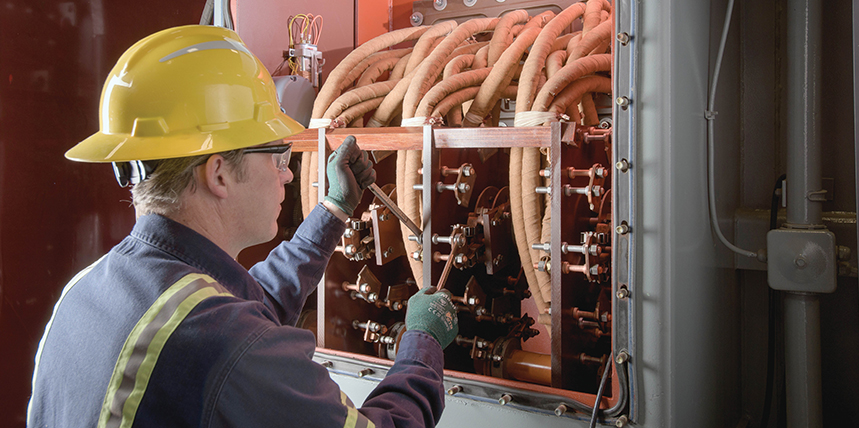
This issue’s theme brings up a question frequently asked by NETA technicians: “When does troubleshooting end and when does repair begin?” This question is often paired with “What does 70E say about troubleshooting and repair?” We hope to make things clear for everyone in the field. To begin, look at the definition of “working on” (energized electrical conductors and circuit …
VLF Tan Delta Cable Testing: Is It Right for Your Company?
To explain VLF tan delta, we must first explain the reason it was developed and how the concept and equipment used to perform this test came about. Tan delta is still a form of high-potential (hipot) testing but utilizes the advantages of both AC and DC testing while eliminating many, but not all, of the disadvantages. The very-low-frequency (VLF) portion …
Categorizing Faults in Power Transformers via Dissolved Gas Analysis
While the chemistry behind dissolved gas analysis (DGA) is complex and important for industry chemists to understand, the typical DGA review need not be as complex. Thermal or hot metal gasses are commonly known in DGA, and they are widely understood by industry experts, chemists, and many asset owners. The carbon oxide gasses — carbon dioxide and carbon monoxide — …
Bushing Condition Assessment and Troubleshooting
Bushings are the means by which electric power passes to and from different electrical devices, as they provide a point of interface for electrical voltage to be applied and current to pass to and from an electrical apparatus. The bushing’s center conductor is above ground potential and must be electrically insulated from the tank walls, which are at ground potential. …
Advanced Moisture Assessment for Transformers
Due to the complex temperature-driven dynamics of the exchange of water between the paper insulation and the oil and the lack of thermal equilibrium in most operating transformers, it is difficult to interpret the water content of oil or paper insulation by looking at individual dissolved-water measurements or time-series data. Furthermore, increases in water solubility due to aging of oil …
Is Your Arc-in-Oil Load Tap Changer Due for Maintenance?
A load tap changer (LTC) failure can be catastrophic to the electric power system. The load tap changer (LTC) is one of the few moving parts of a transformer, and this makes it more susceptible to routine wear and tear. When an LTC fails, it may take the transformer with it. Based on our experience, we estimate that about 40 …
Troubleshooting Human Error to Ensure Safety
What is human error? A human error is the outcome of an action that does not produce results as intended. It can be summed up by saying things did not go as planned. The 6P Rule (Proper Prior Planning Prevents Poor Performance) can go a long way to preventing a human error, but there is still that human factor. James …
NETA Activities Update June Through December 2019
NETA Board Meeting June 20–21, 2019 Girdwood, Alaska NETA’s June Board of Directors meeting took place in “The Last Frontier,” Girdwood, Alaska. The meeting focused on budget and program initiatives proposed for the new fiscal year. NAMO/MUSE Meeting June 22–24, 2019 Port Hueneme, California NETA representatives conducted an informational session on the NETA Training and Certification Exam with members of …
ANSI/NETA Standards Update
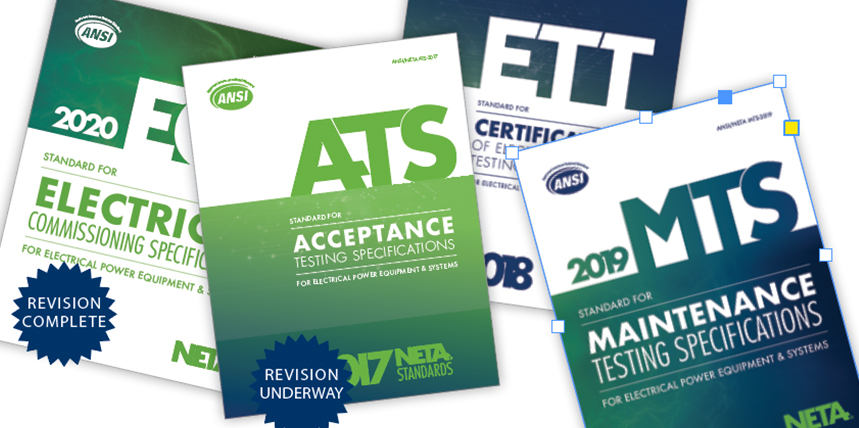
ANSI/NETA ECS-2020 Revision Completed ANSI/NETA ECS, Standard for Electrical Commissioning of Electrical Power Equipment & Systems, 2020 Edition, completed the American National Standard revision process. ANSI administrative approval was received on September 9, 2019. ANSI/NETA ECS-2020 supersedes the 2015 Edition. ANSI/NETA ECS describes the systematic process of documenting and placing into service newly installed or retrofitted electrical power equipment and …
Electrical Canada Update
There has been much emphasis in Canada recently on looking at electrical maintenance from two perspectives: safety and production. Many times, these go hand in hand. The standards committees in Canada are paying specific attention to devices that — when not maintained properly — can have an adverse effect on the electrical safety of workers. These include the most commonly …