
Commuting to and from work by car is a daily routine for most people. Many people are also required to be on the road to a jobsite, client site, the shop, the parts supplier, or anything in between.
One thing that is often overlooked is that driving is one of the leading causes of workplace fatalities. According to the Insurance Institute for Highway Safety (IIHS), there are 40,000–45,000 traffic-related fatalities annually. That number is significant because just one work-related fatality can impact all aspects of the workplace, such as production, insurance costs, and employee morale. To mitigate roadway incidents, it is recommended that companies that require employees to operate a motor vehicle for work purposes develop and administer driver safety programs to manage overall vehicular safety.
Training employees in safe driving techniques will help to reduce the number of vehicular accidents and make the road a safer environment for everybody. The following basic driving skills should be reinforced for employees who drive company vehicles.
TECHNIQUES FOR PROPER BACKING
There are many ways to approach backing vehicles, and no one philosophy is better than another as long as it is used properly every time. Training employees on all these techniques will decrease the likelihood of a backing incident.
- No Backing. Many companies have chosen to use the no-backing approach. This means that vehicles are driven forward through a parking space, allowing them to pull forward out of it. If they are unable to do that, they may back into the space so they can pull out when they leave. The advantage of this approach is that the vehicle will be moving away from potential traffic, not backing into it, thus avoiding the large blind spots that occur when starting the backing maneuver. Drivers initially have a narrow field of vision that widens the farther out of the space the vehicle backs. The opposite is true when backing into the space; the field of vision is large, then it grows smaller as the vehicle gets deeper into that parking space.
Another advantage is that backing into the space upon arrival allows the driver to look over the space prior to backing in. This prevents backing over something on the ground that could potentially damage the vehicle. If the driver approaches the vehicle from the front to get into the cab and back out of a space, they will have no idea what is immediately behind or under the vehicle unless they walk to the rear and look, which leads to our second technique. - 360° Inspection. Performing a 360° inspection is also a common technique used before backing a vehicle. This means that before every backing maneuver, the driver (or spotter) must walk around the vehicle to ensure there are no obstructions behind or under it. Many companies require employees to place cones at the front and rear corners of the vehicle to enforce this inspection. Sometimes, a second person, the spotter, is used to facilitate this technique.
- Use a Spotter. This technique is commonly used by companies that require employees to travel together in a vehicle at all times. For this to be effective, strict training must be conducted with the driver and the spotter. In many incidents, a spotter has been injured while guiding a vehicle during a backing maneuver. The driver and the spotter must use mutually agreed-upon hand signals, like those in Figure 1, since verbal communication may be impossible.
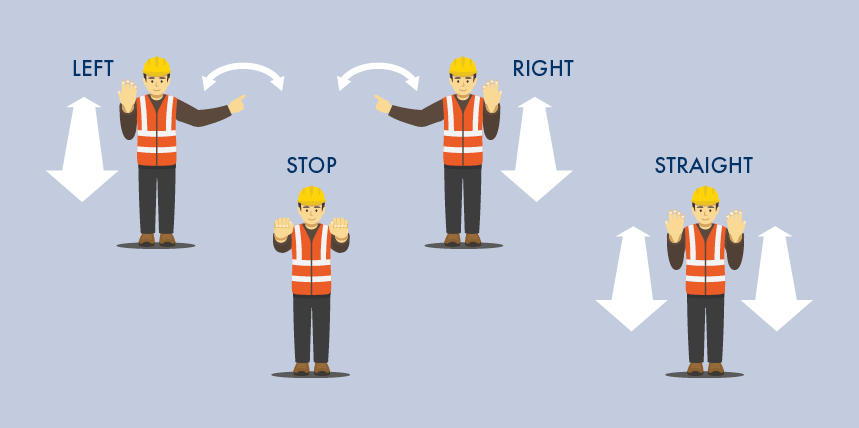
Drivers must be trained to stop the vehicle every time a spotter is out of sight. A suggested practice is to have the spotter remain in one fixed location on the vehicle (i.e., five feet from the driver’s side corner) and never leave that position.
PAYING ATTENTION AND MAINTAINING SPACE
According to the National Transportation Safety Board (NTSB), approximately 1.7 million to 2.5 million rear-end collisions occur annually in the United States. Most of these accidents could have been prevented by simply paying attention to the driving task at hand and increasing the following distance between vehicles.
Paying Attention
Multitasking is a fact of life, and our level of distraction has become increasingly worse with the advent of cellular devices. The incessant need for cell phone activity while behind the wheel has hindered our driving safety. Thirty states and Washington, DC, have enacted hands-free-only laws that state that drivers may talk on the cell phone while driving but may not physically manipulate it (i.e., text, dial, check email, or play games). Nearly all states have banned texting while driving, and some states forbid novice drivers from talking on the phone while operating a vehicle even when using a hands-free device. The map in Figure 2 shows the varying levels of distracted driving laws by state.
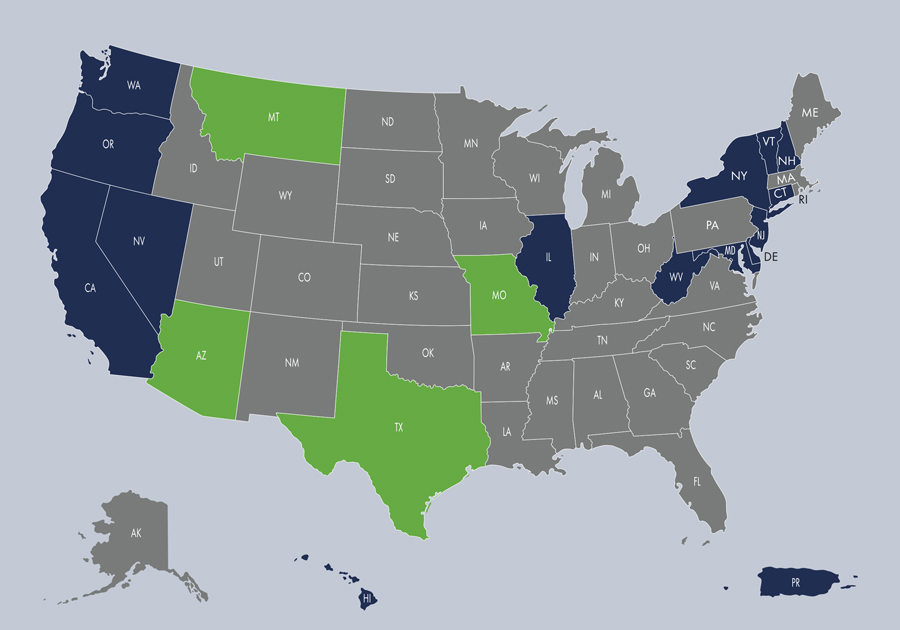
According to the U.S. Department of Transportation, 18 people are injured every half hour in distracted driving crashes, and one person is killed about every 2.5 hours. Putting down the cell phone and concentrating on the road increases the possibility that a driver will see something that requires them to react, potentially mitigating a collision or other incident.
Maintaining Space
Increasing the space between vehicles by creating a wedge also gives a driver more time to react. The old Yosemite Sam Back Off mud flaps had a message with a purpose: Increasing the space gives drivers more time to react. Think of it this way: A vehicle travels 88 feet per second at 60 mph. If it takes a person one second to see and recognize something, and one second to react and hit the brake, the vehicle has traveled 176 feet before it starts to brake. That does not even account for factors like the weight of the vehicle, the condition of the brakes, tires, and the roadway surface, and more. All of those can impact how long it takes for the vehicle to stop. So, the greater the distance between vehicles, the easier it is for a driver to react and stop the vehicle in time.
STAYING WITHIN SPEED LIMITS
“Speed doesn’t kill; it’s suddenly stopping that does,” as the old saying goes. Speed is a contributing factor to many accidents. Training drivers to stay within the speed limits (minimum and maximum) helps reduce the likelihood of a crash. It also reduces the severity of a crash, should one occur. Considering the previously mentioned tips, it also helps to increase the cushion between vehicles and decrease a vehicle’s stopping distance.
One way to show how driving faster doesn’t necessarily get a driver there significantly quicker is by doing some simple arithmetic.
Two drivers are going 200 miles from point A to point B. They travel the same route; the only difference is their speed. Driver A drives at 75 mph, which is 10 mph over the posted speed limit. Driver B drives at the speed limit of 65 mph. Driver A will get to the destination in approximately 2 hours and 40 minutes; Driver B will get there in approximately 3 hours. With less than a half-hour difference for a 200-mile trip, drivers might consider whether the quicker trip is worth the risk.
REQUIRED REST
The Federal Motor Carrier Safety Administration, which regulates commercial motor vehicles (CMV) and their drivers, acknowledges that fatigue reduces reaction time and increases the likelihood of an accident. Because of this, the number of hours CMV drivers may work (driving or not) is regulated and closely monitored.
Even when driving a vehicle does not require a commercial driver’s license, drowsy driving can still greatly affect driver reaction time. The difference is that there are no regulations forbidding non-commercial license drivers from operating a vehicle when tired. Employers must monitor the hours an employee works, and employees must be trained to self-police and ensure they do not get behind the wheel while drowsy.
CONCLUSION
There are many ways an employee can get injured, or worse, behind the wheel of a company-issued vehicle or their own. By training employees and implementing these safety practices, employers can help prevent workplace deaths, which remain the leading cause of fatalities on the job.
REFERENCES
- Bishop, J. and Jackson, L. “National Transportation Safety Board Accident Investigations and Recommendations on Technologies to Prevent Rear-End Collisions,” Automotive and Transportation Technology Congress and Exposition, Barcelona, Spain, October 1, 2001, doi.org/10.4271/2001-01-3243.
- Bureau of Transportation Statistics, US Department of Transportation. State Laws on Distracted Driving Ban on Hand-Held Devices and Texting While Driving. Accessed at www.bts.gov/state-laws-distracted-driving-ban-hand-held-devices-and-texting-while-driving.
- Federal Motor Carrier Safety Administration, US Department of Transportation. CMV Driving Tips – Driver Fatigue. Accessed at www.fmcsa.dot.gov/safety/driver-safety/cmv-driving-tips-driver-fatigue.

Paul Chamberlain has been the Safety Manager for Asplundh Engineering Services, LLC, and formerly Asplundh Electrical Testing, LLC, since 2009. He has been in the environmental health and safety field since 1998, working for various companies and in various industries. He received a BS from Massachusetts Maritime Academy.