
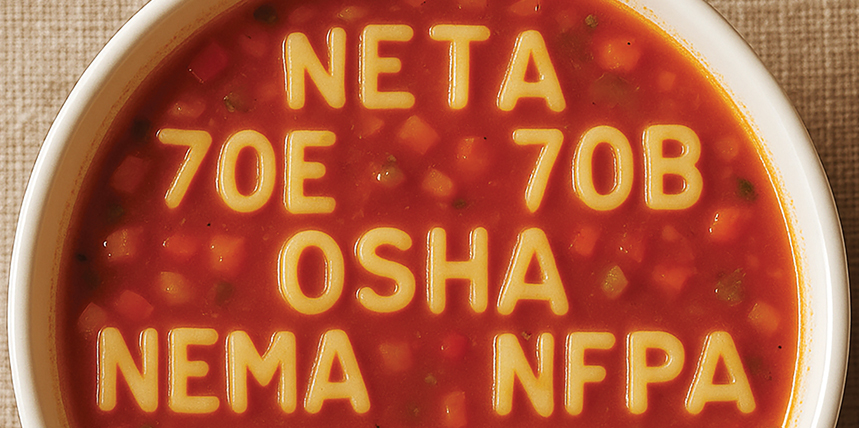
If you work around electricity, your career…and maybe your life…depends on what’s hidden in a bowl of alphabet soup. I’m talking about electrical acronyms: NFPA, OSHA, 70E, 70B, NETA, NEC, Z462, EASA, and so on. At first, they may sound like code meant to confuse you. But once you crack that code, everything about your job makes more sense…and becomes a lot safer.
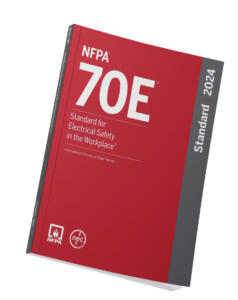
UPDATE: 2027 EDITION OF NFPA 70E
First, here is the status of the current revision cycle for the 2027 edition of NFPA 70E.
The 70E Technical Committee met for the second draft (SD) meeting in August 2025 in Indianapolis. At that meeting, we acted and voted on 213 public comments and processed 93 revisions required by the NFPA Manual of Style. The second draft report will be published soon, which will allow the public to review the actions and committee comments from the meeting.
As a reminder and recap, here is the basic process for the 70E standards-making process after receiving public comments.
First Draft Report: The process starts when the technical committee working on the standard publishes its first draft report, based on public inputs (July 2024 in Memphis).
Second Draft Report: After the public comment period, the committee publishes a second draft report, outlining its final recommendations. (August 2025 in Indianapolis). The SD report will be issued on or before March 2026.
NITMAM Period: A deadline is published for submitting a Notice of Intent to Make a Motion (NITMAM). Anyone who disagrees with the committee’s recommendations in the SD can file a NITMAM by March 31, 2026.
NITMAM
The NFPA’s Notice of Intent to Make a Motion (NITMAM) is a formal step in the standards development process that allows anyone to propose an amending motion to a standard, such as NFPA 70E, for consideration and debate at the NFPA Technical Meeting.
The process is in place to ensure that the standards development remains a public, consensus-based procedure, providing a final opportunity for interested parties to address and amend the work of the Technical Committees
Motions Committee Review: All submitted NITMAMs are reviewed by NFPA’s Motions Committee to ensure they are proper and valid (May 12, 2026).
Technical Meeting: Any certified NITMAMs are brought up for debate and a vote at the NFPA Technical Meeting, which is attended by NFPA members (June 25-26, 2026).
Standards Issuance: If no NITMAMs are filed, or if all are defeated, the document is considered a Consent Standard and goes directly to the Standards Council for final issuance.
We expect the 70E–2027 standard issuance, assuming all goes forward, in the fall of 2026.
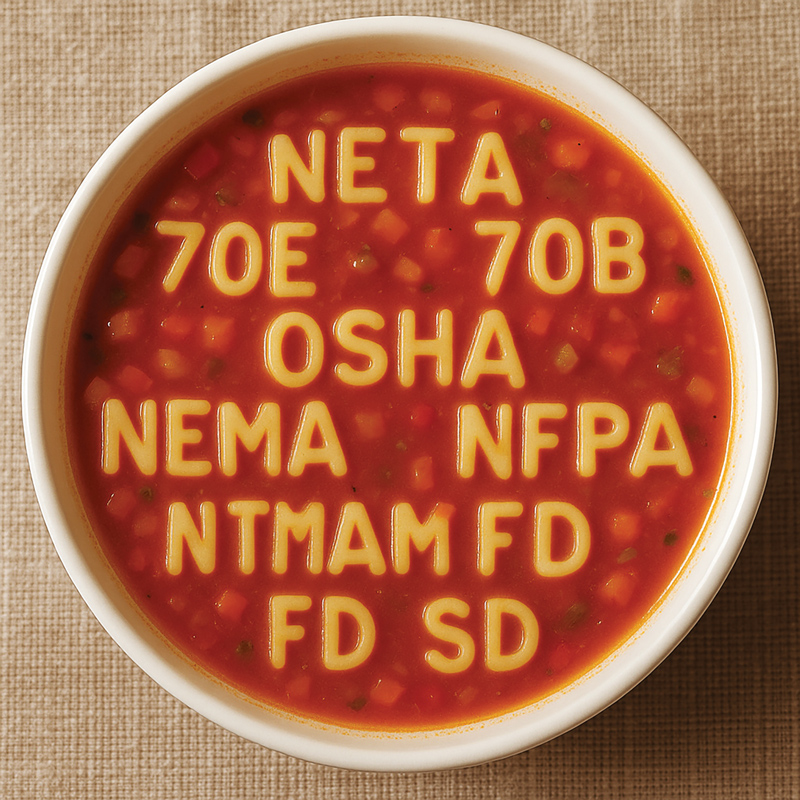
THE ALPHABET SOUP OF STANDARDS AND ELECTRICAL SAFETY
The world of codes and standards has an inherent need — or maybe it’s a yearning — to abbreviate and shorten certain words and phrases that ultimately become commonplace and part of the communication channel for the industry.
Every trade has its shorthand. Doctors talk in Latin. Pilots speak in abbreviations. Electrical workers? We use acronyms. They save time…but they also pack a lot of meaning.
When someone says, “Is this task compliant with NFPA 70E?” that’s not small talk. That’s a life-or-death check. Knowing what 70E is (and what it means) separates a qualified worker from a risky one.
Understanding key terms and abbreviations can help you, the worker in the field, be more knowledgeable, and it will arguably make you safer as you execute your daily tasks on the job because you have a clearer understanding of key terms and abbreviations.
Here’s a list of some of the more important acronyms for electrical safety and standards.And if you aren’t familiar with them already, get to know them…or maybe skim the article for now, and keep it handy to use on the job later!
Standards-Making Organizations and Regulatory Agencies
Knowing and understanding the relevant electrical safety standards-making organizations is important to the electrical worker in the field. Not only will you see and hear many references to certain numbers, acronyms, and sections, but it will also be important to understand their content and intent so you can perform your work safely.
Don’t be confused by the various numbers and acronyms — embrace them! Each one writes part of the rulebook for how we install, test, maintain, and repair electrical systems. Miss one, and you’re missing part of the safety net.
ANSI – American National Standards Institute
ASTM – American Society for Testing and Materials
CIGRE – Council on Large Electric Systems (English Translation)
CSA – Canadian Standards Association
EASA – Electrical Apparatus Service Association
IEC – International Electrotechnical Commission
IEEE – Institute of Electrical and Electronics Engineers
ISO – International Organization for Standardization
NFPA – National Fire Protection AssociatioN
NESC – National Electrical Safety Code (IEEE C2)
NEC – National Electrical Code (NFPA 70)
OSHA – Occupational Safety & Health Administration
UL – Underwriters Laboratories
Common Electrical Terms and Acronyms
Why should you study and understand something as exciting as a list of acronyms and standard numbers? Besides curing insomnia, it helps you be a better technician/engineer/boss.
- Building your electrical safety program? Use NFPA 70E or CSA Z462 and include OSHA 1910; train to 1910.331–335, and implement LOTO with 1910.147.
- Trying to figure out what electrical maintenance and testing you should do? Whip out NFPA 70B, CSA Z463, and the ANSI/NETA ATS and ANSI/MTS standards.
- Concerned about arc flash-related topics? Better grab IEEE 1584 for incident energy calculations; label it per NEC 110.16; reduce energy via NEC’s articles 240.67 and 240.87.
- What about PPE needs? Refer to ASTM, IEC, NFPA, and OSHA.

Read and understand these – it’s important!
AFCI – Arc Fault Circuit Interrupter
AR – Arc Rating or As Required (NFPA 70E)
ATPV – Arc Thermal Performance Value
AFHA – Arc Flash Hazard Analysis
AFB – Arc Flash Boundary
CB – Circuit Breaker
DCR – Dallas Cowboys Rock!
EJHA – Electrical Job Hazard Analysis
EMP – Electrical Maintenance Program
EMS – Energy Management Systems
EEWP – Energized Electrical Work Permit
ESWP – Electrical Safe Work Procedure
ESW – Electrical Safety Watch/Standby Person
FR – Flame Resistant (material)
GFCI – Ground-Fault Circuit Interrupter
HRC – Hazard/Risk Category or Arc-flash PPE Category
JHA – Job Hazard Analysis
JSA – Job Safety Analysis
LOTO – Lockout/Tagout
MCC – Motor Control Center
OCPD – Overcurrent Protective Device
SOP – Standard Operating Procedure
SPD – Surge Protective Device (replaces TVSS)
SR – Selection Required (NFPA 70E)
UPS – Uninterruptible Power Supply
OSHA REGULATIONS
It’s important to spend a little more time understanding key aspects of the OSHA regulations that relate to electrical topics. OSHA is a federal agency within the U.S. Department of Labor (DOL) that works to ensure safe and healthy working conditions for employees. On the electrical side, here are important sections you should be familiar with.
1910 Subpart S – Electrical
This is OSHA’s standard for electrical safety in the workplace, covering the design, installation, and maintenance of electrical systems to protect employees from electrical hazards. It includes regulations for the safe installation of electrical equipment, protective work practices, and maintenance requirements.
- 1910.331 Scope and Applicability. Applies to qualified and unqualified persons who work on, near, or with certain electrical installations
- 1910.332 Training. Outlines training requirements
- 1910.333 Selection and Use of Work Practices. Requires deenergizing live parts before work, when possible
- 1910.334 Use of Equipment. Provides rules for the use of electrical tools and devices
- 1910.335 Safeguards for Personnel Protection. Rules for using and maintaining PPE and other protective equipment and tools
- OSHA 1910.147 General Environmental Controls. Applies to lockout/tagout (LOTO) rules and requirements
- OSHA 1910.269. Electric Power Generation, Transmission, and Distribution. Applies to electric power generation facilities and the employees who work on them
SUMMARY: ACRONYMS = AWARENESS = SAFETY
Electrical work is unforgiving. You don’t get second chances with an arc flash or backfeed. When you see NFPA 70E Article 130, you should instantly know it’s about safe work practices and is not something to look up later.
When you can talk fluently and confidently about 70E boundaries, OSHA lockout rules, or NETA testing requirements, you’re not just another worker — you’re the one people turn to for answers as the subject matter expert or trusted advisor. That’s how promotions, certifications, and leadership roles happen.
So keep a cheat sheet, print it out, and post it where you work. Use it daily when writing reports and summaries, and reference the standard or section number.
Electrical acronyms aren’t just letters — they are the DNA of our trade. The more fluent you become, the better your decisions, your reputation, and your odds of going home in one piece.
Because in this business, the alphabet really can save your life.
Besides the very important DCR, remember this: Always…Test Before Touch! (IYKYK).
BONUS SIDEBAR!
Technical Grammar: It’s a real thing! Here are a couple of examples.
Electrical Bus
An electrical conductor, or bus, is spelled “bus”, not “buss.” “Buss” is the name of a fuse by Bussmann (now Eaton). The plural of bus is “buses.” The electrons on the bus go round and round….
Shock vs. Electrocution
Shock = nonfatal contact with electricity. (Like Frankenstein: He’s alive!!)
Electrocution = fatal contact with electricity (combines “electric” and “execution”).

Ron Widup is the Vice Chairman, Board of Directors, and Senior Advisor, Technical Services for Shermco Industries and has been with Shermco since 1983. He is a member of the NETA Board of Directors and Standards Review Council; a Principal member of the Technical Committee on Standard for Electrical Safety in the Workplace (NFPA 70E); Principal member of the National Electrical Code (NFPA 70) Code Panel 11; Principal member and Chairman of the Technical Committee on Standard for Competency of Third-Party Evaluation Bodies (NFPA 790); Principal member and Chairman of the Technical Committee on Recommended Practice and Procedures for Unlabeled Electrical Equipment Evaluation (NFPA 791); a Principal member of the Technical Committee Standard for Electrical Equipment Maintenance (NFPA 70B); and Chair of IEEE Std. P902 (Yellow Book) Recommended Practice for Maintenance and Operational Safety of Electrical Power Distribution Systems in Industrial and Commercial Facilities.He is Chairman of the Texas State Technical College System (TSTC) Board of Regents, a NETA Certified Level 4 Senior Test Technician, State of Texas Journeyman Electrician, a Senior Member of the IEEE Standards Association, and an NFPA Certified Electrical Safety Compliance Professional (CESCP).