
The first time I handed a young soldier the leads and stepped back, I learned more about our training program than I did about the equipment. He had passed every classroom block. He could recite the theory. But standing in front of energized gear with a job to do, he hesitated, not because he lacked intelligence, but because nothing in his training had yet asked him to own a result. That gap between knowing and doing is the same gap our entire industry is now staring down, and we will not hire our way out of it.
In the 249th Engineer Battalion (Prime Power), our mission is to generate and distribute commercial-grade power wherever the Army needs it, often under conditions that punish any shortcut. We cannot post a job opening when we are short a qualified technician; we have to build that technician to a standard, and we have to do it predictably. The civilian electrical testing industry now faces the same constraint for the same reason: the demand for qualified field technicians is rising far faster than the supply of people trained to do the work safely and correctly.
Steve Park made this case well in his NETA World Fall 2025 article “Workforce Development for NETA Testing Companies,” and Robert Harriman built on it with the case for apprenticeship in Winter 2025. This article picks up where they left off and offers a specific, transferable tool: a competency-based development pathway, adapted from how high-reliability organizations build technicians, mapped directly onto NETA’s Level 1 through Level 4 progression.
THE PROBLEM IS BIGGER THAN HIRING
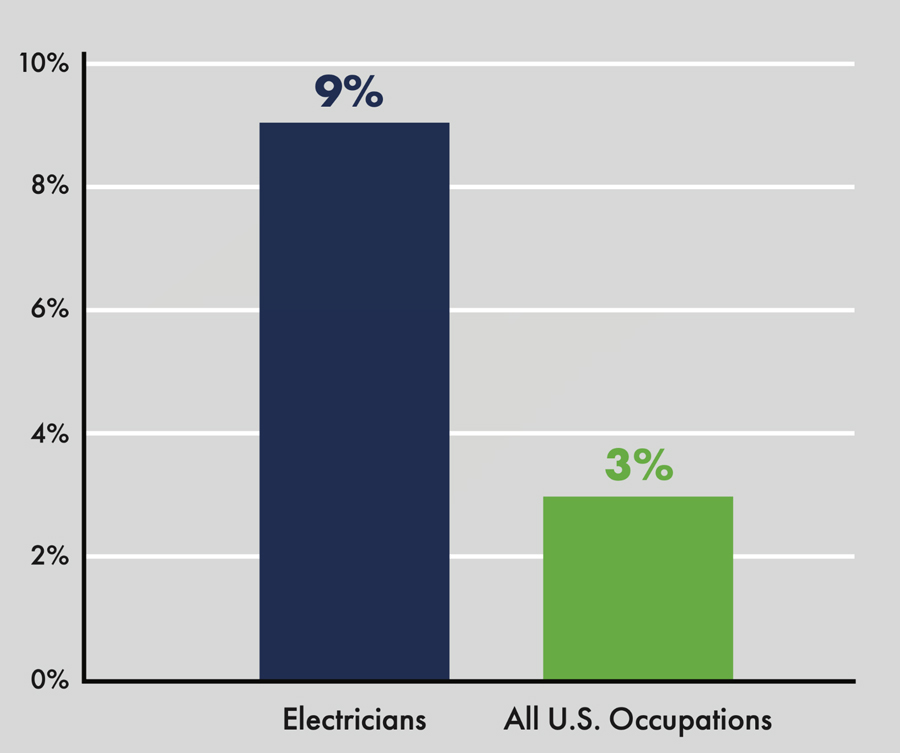
The numbers describe a structural shortage, not a temporary dip. The U.S. Bureau of Labor Statistics projects electrician employment to grow 9% from 2024 to 2034, three times the average for all occupations, with about 81,000 openings each year over the decade. The Center for Energy Workforce Development forecasts that 32 million people will need to be hired into energy and infrastructure jobs between 2025 and 2035.
At the engineering end of the spectrum, a joint Kearney and IEEE Power & Energy Society study found the global power sector will need between 450,000 and 1.5 million more engineers by 2030, and that 40% of power-sector executives already report difficulty hiring skilled workers.
Demand is being driven by forces that are not slowing down. The U.S. Department of Energy reports that data centers consumed roughly 4.4% of all U.S. electricity in 2023, a share projected to reach 6.7% to 12% by 2028. Add grid modernization, electrification, and reshored manufacturing, and you have the strongest sustained growth in electricity demand in a generation, all of it requiring equipment that must be tested, commissioned, and maintained (Figure 1).
Projected Employment Growth, 2024-2034
Here is the part that should concern every NETA Accredited Company (NAC): Even when candidates exist, the qualified ones are scarce. Industry recruiters report that fewer than 15% of applicants for senior technician roles bring both the required certifications and real mission-critical field experience, and that senior testing and commissioning positions routinely take 60 to 120 days or more to fill. The bottleneck is not headcount, it is competence.
WHY TENURE IS NOT COMPETENCE
The most common way our industry tracks technician development is by time served. A technician has three years, so we assume a certain capability. But time is an input, not an outcome. I have seen soldiers reach genuine field competence in 18 disciplined months, and I have seen others coast for years without ever being asked to perform under real accountability.
This distinction is not academic, it is a safety issue. The Electrical Safety Foundation International reports that 70% of electrical fatalities occur in occupations not classified as electrical work; that is, among workers who were never properly trained for the hazard in front of them. NFPA 70E makes the link between competence and safety explicit: Article 130.5 ties arc flash risk directly to the condition of maintenance of the equipment. In other words, the quality of testing and maintenance is not just a reliability question. It is the difference between a routine work order and an incident.
NETA’s own certification philosophy reflects this. The NETA exam is deliberately a field test, not a book test, as it asks whether a technician can answer the question standing in front of the gear without calling a PE. That is exactly the capability a development program has to produce on purpose. It will not appear on its own with the passage of time.
A COMPETENCY-BASED PATHWAY
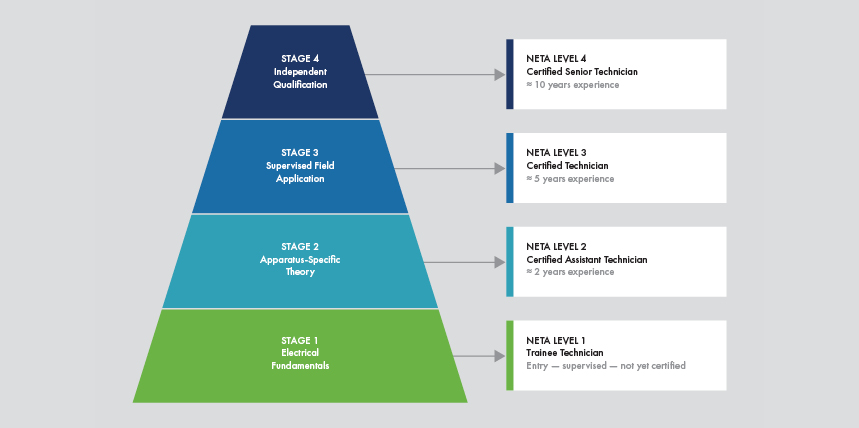
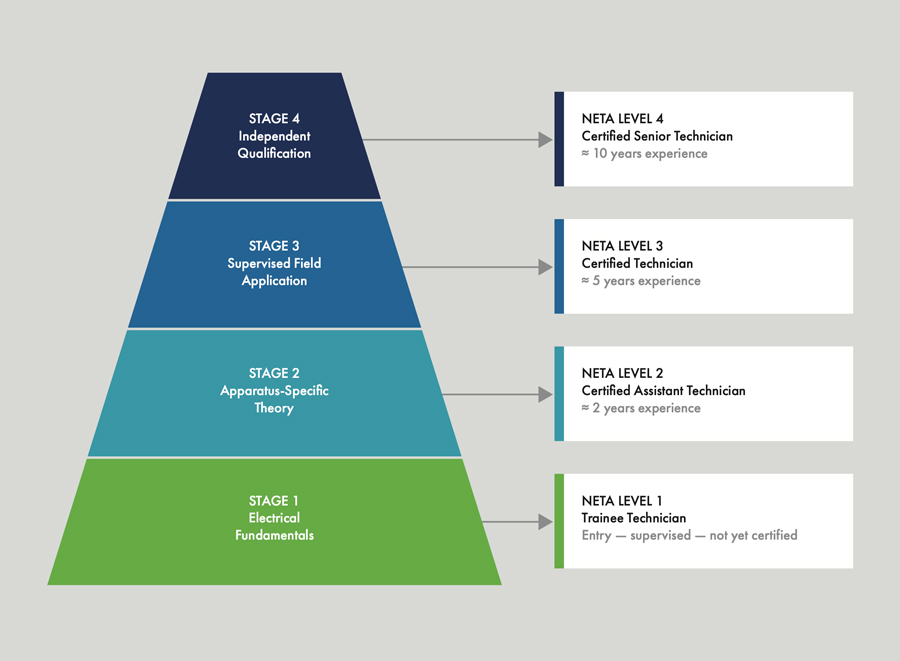
A development pathway works when each stage is defined by what a technician can demonstrably do, and when every stage maps to an external credential that verifies it. The four stages below align deliberately with the four levels defined under ANSI/NETA ETT, Standard for Certification of Electrical Testing Technicians for Electrical Power Equipment & Systems.
Stage 1: Electrical Fundamentals
Before a trainee touches a test set, the fundamentals have to be solid: AC/DC theory, three-phase power, grounding and bonding, instrumentation, and, first and foremost, electrical safety and NFPA 70E. This is the Level 1 Trainee Technician phase, where the individual works strictly under the supervision of a certified technician and is qualified to assure their own safety and little else. The goal of this stage is not productivity; it is to build the mental model that every later test result will be interpreted against.
Stage 2: Apparatus-Specific Theory
Next, the technician learns the equipment itself, transformers, switchgear, circuit breakers, cables, protective relays, and the why behind each test. This is where the ANSI/NETA standards become the curriculum: the Acceptance Testing Specifications (ATS) for new equipment being placed into service, and the Maintenance Testing Specifications (MTS) for equipment already in service. A technician who understands why an insulation-resistance or power-factor result matters has crossed the line from operator to diagnostician. Pairing this stage with the Level 2 Certified Assistant Technician exam, which requires roughly two years of experience plus documented safety and technical training, gives the milestone teeth.
Stage 3: Supervised Field Application
Theory is validated in the field, under a qualified mentor who is watching, correcting, and signing off. This is the stage most often shortchanged, and it is the one that produces the hesitation I described at the start. The technician runs real tests on real equipment, documents the results to standard, and is progressively given more to own, but always with a certified technician accountable for the outcome. In military terms, this is structured on-the-job training (OJT) against a defined task list, not “shadowing.”
Stage 4: Independent Qualification
Finally, the technician demonstrates that they can plan, perform, evaluate, and document complex testing independently, and can supervise others doing the same. This is the Level 3 Certified Technician and, ultimately, Level 4 Certified Senior Technician territory, milestones that require five and 10 years of qualifying experience, respectively, along with cumulative safety and technical training hours. At this stage, the technician is not just executing the standard; they are the person the standard relies on (Figure 2).
CREDENTIAL THE PROGRESS, NOT THE CALENDAR
The advantage of mapping your pipeline to NETA’s levels is that the milestones are externally verified. A technician does not advance because a year has passed; they advance because they passed a proctored, standards-based exam administered through a NAC. That is a defensible, auditable definition of competence, exactly what a safety-critical trade should demand.
Two points are worth making clearly to anyone building such a program:
- NETA certification and engineering licensure are different ladders, and that is fine. A NETA Certified Technician is credentialed to perform and evaluate field testing. The NCEES Fundamentals of Engineering (FE) exam, by contrast, is the first step toward Professional Engineer licensure, a separate engineering track administered by a different body. The two are complementary: the certified technician executes and documents the testing; the PE performs the engineering studies behind it. Encouraging a technician with the aptitude and interest to pursue the FE strengthens your bench; it does not replace NETA certification.
- Recertification keeps competence current. NETA certification runs on a three-year cycle and is maintained through continuing technical development. A development program should treat recertification not as paperwork but as the mechanism that keeps a hard-won standard from quietly eroding.
MAKE IT STICK
The difference between a training program and a stack of training events is consistency. In the military, we hold that consistency with three tools that translate directly to a NETA company:
- A standardized task list. Every technician is trained against the same defined, observable tasks, signed off by a qualified evaluator. This is the single most powerful tool for making competence portable across crews and locations.
- Deliberate mentorship. Pairing each developing technician with an accountable Level 3 or Level 4 mentor turns field hours into structured learning instead of incidental exposure. The mentor’s job is to make the trainee perform, not to perform for them.
- Documentation as a habit. If progress is not written down, it did not happen, and it cannot be audited, transferred, or trusted. A simple qualification record per technician protects the company, the customer, and the worker.
None of this requires a training department the size of a battalion. It requires a defined standard, someone accountable for it, and the discipline to credential progress rather than assume it.
CONCLUSION
The electrical testing industry’s workforce gap will not be closed by recruiting alone, because the scarce resource is not people; it is demonstrated competence in a safety-critical trade. NETA has already given us the framework: four certification levels, a body of standards that defines the work, and exams that test whether a technician can perform it. Our job as leaders is to build the pathway that carries a new technician from fundamentals to independent qualification, and to credential each step honestly along the way.
Build the bench deliberately, to a standard, and verify it. The grid we are being asked to test and maintain is counting on the result.
REFERENCES
- U.S. Bureau of Labor Statistics. “Electricians.” Occupational Outlook Handbook. Employment projections, 2024-2034 projections. www.bls.gov/ooh/construction-and-extraction/electricians.htm?vid=2117383articles%2F?ShowAll.
- Center for Energy Workforce Development. “Energy Workforce Fast Facts.” 2025. cewd.org/resources/energy-workforce-fast-facts.
- Kearney and IEEE Power & Energy Society. “The Future of the Energy Workforce.” 2025.
- Shehabi, A., et al. 2024 United States Data Center Energy Usage Report. Lawrence Berkeley National Laboratory. 2024.
- Electrical Safety Foundation International (ESFI). “Workplace Injury and Fatality Statistics.” March 5, 2026.
- NFPA 70E, Standard for Electrical Safety in the Workplace.
- ANSI/NETA ETT, Standard for Certification of Electrical Testing Technicians.
- ANSI/NETA ATS, Standard for Acceptance Testing Specifications for Electrical Power Equipment and Systems.
- ANSI/NETA MTS, Standard for Maintenance Testing Specifications for Electrical Power Equipment and Systems.
- National Council of Examiners for Engineering and Surveying (NCEES), “Fundamentals of Engineering (FE) Exam.”

SSG Jakenya W. Hill is a Prime Power Production Specialist (12P) and power station leader with the U.S. Army’s 249th Engineer Battalion (Prime Power). He is the first NETA Level 4 Certified Senior Technician in his battalion’s history and also holds NICET Level III and Observer/Coach/Trainer (OC/T) certification. A distinguished honor graduate of the U.S. Army Senior Leader Course, Hill leads a prime power section, develops and qualifies junior technicians, and is preparing for the NCEES Fundamentals of Engineering (FE) exam.