

In Part 1, published in the Fall 2026 issue of NETA World, Valer Banushi and Adis Talovic portrayed a comprehensive perspective on the role of artificial intelligence (AI) in the electrical testing industry. The article offered insights into future applications for NETA Accredited Companies (NACs), while considering opportunities and challenges AI may bring to the electrical testing industry. In Part 2, Neno Pasic touches on AI in everyday business, shares his view on its surprising impact on electrical infrastructure, describes how Tony Demaria Electric, Inc. (TDE), a NETA Accredited Company, has approached implementation, and offers a possible path to AI standardization.
THE EMERGENCE OF AI
AI is often perceived as a recent technological breakthrough; however, it dates back many decades. The term “artificial intelligence” was first formally introduced at the Dartmouth Conference in 1956, where researchers began exploring how machines could simulate human intelligence. At that time, AI was largely theoretical, constrained by limited computing power and data availability.
Progress occurred in cycles—periods of optimism followed by stagnation—until exponential advances in computing, data storage, and machine learning algorithms over the past two decades, especially the last few years, enabled AI to evolve into a practical, widely deployable tool.
What distinguishes the current era is not simply the existence of AI, but the speed at which industries have adopted it. Technologies that once took years, even decades, to become mainstream are now reaching widespread use in months. AI has quickly transitioned from a specialty capability within technology firms to a standard tool embedded in everyday business applications. From finance and healthcare to manufacturing and construction, organizations are integrating AI into workflows, decision-making processes, and operational strategies at an unprecedented pace.
AI IN EVERYDAY BUSINESS
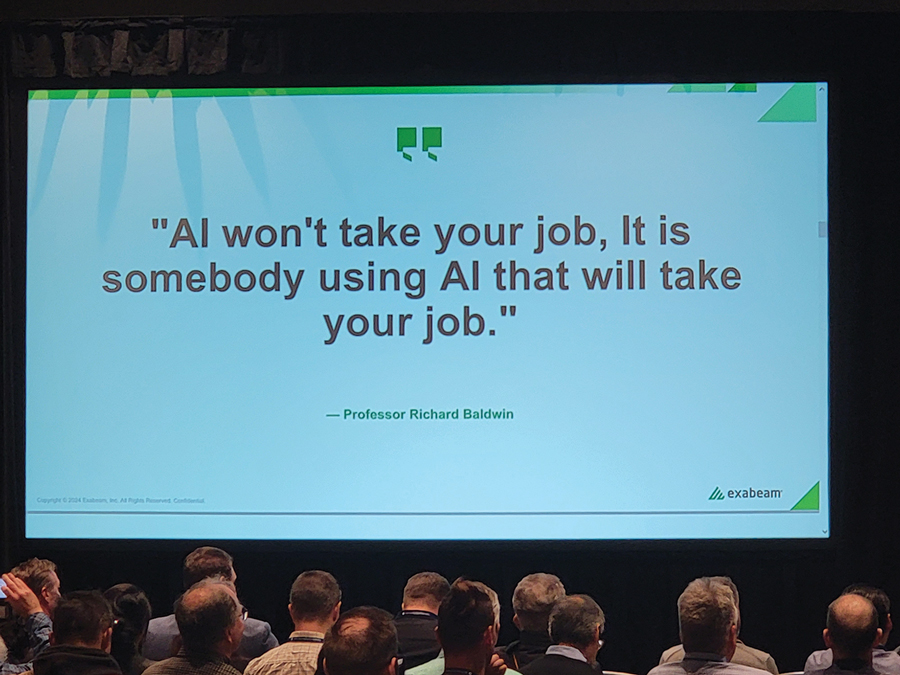
In March 2024 at The Official Cybersecurity Summit in San Diego, California, I noted and took Professor Richard Baldwin’s quote very seriously: “AI won’t take your job. It is somebody using AI that will take your job.”
The electrical testing industry is no exception. While traditionally grounded in standards-based procedures, engineering expertise, and hands-on field execution, it is now experiencing a measurable shift toward incorporating digital tools that enhance productivity and accuracy. AI’s value in this space lies not in replacing human expertise but in enabling faster access to information, improved analysis of large data sets, and more efficient execution of routine tasks.
AI’S SURPRISING IMPACT ON ELECTRICAL INFRASTRUCTURE
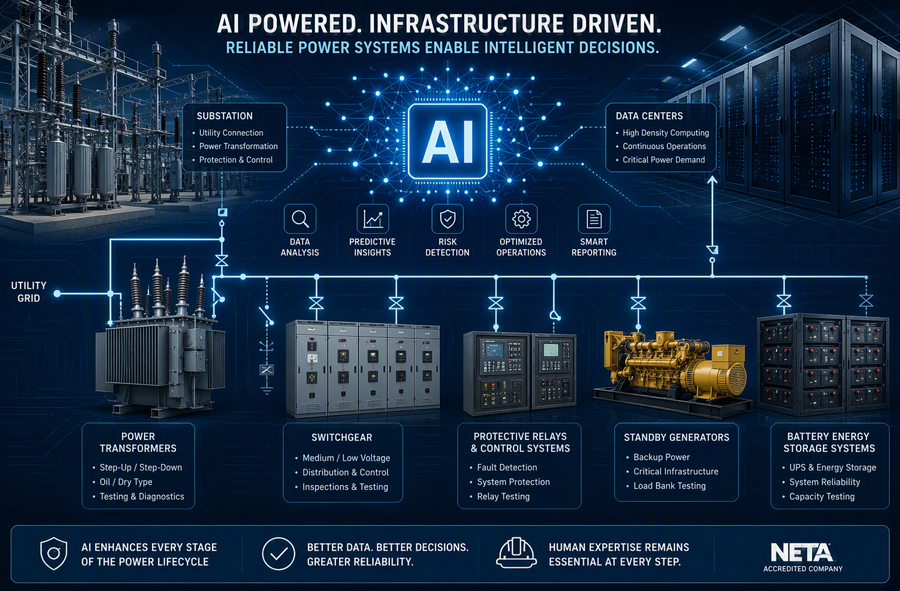
Much of the public discussion surrounding AI focuses on software, chatbots, and automation. Less frequently discussed is the physical infrastructure required to support AI. Every AI query, image generation request, document analysis, or machine learning model relies on computing resources housed within data centers. As organizations increasingly adopt AI technologies, demand for computing capacity continues to grow, driving significant investment in new data centers and the electrical infrastructure that supports them.
Recent industry discussions have raised questions about whether the pace of AI investment can be financially sustained over the long term. Some analysts point to the enormous capital commitments being made for data centers, advanced processors, cloud computing platforms, and supporting infrastructure. Others argue that AI will ultimately justify those investments through productivity improvements and new business opportunities. Regardless of where those debates land, one fact remains clear: Substantial electrical infrastructure is being designed, constructed, commissioned, tested, and maintained to support AI growth.
For the electrical testing industry, this trend presents significant opportunities. Modern AI-oriented data centers often require large utility interconnections, medium-voltage distribution systems, standby generation, uninterruptible power supplies, protective relaying systems, and increasingly complex monitoring and control networks. These facilities depend on the reliability, safety, and performance standards that NACs have long supported.
In many ways, AI creates a unique relationship with the electrical industry. While AI can help NETA companies review test reports, locate information, and improve operational efficiency, it still depends on reliable electrical systems to function. Every AI advancement ultimately relies on transformers, switchgear, cables, generators, batteries, and power distribution equipment operating as intended. Without reliable power systems, AI cannot exist.
As data center development continues, NACs may find themselves supporting not only the adoption of AI within their organizations but also the critical infrastructure that enables AI to exist in the first place. Whether AI ultimately exceeds expectations or falls short of some of the industry’s more ambitious forecasts, the demand for dependable electrical infrastructure and qualified testing professionals will remain essential.
THE TDE APPROACH
At TDE, the approach to AI adoption has been deliberate, structured, and governed by a clear set of principles. Recognizing both the potential benefits and inherent risks of AI, TDE established an internal AI committee to oversee all aspects of AI implementation across the organization. This committee ensures AI is deployed in alignment with company standards, cybersecurity requirements, and the professional responsibilities expected of a NAC.
A key decision made early in this process was to avoid fragmentation by standardizing on a single enterprise AI platform. Rather than allowing multiple unregulated AI tools to be used across departments, TDE has implemented a controlled environment that relies on a single primary AI solution integrated with existing business systems. Others may disagree, but TDE believes this approach simplifies governance, strengthens data security, and ensures consistency in how AI is used across the organization.
The AI committee’s role extends beyond governance. It is also responsible for developing and implementing AI agents tailored to specific business processes within TDE. These agents are designed to support both field and office operations by streamlining repetitive tasks, improving access to information, and enhancing decision-making. The committee is also responsible for AI training used within the organization and for gathering and reviewing feedback from AI users.
THE PATH TO STANDARDIZATION
However, practical challenges and exceptions to this standardization exist. Many software platforms already in use—such as Autodesk AutoCAD and Adobe Acrobat—now include embedded AI capabilities as part of their functionality. These built-in tools are accepted as part of the overall ecosystem because they are directly tied to the applications already used in daily operations. The distinction is clear: Externally sourced AI tools are restricted and centrally managed, while embedded AI features in trusted enterprise software are used for their intended purpose.
On the other hand, manufacturers of some technical software, such as PowerDB and Doble, are not planning to deploy such tools yet or at all. They might be testing it, but specific applications make it challenging and even questionable whether such adoption would benefit end users. However, their technical support groups might be implementing AI to help users find answers by crawling their knowledge bases or FAQ sections, or to provide best practices based on historical data and similar cases.
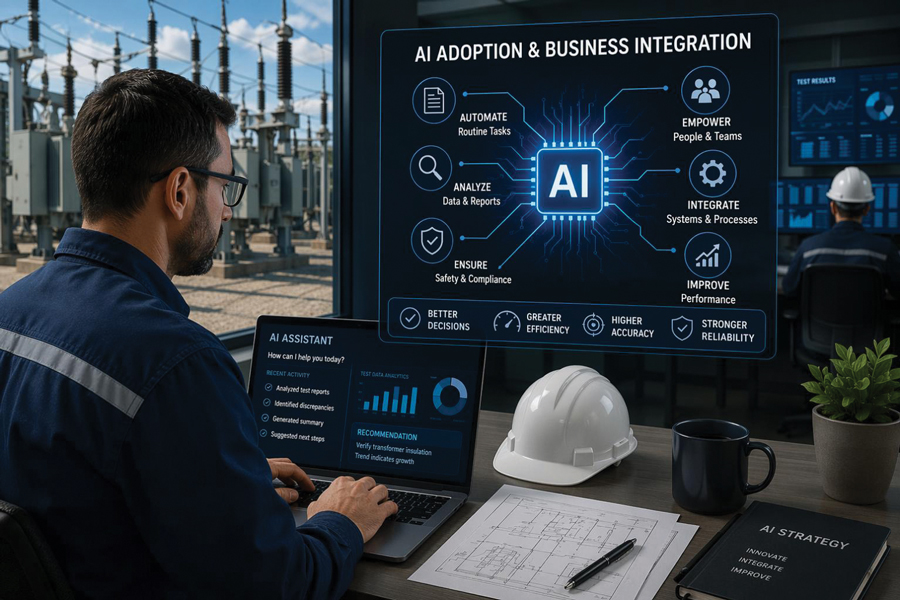
In the field, technicians are often required to reference extensive technical documentation, including standards, OEM manuals, white papers, and historical test data. Locating relevant information within hundreds of pages can be time-consuming and, in some cases, delay critical decision-making. AI-driven tools can significantly reduce this burden by enabling technicians to retrieve precise information quickly and efficiently. Instead of manually searching through documents, technicians can query AI systems to identify applicable procedures, requirements, or troubleshooting steps.
In the office, AI delivers similar efficiencies in administrative and operational processes. AI-supported workflows can accelerate tasks such as analyzing test reports, identifying inconsistencies, and assisting with documentation. This allows engineers and project managers to focus more on interpretation and decision-making rather than manual data processing.
One area where AI has shown immediate impact is in document analysis. Using technologies such as optical character recognition (OCR), which predates AI and has been commercially available since the 1950s, combined with AI-assisted review, large volumes of test documentation can be evaluated in a fraction of the time required by traditional methods. For example, reports that previously required extended manual review can now be assessed quickly to identify discrepancies, missing information, or potential errors. Qualified personnel then verify these findings, ensuring the final output meets the standards required for accuracy and compliance.
Despite these advantages, it is critical to recognize that AI is not infallible. As mentioned in Part 1, one of the most widely discussed challenges associated with AI systems is the phenomenon often referred to as “hallucination,” where AI generates information that appears credible but is not based on verified data. In an industry where precision and safety are paramount, relying on incorrect information can have significant consequences.
For this reason, TDE has adopted a strict human-in-the-loop approach. As Banushi revealed in Part 1, AI is treated as an assistive tool rather than a source of authority. Qualified professionals must review and validate all AI-generated outputs before applying them in real-world scenarios, especially in final customer reports or other sensitive and financial decisions. This ensures that the responsibility for decision-making remains with experienced personnel who understand the context, risks, and technical requirements of each situation and are likely to have more intimate knowledge about it than AI could ever have.
The adoption of AI within TDE also reflects a broader trend in how organizations approach technological change. Initial reactions to AI often include skepticism or reluctance, particularly in industries where established processes have been refined over many years. However, once individuals begin using AI tools and experience their practical benefits, adoption tends to accelerate. This pattern highlights the importance of education, training, and controlled implementation in driving successful integration. I’ve witnessed this firsthand at TDE as well.
AI AT NETA: SAY HI TO BETTY!
Interest in AI isn’t limited to individual NACs. NETA itself is actively evaluating how AI can support its mission and better serve members. As part of its technology initiatives, NETA has tested and completed the first version of “Betty AI,” a closed large language model (LLM) built around NETA’s technical intellectual property database and intended for use by internal staff and select subject matter experts.
The initiative reflects a deliberate approach like that taken by many NACs: leveraging AI within a controlled environment while emphasizing accuracy, content governance, appropriate limitations, and protection of proprietary information. NETA is also exploring future AI applications that could help members and industry professionals access information more efficiently, including certification resources, technical standards, training materials, conference information, and educational tools designed to support certification preparation and professional development.
Concepts under evaluation include AI-powered study tools to help candidates pursuing NETA certification, as well as AI resources that help conference attendees navigate educational sessions and find relevant information more effectively. These efforts demonstrate that AI is increasingly viewed not simply as a business productivity tool but as a means of improving access to technical knowledge across the electrical testing industry.
As both NACs and NETA itself explore responsible AI adoption, the focus remains the same: improving access to information, supporting better decisions, and enhancing the value delivered to members and customers without replacing the expertise and judgment of qualified professionals.
CONCLUSION
Ultimately, AI represents a powerful opportunity for NACs to enhance their operations while maintaining the standards that define the industry. By implementing AI in a structured and responsible manner—supported by governance, standardization, and human oversight—organizations can achieve measurable improvements in efficiency, accuracy, and consistency.
At the same time, it is essential to remain grounded in the principles that have long guided the electrical testing profession. Automation cannot replace technical competence, adherence to standards, and professional accountability. Instead, AI should be viewed as a tool that strengthens these principles by enabling professionals to work more effectively and make better-informed decisions.

Neno Pasic is a NETA Accredited Representative and Tony Demaria Electric (TDE) Chief Information Officer. Neno has been working with TDE for almost 25 years. He is the NETA Volunteer Engagement Committee Chair, a NETA Training Committee Member, a NETA Promotions and Marketing Committee Member, and an IEEE and NFPA Member. Neno earned a BS in computer information systems and business administration from California State University Dominguez Hills (CSUDH), along with Project Management and Information Technology Management Certificates from the University of California, Los Angeles (UCLA). He received NETA’s 2021 Outstanding Achievement Award and the 2025 NETA Excellent Service Award.
Note: AI-generated images created by Neno Pasic using Microsoft 365 Copilot.