

Power quality is a cornerstone of reliable electrical service, particularly for large commercial and industrial customers. Poor power quality can lead to costly disruptions, equipment damage, and operational inefficiencies, making it essential for utilities to ensure consistent and clean power delivery. According to the Electric Power Research Institute (EPRI), poor power quality costs U.S. businesses more than $145 billion annually.
Power quality events can halt entire production processes, often occurring 20 to 30 times per year, with a one-second outage costing industrial and digital economy firms $1,477 per second. A paper by Sharmistha Bhattacharyya and Sjef Cobben of the Technical University of Eindhoven in The Netherlands shows 70% of power quality issues occur on the customer side because of equipment operation and wiring, with the utility often shouldering the blame for poor power quality.
The technology to spot power quality problems and their causes—no matter whose side the issue is on—plays an integral role in preventing future interruptions and outages as well as providing accurate information to forge a solid partnership with the customer.
ENGINEERING FOR RELIABILITY
Orlando Utilities Commission (OUC) is the 14th largest municipal utility in the U.S. and has long prioritized reliability, serving more than 242,000 metered accounts, including 32,000 commercial and industrial clients, in Orlando (Orange County) and St. Cloud (Osceola County). OUC’s 418-square-mile (1,083-square-kilometer) service territory includes significant installations such as an international airport, nationally recognized tourist attractions, major health care facilities, and large-scale manufacturing and supply chain operations.
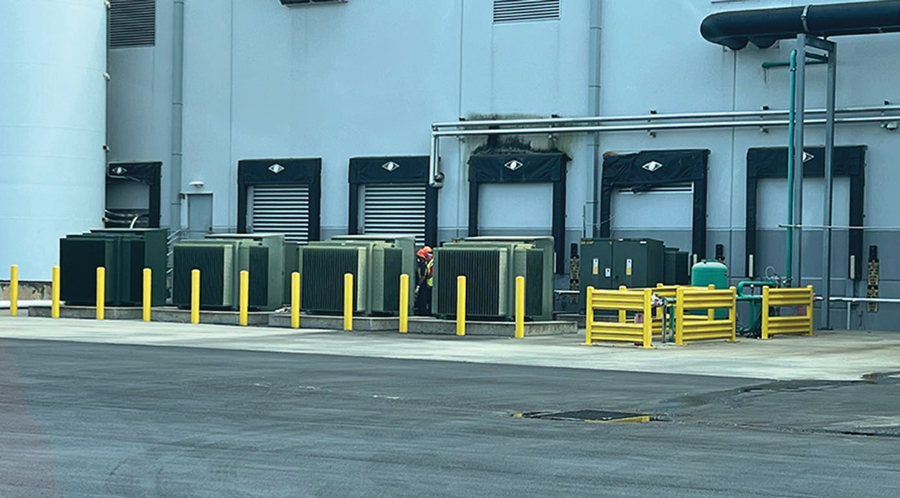
For nearly six years, OUC provided uninterrupted power to a large manufacturing plant in Orlando, thanks to infrastructure designed for maximum reliability. The plant was served by three dedicated underground feeders and 10 three-phase transformers, eight of which were 2,500 kVA units. These transformers were part of an engineered system featuring automation capabilities, such as auto-transfer switches that could switch to backup power sources within two seconds of a disruption. This setup was critical, as it ensured the manufacturer could operate without interruption—even during hurricanes and daily thunderstorms common in central Florida.
However, that changed in 2022 when the manufacturer experienced unexpected partial power outages and low-voltage events. These events caught the utility off guard, as the system had previously withstood numerous challenges—including Category 3 and 4 hurricanes such as Irma, Ian, and Idalia—as well as many tropical storms, without issue.
UNCOVERING THE CAUSE
OUC began a thorough investigation to pinpoint the cause, deploying temporary data loggers and pulling historical data from meters to discover why certain transformers were blowing fuses. While these tools were effective for basic monitoring, the utility needed more detail to diagnose the complex power quality issues. Because two meters were connected to the customer’s 10 transformers, providing data every 15 minutes, and the data loggers only held two weeks of data, OUC installed two power quality meters to gather more precise data.
With access to more data points, the utility discovered that three transformers linked to the outages were overloaded. However, it still required more information to understand the root cause of the issue. Seeking to understand the partial outages better, the utility visited with the plant engineer and discovered the manufacturer had recently installed an 800-hp compressor and an entire process line wired to a fully loaded transformer. Each time the compressor started, it brought the transformer well above its current rating and caused bayonet fuses inside the transformer to blow several times.
OUC continued using its older monitoring equipment and discussed transferring loads with the customer to improve load balance. At the same time, the utility discovered a solution that could obtain a real-time view of the customer’s power quality issues, especially the load profile, which could potentially help the utility to be more proactive and prevent problems.
REAL-TIME MONITORING
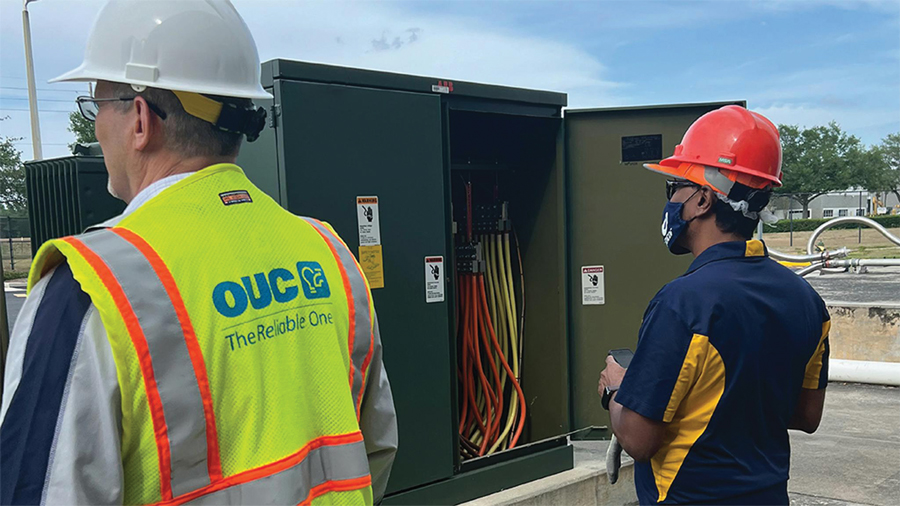
OUC learned from another utility about the distribution transformer monitor (DTM) and AI-driven asset management platform that it uses. During a planned outage, OUC installed the DTM units on the three overloaded transformers.
The impact was immediate, providing OUC with real-time transformer load monitoring, voltage, internal pressure, temperature, and dozens of other monitoring capabilities upstream, downstream, and in the transformer. For example, OUC can now monitor the customer’s load profile and see current spikes when a process starts. The utility can detect sags and harmonics, determine the origin and cause, and address them before outages occur or transformers are damaged.
Shortly after the units were installed, the manufacturer experienced another outage over the Christmas and New Year’s holidays. This time, OUC was equipped with real-time data, leading to a rapid diagnosis. An engineer was able to access the asset management platform from a laptop at home, pinpoint the cause down to the specific transformer and circuit—a blown bayonet fuse—and coordinate a swift response to restore power.
The information helped guide the field technician to the right transformer to replace the fuse without having to waste time inspecting all 10 transformers and coordinating with the customer to reenergize.
INSIGHTS FOR BETTER SERVICE
With real-time monitoring units, OUC can provide customers with valuable insights. For example, the ability to monitor overloaded transformers enables the utility to provide this information to the customer to improve load balancing. In turn, this improves reliability and extends the useful life of assets.
OUC can measure a wide range of grid and transformer health factors by monitoring primary current, secondary current, and secondary voltage 7,800 times per second to gain a more accurate picture of power quality issues. This enables measuring frequency, power factor, sags, swells, harmonic distortion, transients, and critical transformer health data such as temperature, pressure, load, pole tilt, and impact. Health reports are delivered every two minutes, and alerts are sent immediately by text or email.
OUC’s power quality team works closely with the manufacturer of its DTM units, establishing alert thresholds and reports while keeping the utility updated when new analytics capabilities are released.
CONTINUED EXPANSION AHEAD
Building on the success of the real-time monitoring units at the manufacturing plant, OUC plans to expand the technology to other commercial and industrial customers. Future deployments include applications at a new theme park with rides and hotels, and possible deployments at a growing number of small satellite emergency room (ER) facilities, where reliable power is critical.
ER facilities require a high level of power quality due to the sensitive nature of imaging equipment. This can be challenging because some facilities must be served with overhead feeders, making them susceptible to weather, vegetation, and wildlife. With new monitoring and analytics capabilities on distribution transformers, the utility’s power quality team is focused on the feeders to improve reliability.
The journey from a sudden power quality issue to a successful resolution demonstrates how continuous transformer monitoring can strengthen reliability and innovation. By embracing advanced monitoring technologies, OUC can ensure its customers receive the reliable service they depend on. As the utility looks forward, it sees the continued expansion of smart monitoring solutions playing a crucial role in maintaining and enhancing the reliability of Orlando’s power grid.
REFERENCES
- Electric Power Research Institute (EPRI). “Societal Costs of Power Quality Disturbances.” PQ TechWatch. July 22, 2022.
- Bhattacharyya, S. and S. Cobben. Technical University of Eindhoven in The Netherlands. “Consequences of Poor Power Quality — An Overview.” Power Quality. April 2011. doi.org/10.5772/13787.

Melvin Liwag is a Senior Engineer, System Planning and Reliability Engineering, at the Orlando Utilities Commission, establishing himself as an experienced electrical engineer within the electric utilities industry. With expertise in operations and construction management, Liwag excels in the distribution control center and trouble dispatch environment. Liwag holds a BS in Electrical Engineering from the University of Central Florida.