
Mose Ramieh’s article from the Summer 2026 issue of NETA World, “Passing the NETA Exam: Train, Don’t Cram,” makes a critical point: NETA certification exams do not simply measure what someone does every day in the field—they measure how well that person understands the work across the discipline. That distinction matters. Experience is essential, but experience alone is not a preparation strategy.
The NETA Electrical Testing Technicians (ETT) Roadmaps for Levels 2–4 provide a structured way to convert that message into action. Used properly, they help candidates move from generalized experience to deliberate development. They also reinforce an important reality: certification preparation is not a last-minute event. It is a staged process built on safety, technical fundamentals, standards awareness, field exposure, and consistent self-study.
START WITH THE ROADMAP, NOT THE CALENDAR
A common mistake is to begin by asking, “When can I take the exam?” A better question is, “What knowledge, skills, and abilities do I still need to build?” The roadmaps are valuable because they organize preparation by phases and milestones rather than by urgency.
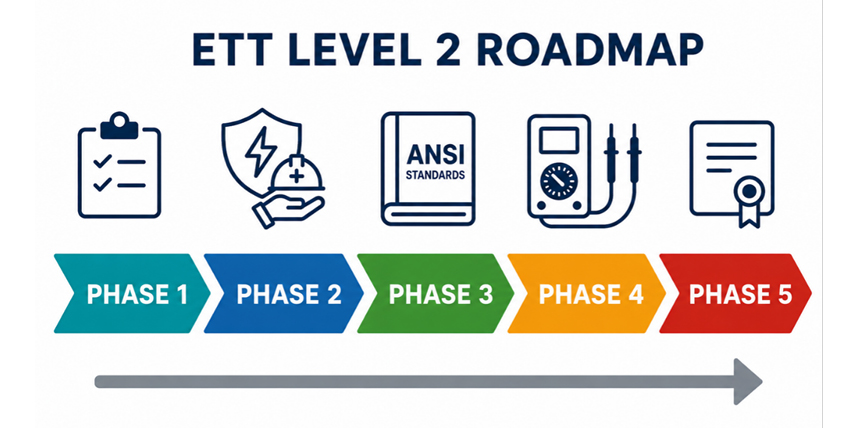
For Level 2, the roadmap presents a typical two-year progression. It identifies prerequisites, experience expectations, supervision requirements, and a phased process that includes onboarding, safety training, electrical fundamentals, hands-on field development, standards awareness, practice testing, and final exam readiness. While individual paths vary based on education, available training resources, and access to fieldwork, the roadmap provides a flexible framework that helps candidates and employers build disciplined progression.
That same principle applies across ETT Levels 3-4 Roadmaps. The roadmap should be treated as a development tool progression, not a checklist to glance at a few weeks before the exam.
USE THE DETAILED CONTENT OUTLINE AS YOUR ANCHOR
Ramieh emphasized that if a subject appears in the Detailed Content Outline, it is fair game on the exam. The roadmaps support that same approach by directing candidates back to the ANSI/NETA ETT outline and its four key domains: Safety, Electrical Testing Fundamentals and Theory, Component Testing, and Systems and Commissioning.
This is where customization begins. A candidate should review the outline and mark three categories:
- Strong areas — topics regularly performed and well understood
- Familiar but weak areas — topics seen in the field but not fully understood
- Blind spots — equipment, standards, math, or theory rarely encountered
That exercise is important because the exam is not limited to the equipment that a company most often tests. Ramieh specifically pointed to common gaps, including unfamiliarity with the apparatus, math skills, and a deeper understanding of the standards. The roadmaps help candidates address those gaps early enough for meaningful improvement.
BUILD THE PLAN IN PHASES
The strongest recommendation from the roadmaps is to prepare in phases. For Level 2, that progression is especially clear:
Phase 1: Initial training and work experience
Focus on company onboarding, required safety training such as NFPA 70E and OSHA, electrical testing fundamentals, and direct hands-on field experience. This is also the time to begin reviewing exam preparation resources and the certification outline.
Phase 2: On-the-job training and knowledge development
Use company training materials, complete NFPA 70B training, and gain practical exposure to acceptance testing, maintenance testing, and commissioning testing. Continue broadening familiarity with related standards such as NFPA, CSA, IEEE, ASTM F-18, and OSHA.
Phase 3: Fundamentals and self-study
Take the practice exam to gauge progress, identify weak areas, attend technical and safety training, and use the certification outline as a study checklist. Mentorship and peer study groups have become especially valuable here.
Phase 4: Advanced exam preparation
Commit to weekly study hours, retake the practice exam, target weak areas with focused training resources, and continue accountability through study partners or mentors.
Phase 5: Exam execution
Confirm eligibility with the NETA Accredited Representative, schedule the exam, and pursue the final push with realistic expectations. The roadmap notes that not all candidates pass on the first attempt and that growth often comes from gaining more knowledge and experience.
This phased structure supports Ramieh’s central message, that training over time is more effective than cramming at the end.
USE THE NETA ETT PRACTICE EXAM AS A DIAGNOSTIC TOOL
One of the most practical tools in the roadmap is the NETA ETT practice exam. It should not be treated as a score to admire or fear. It should be used as a diagnostic.
Ramieh noted that practice exams help identify where a candidate struggles and how questions are structured, but their real value comes afterward in the focused study that follows. He also cited a NETA review showing that technicians who completed the practice exam before the proctored test achieved a 30% higher pass rate than those who did not.
That matters for Level 2, and it matters even more as candidates progress toward higher levels. A good approach is simple:
- Take the practice exam once to establish a baseline.
- Sort missed questions by domain.
- Rebuild weak areas through study, field exposure, and mentoring.
- Retake the practice exam later to measure improvement.
The roadmaps specifically recommend taking the practice exam during the self-study phase and again during advanced preparation. That sequence helps candidates move from broad awareness to targeted readiness.
CUSTOMIZE THE ROADMAP TO THE CANDIDATE
The roadmaps are most effective when they are personalized. A customized plan should account for:
- Educational background
- Access to field assignments
- Available internal training resources
- Current exposure to apparatus and systems
- Strengths and weaknesses in math, theory, safety, and standards
For example, a candidate with strong field exposure but weak math skills may need short, consistent sessions focused on formulas and calculator use. A candidate who routinely works on only one equipment type may need intentional exposure to unfamiliar apparatus and systems. Another candidate may need deeper review of standards foundations and the purpose behind specific tests.
Ramieh’s article is especially useful here because it identifies the most common blind spots: safety, math, unfamiliar apparatus, and surface-level understanding of codes and standards. The roadmap provides the timeline; his article helps define where extra effort is often needed.
NETA ETT EXAM PREPARATION SEMINAR
For candidates looking to strengthen their preparation strategy, the NETA Exam Preparation Seminar available through the NETA Bookstore is an excellent supplemental resource. Presented at PowerTest 2026 by Dan Hook and Jim Cialdea, Chair and Vice Chair of the Technical Exam Committee, the seminar offers practical guidance on how to prepare for the next level of NETA ETT certification with greater structure and confidence.
The training covers proven study approaches, effective use of the Detailed Content Outlines, reference lists, formula sheet, exam roadmaps, and the practice exam, along with practical test-taking strategies such as pacing, flagging difficult questions, writing out formulas and circuit sketches, and using field experience and standards study together.
For technicians serious about advancing, this seminar provides direct insight from technical leaders closely involved in the exam process and is a valuable tool for turning day-to-day experience into focused exam readiness.
PRACTICAL RECOMMENDATIONS FOR TECHNICIANS AND EMPLOYERS
To get the most value from the roadmaps, candidates should:
- Review the roadmap at the start of the preparation cycle, not near the end.
- Align training activities with the four exam domains.
- Schedule recurring study time in short, consistent sessions.
- Use the practice exam to identify weaknesses, not just to estimate passing potential.
- Combine classroom learning with hands-on field exposure.
- Build mentorship and peer accountability into the plan.
- Watch the Exam Preparation Seminar from the NETA Bookstore.
- Revisit the roadmap periodically and adjust based on progress.
Candidates should not prepare alone if support is available. The roadmap explicitly points to mentorship, peer study groups, company training resources, on-demand training, and apprenticeship pathways. That is consistent with Ramieh’s reminder that while no one else can do the work for you, you do not have to figure it all out alone.
THE ROADMAP IS A TRAINING SYSTEM
The NETA ETT Roadmaps are more than scheduling aids. They are structured preparation frameworks that help candidates develop competence in the same deliberate way the exams are designed to measure it. When combined with the Detailed Content Outline, on-the-job learning, standards-based study, and the NETA ETT practice exam, they provide a practical path from exposure to understanding.
That is the real connection to Train, Don’t Cram. Candidates who use the roadmaps well are not just studying to pass an exam. They are building the habits, knowledge base, and technical judgment that support safer work, stronger performance, and long-term growth in the electrical testing field.

Dan Hook is NETA President and Chair of the Technical Exam Committee, and Vice President of GCBS Engineering Services and Solutions at CBS Field Services.