
Within the commercial and industrial renewable energy sector, few terms have garnered more attention lately than the system label “microgrid.” This article provides an overview of microgrid fundamentals: what a microgrid is and what it can do.
WHAT IS A MICROGRID?
The answer depends on who is asking and answering. From our experiences, we’ll stipulate that most microgrids share these four features—all within a defined boundary:
- Distributed energy resources (DERs). Local (on-site) energy storage and generation sources can function independently from the centralized, bulk power supply infrastructure.
- Islanding capability. The system is ready to operate independently of the grid and can transition predictably between grid-interactive and islanded modes.
- Electrical loads. The known sets of loads served in grid-interactive and island modes.
- Dispatchable energy source. One or more DER can be dispatched at will to serve the electrical load.
This description may feel too general, nondescript, or incomplete, especially to those who are already actively developing, designing, owning, or operating microgrid systems in the commercial and industrial market space. Let’s take a closer look at each in turn.
To elaborate on the DER’s condition, as third-party consultants or engineers-of-record, we predominantly work with the latest inverter-based resources, such as solar photovoltaics, lithium-ion battery energy storage, and generators (Figure 1).
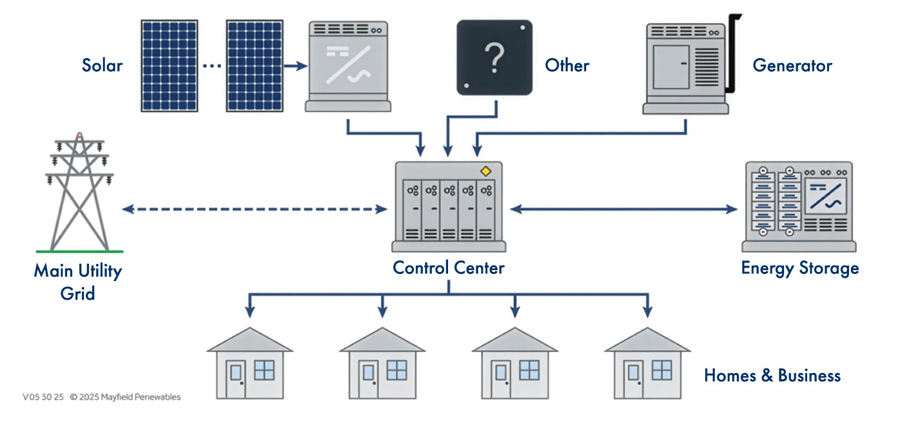
Yet, with an eye for any energy future that includes a diverse abundance of renewable energy solutions, any good microgrid definition should consider proven technologies such as fuel cells, modular nuclear reactors, turbine-based assets, and any number of non-lithium storage technologies, including compressed air, redox flow-battery, thermal systems, pumped hydro, flywheels, and others. Notice that a simpler system consisting of loads, a generator, and proper controls for islanding capabilities could meet this four-part definition of a microgrid. This working definition is intentionally open-ended to accommodate all possible DER combinations.
ISLANDING
Some off-grid energy systems in remote areas far from the bulk energy grid demonstrate #1, #3, and #4 above, but are not designed for grid interaction and are always islanded. We do not exclude these types of systems from the rest of this article; however, based on our experience, they are more the exception than the rule.
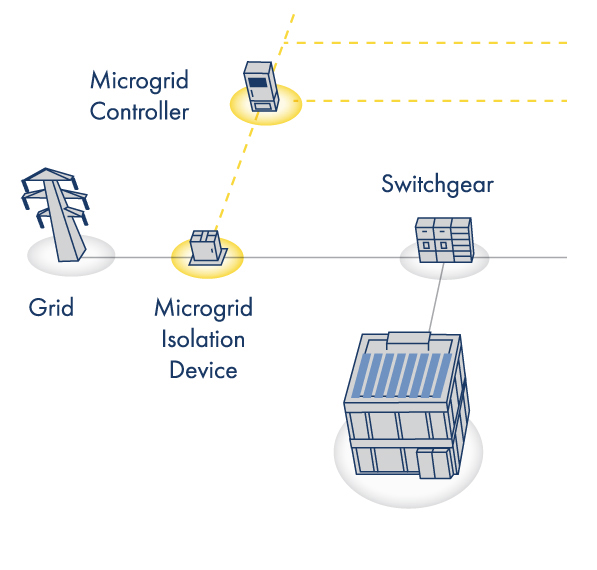
In most cases, the transition from grid-interactive to islanded and back again to grid-interactive is a key feature of microgrid design (Figure 2). However, this transition can present significant design challenges and considerations. Questions may include:
- How quick is the islanding transition?
- Can I avoid having to black-start my motor loads?
- How do I integrate a generator or an uninterruptible power supply (UPS) with a BESS, and which turns on first?
- Who defines and programs the sequence of operations if PV, BESS, and a generator are talking to each other?
BACKUP LOADS: WHICH ONES, HOW MANY, AND FOR HOW LONG?
At the outset of a microgrid feasibility study, it’s vital to align expectations among client(s), design team(s), and other stakeholders on load selection and preliminary resilience targets. Optimizing a microgrid design to meet a facility owner or operator’s specific resilience targets—whether in hours, days, or weeks—is usually accomplished by a) reducing the amount of load the system needs to serve for some or all of the resilience period; b) increasing energy generation and storage capacity; or c) both. Let’s spend a little time looking at load selection.
Schemes for managing backup loads can range in complexity. Perhaps you’re committed to a full-facility backup, or you are tasked with backing up a whole campus. An example is shown in Figure 3.
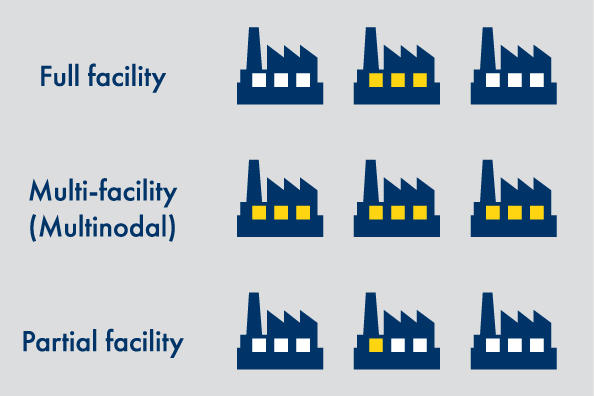
In a partial-facility backup design, the loads the facility cannot do without during an outage can be aggregated separately from loads that the facility operator might afford to leave unpowered.
In Figure 4, backup loads are aggregated in two backup load panels that can be isolated from the grid with the inverter bypass switch. During an outage, only the backup loads will receive power from the PV and BESS.
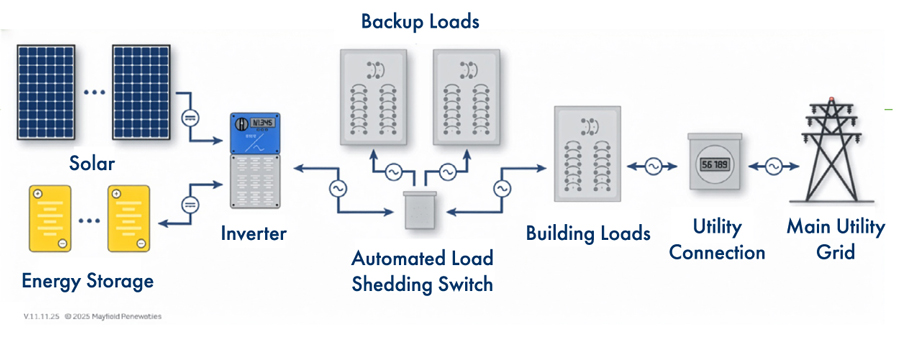
Taking load management one step further in complexity, what if I want to provide full-facility backup for as long as possible but also have the flexibility to remove some loads to extend the resilience period if needed? There could be any number of reasons to reduce load to the most important ones. When the time is right, a microgrid controller, contactors and relays, and subsystem controllers can be programmed and coordinated to shed predetermined sheddable loads in order to keep the most important loads powered. Consider load shedding based on battery state-of-charge (SOC) as one example, shown in Figure 5.
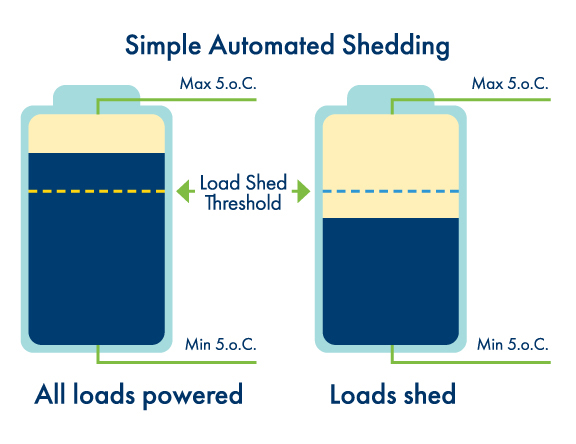
Within the usable energy capacity of a BESS, an SOC threshold can be designated to initiate load shedding. Here, the microgrid will transition from full-facility backup to partial-facility backup when SOC falls below a programmed threshold.
Here’s what programmable load shedding can look like in a single-line diagram (Figure 6). In this case, our microgrid includes solar PV (generation), BESS (storage), a grid isolation device (islanding), and two groups of loads (primary backup and sheddable loads).
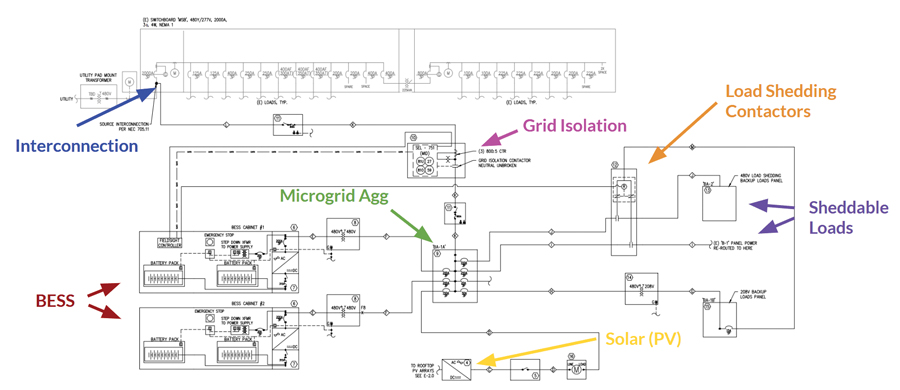
This microgrid system has two backup behaviors: full-facility and partial backup. During full-facility backup, non-sheddable loads (see Microgrid Agg panel in Figure 6), as well as the sheddable loads to the right side of the diagram, receive power. When the load-shedding threshold of the BESS SOC is reached, the load-shedding contactors, in communication with the controller integrated into the BESS, will transition from serving all loads to serving only the key loads located in the Microgrid Agg panel.
Lastly, as with many microgrid design considerations, note that the microgrid backup load management discussion can become more complicated and more dynamic. We described just one example above, but sophisticated market solutions can use real-time data to manage a load-shedding schedule algorithmically. In all cases, determining which loads will be backed up is a vitally important question to ask as early as possible in the microgrid design process.
DISPATCHABILITY OF ENERGY AND ENERGY STORAGE
The final important reminder is that energy storage is needed to fully leverage the benefits of any microgrid. It may not be obvious, but a system with only PV has little control over the exact timing of energy generation, as these kilowatts are intermittent in nature. Energy generation sources that are paired with storage become dispatchable and can fully optimize intermittent generation sources by storing otherwise curtailed PV energy. What’s more, modern BESS products can stack multiple functions to accelerate a project’s ROI and add more value to the broader grid.

TYSON BITTRICH joined Mayfield Renewables, Inc. in 2023, and he is currently an Engineering Consultant, helping lead initiatives in education curriculum development and microgrid feasibility modeling. Bittrich is a member of the Sustainable Energy Action Committee’s ESS Standards Working Group. He holds an MA in philosophy and a BS in renewable energy engineering from Oregon Tech.