

Sigma C and MVA Collaborate to Help Avoid a Prolonged Outage
In today’s power industry, maintaining transformer reliability requires more than a single test or diagnostic technique. The most effective asset management programs combine oil analysis, electrical testing, engineering evaluation, and field service expertise to provide a complete picture of equipment condition.
A recent project at a customer generation plant in New England demonstrates how collaboration between Sigma C Power Services, a NETA Accredited Company, and MVA, a NETA Corporate Alliance Partner specializing in transformer services helps customers identify emerging issues, execute critical repairs, and avoid potentially catastrophic outages.
A PLANNED OUTAGE WITH AN UNEXPECTED DISCOVERY
During a spring outage, Sigma C Power Services was requested to perform comprehensive maintenance testing at the plant, which included testing a 1999 226-MVA generator step-up (GSU) transformer. The transformer is 17.6 kV to 115 kV and contains approximately 14,400 gallons of insulating oil.
As a NETA Accredited Company, Sigma C conducted testing in accordance with ANSI/NETA MTS-2023, Standard for Maintenance Testing Specifications for Electrical Power Equipment and Systems. The objective of the maintenance program was to verify that the transformer remained operational, within manufacturer tolerances, and suitable for continued service. The maintenance scope included insulation resistance testing, winding resistance testing, turns ratio testing, power factor testing, capacitance testing, and other electrical diagnostic procedures outlined in the ANSI/NETA maintenance testing standard.
OIL DIAGNOSTICS INDICATED A HEALTHY TRANSFORMER
Sigma C utilizes MVA’s oil testing laboratory for all oil analysis for its customers. Previous oil test results for this transformer indicated no historical internal faults generating gases. The transformer remained in IEEE Std. C57.104 Status 1 condition and all oil-quality tests met the requirements of IEEE Std. C57.106 for continued service. From an oil diagnostics perspective, the transformer appeared healthy and suitable for continued operation.
This serves as an important reminder that dissolved gas analysis (DGA) is primarily designed to identify faults within the transformer’s insulation system, windings, leads, connections, and oil-paper insulation. While DGA remains one of the most powerful predictive maintenance tools available, not every developing problem will generate detectable gas signatures.
That is why a comprehensive maintenance strategy must include both oil diagnostics and electrical testing.
ANSI/NETA TESTING REVEALED A CRITICAL PROBLEM
While the oil analysis showed no indication of internal problems, Sigma C’s electrical testing uncovered a significant issue involving the transformer’s 115-kV high-voltage bushings.
Power factor and capacitance testing identified deterioration in all three high-voltage bushings. The H1 bushing exhibited the most severe condition, with a power factor value that had increased approximately 168% above its nameplate value. The H2 and H3 bushings also showed significant deterioration, with values exceeding nameplate readings by more than 80%. Under ANSI/NETA MTS-2023 guidelines, these results warranted investigation and corrective action, and Sigma C recommended replacement of the bushings.
The findings demonstrated exactly why NETA maintenance testing plays such a critical role in transformer reliability programs. Although the transformer oil showed no evidence of an active fault, the electrical condition assessment identified a developing reliability issue that could have eventually resulted in an in-service failure.
Bushing deterioration frequently develops independently of transformer oil conditions that are not detectable through routine DGA. Without the power factor and capacitance testing performed by Sigma C, the condition could have remained undetected until a future failure occurred.
FROM DIAGNOSTICS TO ACTION
Once the failed bushing was identified, the outage quickly shifted from routine maintenance to repair planning.
The power plant had only one spare high-voltage bushing available onsite. While that spare allowed immediate replacement of the most severely deteriorated H1 bushing, the repair itself was far more involved than a simple bushing changeout.
Because of the bushing design, replacing the bushing required draining the transformer. Due to the transformer’s age, there was concern that the gaskets would not withstand the vacuum force during final filling of the transformer. The force from the vacuum could flex the tank inward, and if the gasket failed while pulling vacuum, the transformer would be at risk for drawing in moisture that accumulates in the insulation. The second concern is that after re-filling the transformer, leaks could form from where the aged brittle gasketed failed.
The customer understood the risks and made the prudent decision to re-gasket the transformer. Re-gasketing the transformer did not require much additional time, but the outage schedule was already established, and extending the outage would have created significant operational and financial challenges for the facility.
At that point, Sigma C’s customer needed more than diagnostics and recommendations. They needed a transformer service company capable of mobilizing immediately and executing the repair within the allocated outage window.
MVA MOBILIZIES
After the failed bushing was identified, MVA Services mobilized personnel and equipment to support the repair effort.
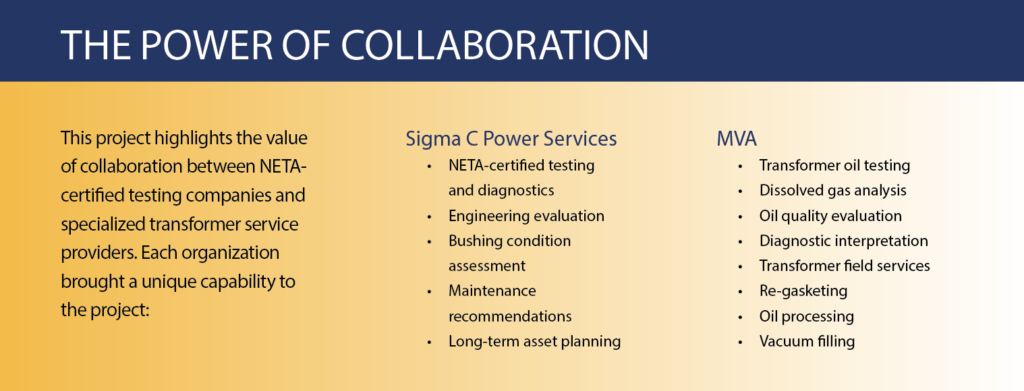
Working closely with Sigma C and the plant maintenance team, MVA developed and executed a repair plan that allowed the work to be completed without extending the scheduled outage. The project scope ultimately included:
- Complete transformer re-gasketing
- High-voltage bushing replacement
- Oil circulation and processing within the storage tank
- Heat run under vacuum to dry out the insulation
- Final vacuum and vacuum fill
- Post electrical testing
- Return-to-service support
The transformer was exposed to the atmosphere while performing the repair, and because of the age of the unit, MVA recommended performing a heat run to circulate hot oil while under vacuum. This process involves filling the transformer to approximately 50% of its oil volume while maintaining a vacuum below 1,000 microns. Once filled, the oil is circulated from the transformer, through oil processing, and back to the transformer until the incoming oil temperature to the oil processing rig is 50°C. At that point, the oil is drained while maintaining vacuum.
After the oil is removed, the transformer will begin final vacuum. The heat run is very important because, as pressure is removed from the transformer while pulling vacuum, the temperature drops within the transformer tank. Eventually, it will fall below 0°C, where it is very difficult to remove moisture from the insulation. By performing the heat run under vacuum, the temperature will be maintained in the core and coil during final vacuum because of the difficulty in transferring the energy to the tank walls. This allows the moisture to continue to flash off from the insulation while under final vacuum. This additional work helped ensure moisture, gases, and contaminants were removed prior to energization.
Despite the compressed schedule and expanded scope, all work was completed within the plant’s allocated outage window, allowing the transformer to return to service on schedule.
PROACTIVE PLANNING PREVENTATIVE A FUTURE OUTAGE
While replacing the failed H1 bushing addressed the immediate concern, Sigma C recognized that the issue extended beyond a single component.
Testing results clearly showed that all three high-voltage bushings were exhibiting elevated power factor values. Although only one spare bushing was available during the outage, Sigma C recommended replacing the remaining bushings and advised the customer to immediately order a complete replacement set.
Consistent with challenges experienced by utilities and power producers in recent years, the power plant faced extended lead times for high-voltage transformer bushings. Procuring replacement bushings ultimately took ten months.
After the initial outage, the remaining two high-voltage bushings were replaced during a follow-up planned maintenance outage. As with the original repair, the work required opening the transformer and performing a complete vacuum fill process to ensure the insulation system was returned to service in optimal condition. Because the transformer had undergone a complete re-gasketing and heat run during the initial outage, it was recommended not to perform those steps for the replacement of the other two primary voltage bushings, saving money for the customer.
The value of that proactive planning cannot be overstated. Had the deteriorated bushings remained in service until a failure occurred, the plant could have faced an unplanned outage, extended generation losses, emergency procurement challenges, and potentially significant collateral damage to a critical GSU transformer.
Instead, the issue was identified through routine maintenance testing, replacement components were secured before they became critical, and the repairs were completed under controlled conditions. What could have become a major reliability event became a planned maintenance activity.
Together, these capabilities provided the customer with a complete solution—from identifying the problem to executing the repair.
A MODEL FOR RELIABILITY-CENTERED MAINTENANCE
As the transformer fleet across North America continues to age, successful maintenance programs will increasingly depend on combining multiple diagnostic disciplines with experienced field execution.
Testing identifies problems.
Diagnostics help explain them.
Field services solve them.
CONCLUSION
This project demonstrates how ANSI/NETA MTS-2023 testing, transformer oil diagnostics, engineering evaluation, and rapid field execution work together to protect critical assets.
Sigma C’s testing program identified deteriorating bushings before a catastrophic failure occurred. Their recommendation to immediately order replacement bushings enabled the customer to overcome extended industry lead times and avoid a potentially prolonged outage. MVA’s oil testing confirmed the transformer itself remained healthy internally, while providing the field expertise necessary to execute both the initial repair and the subsequent bushing replacement project.
The result was a successful outage, a repaired transformer, a proactive long-term maintenance strategy, and a happy customer who avoided what could have become a costly and disruptive reliability event. That is the true value of partnership.