
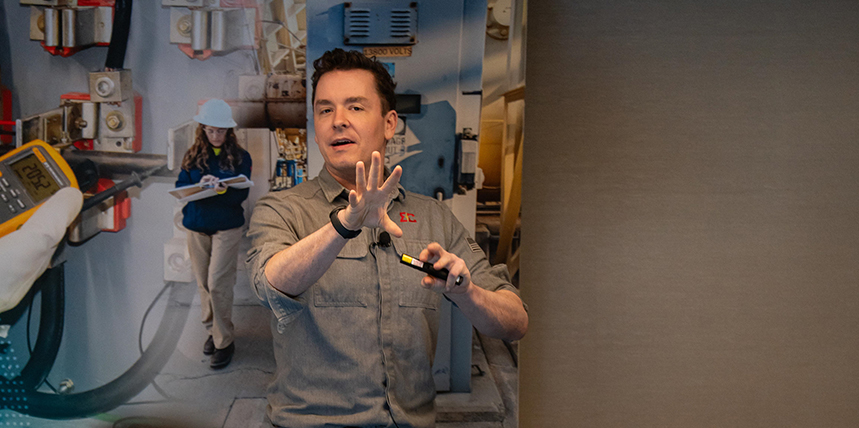
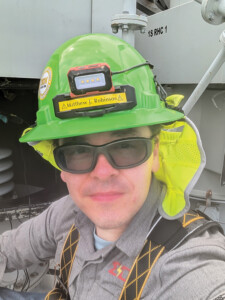
This issue of NETA World’s “Insight and Inspiration” series features Matt Robinson, Director, Safety and Training at Sigma C Power Services. His current role includes the safety and well-being of all personnel within the organization and the responsibility for safe, high-quality operations of the company. In addition to safety, Robinson’s duties make him responsible for the technical and professional development of the organization’s employees. Robinson earned BS and MS degrees in electrical engineering from Northeastern University and is currently pursuing a DEng at Penn State with a focus on workforce development within the American power industry. He is a NETA Level 4 Certified Senior Technician.
NW: How long have you been in the field, and what was your path to your current position?
Robinson: I have been in the field in some capacity for 25 years, starting with my apprenticeship to the electrical department of a large commercial facility the summer after my freshman year of college. I was going to school for electrical engineering, but the shop foreman saw something in me and wanted to challenge me. His words were along the lines of, “So, you’re going to school for engineering? A lot of engineers spend their whole lives designing installations without ever seeing the real-world issues that go into actually building what they have put on paper. I’m going to make sure you’re different. You’re going to build, and I hope that will make you a better engineer.” It’s amazing to consider the little nudges that aggregate into an overall career trajectory.
I spent that summer hammering out floor boxes, rewiring cubicles, running conduit, pulling cable, hanging fixtures, replacing ballasts, changing breakers, and dealing with a never-ending flood of tickets from people tripping off panel breakers by running space heaters under their desks during the summer. My university’s co-op program offered a six-month class/six-month work rotation after freshman year, and I convinced my advisor that doing my current job for another six months to start my sophomore year would be an excellent use of my time. I worked all three co-op rotations under that same foreman, but my advisor and the people I worked with pushed me to broaden my horizons and seek out additional opportunities instead of getting too comfortable where I was.
Leading up to my final co-op rotation, we gave presentations on our experiences and shared our reflections on the program with the freshmen coming into the program. These presentations were attended by several potential employers who used co-op students as a direct pipeline to full-time hire. A manager from CDM attended who attended, said he had a position to fill and was having a hard time finding the right candidate from the students they had interviewed. He hired me—another nudge and lucky circumstance.
The position was for a division taking on special projects that the rest of the electrical discipline had no interest in or no expertise to pursue. This included cogeneration, system stability, reliability, coordination, and a host of other system studies I had never touched during my undergraduate degree. My mentor and I were a team of two. He encouraged me to read, pursue my master’s degree, research, learn to learn, and get out into the field to get a complete picture of the system I was trying to assess. I earned a reputation for taking every opportunity to get hands-on experience with the equipment I was designing or investigating. Eventually, I wanted more opportunities in the field to apply my engineering degree in a practical way, and I was hired for an engineering position at 3C Electrical. This became my introduction to the world of NETA.

NW: What attracted you to the electrical testing field?
Robinson: I’ve always loved the practical diagnostic aspects of testing, disassembling, and testing equipment to determine not only the current condition, but also to trend over time and predict future performance. There is something about taking the raw information our testing provides and interpreting it into a discrete set of actions that feels almost magical to me.
NW: Who influenced or mentored you along the way?
Robinson: I’ve been fortunate to have several: Darryl McDonald, the electrical shop foreman who saw my potential and wanted to make me a better engineer; Syed Peeran, my mentor at CDM who taught me how to learn and pushed me to do more academically in my first year of working with him than I had done in my previous 22 years combined; and Sarah Salgueiro, who taught me how to teach and opened my eyes to a world of educational design that I have only begun to tap. Finally, Jim and Stephen Cialdea, Jeff Mannis, and Mike Roach, all who spent so much time helping me find my way and supported my growth into who I am today.
NW: What about this work keeps you committed to the profession?
Robinson: For me, it’s the spark when I see someone get it. It’s when a junior technician connects the principles we’ve covered to the testing they just completed, or when a more senior-level person understands why their power factor results can change so much depending on where they connect their ground. I really believe in Feynman’s Razor: “If you cannot explain something in sensible, accessible terms, then you truly don’t understand it.” I live by that maxim. If I haven’t been able to relate the concepts of a certain test or work to a technician, it means I have more work to do in terms of learning it for myself.
NW: How did you transition from engineering to training?
Robinson: At 3C, I quickly learned what it meant to work the full lifecycle of electrical installations, from design to installation, maintenance, and retirement. My first few years with the firm were eye-opening. I also had the opportunity to start teaching at a local university, which ignited my passion for training and professional development. 3C was purchased by CE Power, which became Qualus, and I had the opportunity to transition to the Qualus University training and development team in 2020.
While I had been teaching for seven years and had hosted several learning seminars before joining the training and development team, my introduction to the team is where I really began to learn about learning, specifically approaches and structures to support adult learning and improve outcomes. This was a period of intense study for me. I had to let go of everything I thought I knew about education and go back to the basics. These years of mentorship were some of the most important for my professional development. I sadly had to say goodbye to my role at Qualus due to a change in family circumstances and later moved on to my current position at Sigma C Power Services, where I can train and develop our staff to my heart’s content.
NW: How does your early field experience improve your teaching?
Robinson: That foreman was absolutely right. Seeing how things went together gave me a thorough education on how the work should be done. The field experience, the lessons learned, the triumphs, and most importantly, the failures, are all things I can and do pass on in every lesson. Not everything gets through to everyone I teach, but relating the concepts I’m teaching to real-world applications—and more importantly, real-world examples of things gone wrong—is an invaluable tool for helping people avoid those same pitfalls while passing on the valuable tribal knowledge that seems to be leaking out of our industry.
Those early experiences are the ones I most want to share, so when I had a chance to get involved with NETA’s QEMC/QEMW program and teach some of the first client-facing QEMW prep courses, I jumped at the opportunity. Being in front of technicians at the very start of their journey and passing along the insights I wish I had early in my career is a lot of fun for me. My teaching style uses a lot of self-deprecation, so I don’t mind sharing the mistakes I made in a fun, light-hearted way. It is a good tool to show technicians that mistakes are a way of learning, but that learning from someone else’s mistakes is a lot less painful.
NW: What is the biggest challenge for meeting the rising demand for energy?
Robinson: The mismatch between energy demand and infrastructure will be the elephant in the room for the coming generation of energy workers. The pipeline of power professionals has dwindled to almost nothing, companies regularly poach senior talent from each other in an ever-narrowing labor pool, and the demand for workers continues to increase. The rate at which the industry is growing is already unsustainable, and unless we make a major change in how we educate and develop our power and energy professionals, I believe we will experience a major bottleneck to innovation and development.
NW: What advice would you give a young person interested in joining the electrical testing industry?
Robinson: “Hey kid, want a job that pays well, offers tremendous job security, and won’t be replaced by AI until the robots have taken over the world?” In all seriousness, I strongly recommend this industry. It has proven to be recession-proof and AI-proof, and it offers tremendous upward mobility. To anyone who takes this path, never stop learning. Opportunities to add certifications, degrees, capabilities, and skills to your repertoire are always available. Many companies offer tuition reimbursement, upskilling, or development programs. Take advantage of as many as you can. Your investment in education and development early in your career will pay dividends you cannot imagine down the road.