
EPIC26 convenes this October in Fort Worth, Texas, bringing together leading organizations, industry experts, and power professionals to explore the trends shaping the electrical power landscape over the next 5, 10, and 20 years. With a focus on strengthening resiliency, advancing safety, and preparing for a rapidly evolving grid, the conference offers a forward‑looking forum for insight and innovation.
Artificial intelligence has moved decisively into the mainstream of the power industry. Once viewed as a future‑leaning experiment, AI is now a practical tool reshaping how companies plan, operate, and maintain electrical infrastructure. With rising demand for power, increasing system complexity, and a constrained workforce, organizations are turning to AI to scale expertise, accelerate decision‑making, and improve reliability. The industry is entering a period where thoughtful AI adoption is becoming essential to staying competitive and meeting the expectations of modern power consumers.
AI AS AN OPERATIONAL ACCELERATOR
Across the sector, AI is already delivering measurable improvements in efficiency and productivity. Companies are applying AI to quoting, scheduling, dispatching, and reporting, reducing administrative burdens and enabling smaller teams to accomplish more. These tools streamline workflows, minimize delays, and support more consistent service delivery.
AI‑powered knowledge systems are transforming field troubleshooting. By consolidating institutional manuals, historical failures, and best practices into instantly accessible information, technicians can diagnose issues faster and arrive on‑site better prepared. Route optimization tools reduce travel time and fuel use, while automated reporting cuts hours of manual documentation. By shifting repetitive, low‑value tasks to AI systems, organizations free technicians and engineers to focus on higher‑value work—an essential advantage in a labor‑constrained environment.
KNOWLEDGE CAPTURE, WORKFORCE EMPOWERMENT, AND TRAINING
AI is emerging as a powerful mechanism for capturing and distributing institutional knowledge. As experienced technicians retire, AI systems help preserve decades of expertise, making it accessible to apprentices and junior engineers. Machine learning models can identify patterns—such as partial discharge signatures or transformer degradation indicators—that traditionally required long-term field experience to recognize.
At the same time, workforce development remains critical. Younger workers may adopt AI tools intuitively, but experienced technicians benefit from structured onboarding that emphasizes interpretation, judgment, and understanding the limitations of automated recommendations. High‑quality data, contextual awareness, and human oversight remain essential to ensuring AI outputs are accurate and actionable.
AI is also reshaping the skill profiles of field roles. Networking, communications, and cybersecurity competencies are becoming increasingly important as digital and electrical power systems converge. The technician of the future will be as comfortable navigating digital platforms as electrical schematics.
SAFETY, RISK MANAGEMENT, AND CYBERSECURITY
Safety remains the industry’s foundational priority, and AI must be integrated in ways that reinforce—not replace—human accountability. AI can support decision‑making, but it cannot assume responsibility for safety‑critical actions. Over‑reliance on automated recommendations can lead to skill degradation, misinterpretation of outputs, and unsafe decisions. Human verification and traditional skills remain essential safeguards.
Cybersecurity considerations are equally important. As systems become more connected, the attack surface expands. AI can strengthen defenses by detecting anomalies and analyzing large datasets, but adversaries are also leveraging AI to increase the sophistication of their attacks. Tiered, role‑based access to data and systems is essential, along with governance frameworks that ensure AI tools operate within clearly defined boundaries. Criticality assessments help determine where AI can be safely applied and where tighter controls are required.
AUTONOMY, ACCESS, AND GOVERNANCE
While AI can analyze, classify, and recommend, full autonomy is not appropriate for most power applications today. Human‑in‑the‑loop governance remains essential. AI tools should support decision‑making, not replace it.
Access to data must be granular, not universal. Tools such as Microsoft Copilot and other AI‑driven platforms can be highly effective for internal analysis, but only when paired with clear data classification and human judgment. Governance frameworks must ensure transparency, traceability, and accountability in how AI recommendations are generated and used.
CUSTOMER EXPERIENCE AND BUSINESS IMPACT
AI is also reshaping the customer experience. Automated specification reading and proposal summarization free engineers to focus on solution quality rather than administrative tasks. Improved data analysis leads to clearer, more actionable recommendations for customers.
Transparency remains essential. Customers must understand how AI‑informed decisions are made, and organizations must communicate clearly about how AI supports—not replaces—the engineering process. When used effectively, AI enhances both service quality and customer trust.
FUTURE OUTLOOK: THE NEXT 5 TO 10 YEARS
AI adoption in the power industry is expected to accelerate rapidly in the coming decade. Several trends are likely to shape the future:
- Remote monitoring and predictive maintenance will reduce emergency service calls and enable more proactive asset management.
- Centralized monitoring hubs will oversee larger geographic areas, supported by AI‑driven analytics.
- Technicians will require higher‑level digital skills, particularly in interpreting AI insights and managing interconnected systems.
- Innovation cycles will shorten, with tiered AI adoption ranging from basic automation to advanced predictive modeling.
These developments will fundamentally reshape how power systems are designed, monitored, and maintained. Organizations that invest in AI readiness—technologically and culturally—will be best positioned to navigate this transformation.
CONCLUSION
AI is transforming the electrical power industry, offering unprecedented opportunities to scale expertise, improve efficiency, and strengthen reliability. Its success, however, depends on thoughtful integration, disciplined governance, and a steadfast commitment to human oversight. Organizations that treat AI as a partner—rather than a replacement—will be best equipped to meet rising demands while preserving the safety, reliability, and craftsmanship that define the profession.
By combining the strengths of human judgment with the speed and scale of AI, the industry can move confidently into a future defined by innovation, resilience, and smarter power systems.
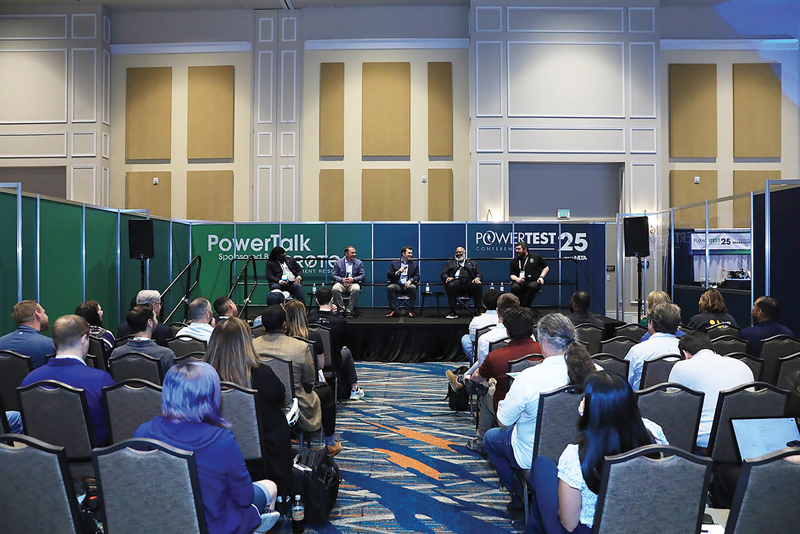
Article content credited to PowerTalk Stage Panelists:
Christopher Campbell, JCL Energy
Ben Clark, LUMA Energy
Theron Hill, IBEW 291
Keon McEwen, Black & Veatch
Darwin Newton, Siemens