

I sat down for my NETA Level 4 exam and immediately realized I was in trouble. The first question, I didn’t know the answer. The second, totally clueless. After working through nearly twenty questions, I finally found one I could confidently answer. That is not a great feeling when you are supposed to be operating at the highest level in your field.
A DIFFERENT KIND OF TEST
I had more than ten years of experience. I had been in the field, performed the tests, and built a level of confidence that I thought would carry me through. It almost did not. I was able to recover and pass, but it exposed something I’ve seen repeatedly since that day: The NETA exam doesn’t evaluate what you do every day, It evaluates how well you understand it.
What the NETA Exam Really Is
One of the biggest mistakes technicians make is assuming the exam will reflect their daily work. It doesn’t. The exam is built around the entire discipline of electrical testing. It is not based on your company’s scope or your personal experience. If it is in the Detailed Content Outline (DCO) of the NETA exam preparation materials, it is fair game.
You’ll be tested on things you do not perform regularly. You will be tested on apparatus you have not touched in years, or ever (e.g., network protectors)! And you will need to apply electrical power system knowledge and testing skills.
This is not a memorization exercise. It is validation that you understand how electrical testing works across a broad range of equipment and situations. It is designed to confirm that you understand the appropriate amount of “why” behind the work, not just the “how.”
WHY GOOD TECHNICIANS STRUGGLE
The technicians who struggle the most are often the ones you would expect to pass. They have years of experience, they know common power system equipment, and they perform their work well. And that’s exactly the problem; they rely too heavily on experience and underestimate the difficulty presented by proper preparation.
In the field, experience allows you to be efficient and move on to the next device or project. The exam requires you to peel back the anticipation of passing or failing results and explain them. The exam does not measure what you have done repeatedly. It measures your depth of understanding across the entire electrical discipline. Any shallow areas show up quickly when a question is presented in a way that requires explanation instead of recognition.
There is a difference between becoming more experienced and becoming better. Experience builds familiarity. Improvement requires effort, curiosity, and a willingness to move beyond what you already know. The exam makes that difference obvious and separates those who pass from those who don’t.
WHERE THE GAPS SHOW UP
Most technicians do not fail because they lack intelligence or a work ethic. We all know that guy who is the go-to individual to get a project done. However, they may struggle because of gaps they do not know they have.
Let’s get tactical here and point out the biggest gaps technicians are unprepared for.
Safety
It’s the classic complaint from every technician who didn’t pass the exam: “I only missed it by a couple of questions.” When they get the full breakdown of the results, it shows that they did not get 100% on safety-related questions. Table 1 shows average performance results across content areas on actual exams.
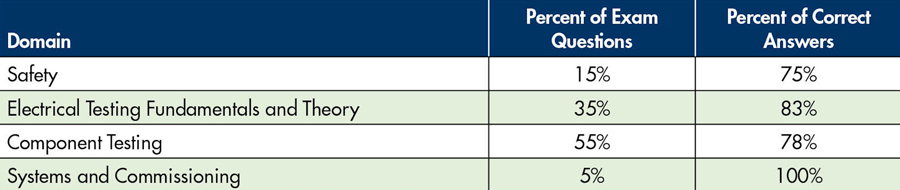
This points out an opportunity: The industry focuses tirelessly on safety, and you must be prepared to nail all the safety questions! While we talk about safety almost every day on the job, there are specific things we must review before the exam:
- PPE use and limitations (e.g., insulated gloves, hard hats)
- Procedures and requirements related to lockout/tagout
- OSHA and NFPA 70E standards and their requirements
Math
Math skills are the most common problem area, not because technicians have never seen the required math, but because they do not use it every day. Without use, any skill becomes rusty, and math is no exception. Be honest; when was the last time you added resistors in a series-parallel circuit to create the equivalent circuit and then calculated the current flow? Or had to calculate the power factor of a power system, knowing only the KW and an angle of 22 degrees?
The assumption that can creep into your math skills is that you know it well enough to get through the problems. However, on a two-hour, 100-question exam, you have 1.2 minutes per question. Any delays or uncertainty will cost you valuable time.
This means that if you aren’t proficient in the necessary math skills, a simple problem becomes a time suck. The exam writers are challenged to provide great distractors (the wrong answer) from the correct answer on the exam. This means that if there is a common math mistake, like forgetting to use the square root of 3 in your calculations, the exact answer you calculated will be on the test, but it will be wrong. This potentially leads you to think you have the correct answer and move on to the next question.
The internet, modern test equipment, and now AI have changed the way we work with math. With your phone in your hand, you are a second away from the answer to the most advanced math calculations ever imagined in our industry. You enter a transformer’s nameplate data, and the test set (or the internet) provides you with the turns ratio, or the pass/fail results on a winding resistance test. These routine calculations, now done by the apparatus or the internet, become your Achilles heel during the exam when all you have is a formula sheet and a TI calculator.
If you have not practiced these calculations with the calculator you’ll use on the exam, which can be found on the NETA exam preparation website, you’ll hesitate. You may know the process, but you aren’t confident in the execution. That hesitation costs time. It is one thing to understand a concept; it’s another to apply it quickly and accurately under pressure.
Unfamiliar Electrical Apparatus
Another common gap is exposure to the wide variety of apparatus in our industry. If your company does not work on certain equipment, you will not see it in the field. Motors, relays, network protectors, and other system components can become blind spots.
The DCO provides a comprehensive list of the equipment you must be familiar with, as it will show up on the exam. Here are a few of the areas you must study:
- Medium-voltage cables. It’s important to ensure you understand the construction of a medium-voltage cable and how each layer plays a role in completing a medium-voltage cable system.
- Network protectors. It’s uncommon for a technician to ever see one of these.
- Motors and other rotating machinery. Some people work on motors all the time; others do it rarely. They’re common, so you must learn a lot more about them than you currently do.
- Fiber optics. Another example of something we don’t often test.
- Fuses. They’re everywhere, but do we know enough about them to pass the exam?
Electrical Standards
Another issue is surface-level understanding of codes and standards. Studying the NETA standards is necessary, but it is not enough. The NETA standards are built on a foundation of other industry standards, and understanding those references is what separates familiarity from true competence.
Passing the exam and being an articulate technician in front of a customer requires more than recognizing procedures. It requires the ability to interpret results, apply concepts, and understand the intent behind the tests. Knowing what the NETA standards say is not enough. You must understand where those requirements come from and what they mean in practice.
The NETA standards are not written in isolation. They reference a wide range of industry standards that provide the technical depth behind the testing requirements. If you want to go beyond surface-level understanding, you must become more familiar with these more common references.
Key examples where technicians can benefit from going deeper include:
- Ground Fault Systems and Protection – NEC (NFPA 70). An important standard that governs how new systems are installed. Ground fault protection systems are one of the more common questions you might find on the exam.
- Insulation Testing and Dielectric Analysis – IEEE 43 and IEEE 400 Series. Insulation resistance testing, polarization index, and VLF cable testing are all rooted in IEEE guidance.
- Circuit Breaker and Protective Device Testing – IEEE C37 Series. Testing circuit breakers and protective devices relies heavily on IEEE standards for performance expectations, timing, and interpretation of results.
- Transformer Testing and Diagnostics – IEEE C57 Series. Transformer testing, including turns ratio, insulation, and diagnostic testing, is supported by IEEE standards.
- Electrical Safety – NFPA 70E and OSHA. Safety is not just a checklist. It is a framework for how work is performed.
WHAT PREPARATION ACTUALLY LOOKS LIKE
Preparation for the NETA exam does not happen in a single study session. It happens over time, and it requires intention. Doing it well has two parts.
Studying
The first is studying (outside of work hours). You must set aside time for it. That means weeks, and in many cases months, ahead of the exam. Short (30–45 minutes) consistent sessions are far more effective than trying to study in large blocks. Cramming information into a few days does not work.
Taking a topic from the Detailed Content Outline and spending time reading, watching videos, and working through the concepts builds a level of understanding that cannot be rushed. Pro-tip: If you can envision the amount of time you believe it will take to prepare for the exam, double it.
On-the-Job Training
On-the-job training happens in the field, and this is where many technicians miss an opportunity. The job itself is a training environment if you treat it that way. It is easy to focus on completing the work, but the technicians who improve are those who go further. They research why a test is being performed, what the expected results should be, and what those results actually mean.
Working in the field also allows you to experiment and learn in ways you cannot replicate in a classroom. You can take the time to understand how the test equipment produces its results. You can run a test a different way, within reason, and observe how it impacts the outcome. You can compare expected values to actual results and begin to understand where those numbers come from. That kind of hands-on learning builds confidence and depth that studying alone cannot provide.
Unfamiliar Equipment
Preparation also requires stepping outside your normal scope. If you primarily work on one type of equipment (maybe you’re the transformer guy), you need to make an effort to learn the testing requirements for other equipment. That may involve volunteering for different work scopes, observing how other technicians perform testing on apparatus you don’t normally test. Spend time reviewing the construction and operation of unfamiliar apparatus. The exam does not adjust to your experience; you must expand yourself.
Practice
Once you identify your weak areas, the work becomes more focused. Practice exams are one of the most effective tools. They highlight where you struggle and how questions are structured, but they only point out the gaps. The real value comes from going back, working through those areas, and building a deeper understanding of the content.
A recent review by NETA found that technicians who completed the practice exam prior to taking the proctored test achieved a 33% higher pass rate than those who did not. While the practice exam is not intended to mirror the exact questions on the proctored test, it covers a broad range of topics and sample questions designed to highlight knowledge gaps and reinforce effective test-taking strategies.
Fundamentals
Building the fundamentals is critical. You must be comfortable with electrical theory, basic formulas, and interpreting electrical drawings and protective curves. Practicing by writing things down, working through equations, and drawing circuits reinforces understanding.
Working with others can also make a significant difference. Study partners, mentors, and peer discussions expose gaps, challenge your thinking, and create accountability. Many technicians do not fail because they are not capable. They fail because they do not stay consistent, and this is where an accountability partner(s) can deliver amazing results.
HOW TO TAKE THE EXAM
Preparation gets you ready, but exam strategy determines how effectively you perform on exam day.
Keep moving. One important thing to remember is to keep moving forward. On a 100-question exam, the first pass should take no more than 20 to 30 minutes. This is not the time to solve every problem. It is the time to secure the points you already know. This was the strategy I utilized during the NETA 4 exam I passed.
Answer what you know first. A structured approach works best. On the first pass, answer the questions you know immediately. On the second pass, return to the questions that require some effort. On the third pass, work through the most difficult problems, eliminate the obviously wrong answers, and make your best guesses. Be aware of distractor answers. The exam is not designed to trick you, but it does include plausible incorrect answers. Read all the answers thoroughly before choosing the best answer.
Break it down. Writing things down and breaking problems into steps is critical. Do not rely on mental calculations; use the calculator. Write equations, sketch circuits, and work through the problem. This reduces errors and allows you to verify your work.
TWO PATHS AFTER THE EXAM
Passing the exam brings a sense of relief and excitement. It confirms that the time and effort you invested paid off. It also reinforces your credibility, builds confidence, and creates opportunities for career advancement. In many cases, it leads to increased compensation and industry recognition.
Failing is a different experience. It is frustrating, especially for technicians who believe they were prepared. From there, the response can go in two directions.
Some technicians take it as an experience to be learned from and an opportunity to improve. They use the exam experience to go deeper and more accurately identify their gaps. They learn areas where they must rebuild skills they have not used and push themselves outside of their comfort zone.
Others take a different path. They might double down on the fact that they don’t need to pass the exam to be successful in this industry. In some ways, they’re right, but in other ways, they are doing themselves a disservice. They convince themselves that it is enough to build on their years of service.
FINAL THOUGHTS
There is no secret or silver bullet to passing any NETA certification exam; the process is straightforward:
- Follow the Detailed Content Outline (DCO).
- Use practice exams to identify weaknesses in the four domains:
- Safety
- Electrical tests and fundamentals in theory
- Component testing
- Systems and commissioning
- Bonus Area: Test-taking techniques
- Spend time on the areas you don’t fully understand. Remember that it will take more time than you think (twice as long) to become proficient.
It is simple; it’s just not easy. If there is one thing to remember, it’s this: You don’t have to figure it all out on your own, but you must put in the work. No one else can do that for you.

Mose Ramieh is Vice President of Business Development at CBS Field Services. A former Navy man, Texas Longhorn, Vlogger, CrossFit enthusiast, and slow-cigar-smoking champion, Ramieh has been in the electrical testing industry for more than 25 years. He is a Level IV NETA Certified Technician with an eye for simplicity and utilizing the KISS principle in the execution of acceptance and maintenance testing. Over the years, Ramieh has held positions ranging from field service technician, operations, sales, and business development to company owner. To this day, he claims he is on call 24/7/365 to assist anyone with an electrical challenge. That includes you, so be sure to connect with him on the socials.