

The energy sector has entered an era defined by speed, scale, and continuous delivery. Data centers, renewables, and grid modernization programs demand faster project cycles and higher utilization of field resources. In response, business models have shifted toward volume-driven delivery, aggressive schedules, and increasingly distributed responsibility.
However, many project management practices—particularly those governing field execution—remain rooted in legacy delivery models built for slower, more linear work. This article examines how that misalignment reshapes project execution, why traditional responses often fall short, and what structural realignment requires.
WHEN THE OLD MODEL FIT THE SYSTEM
A decade ago, the business model supporting energy-sector field projects was built around predictability. Project timelines were measured in years, not quarters. Engineering, construction, testing, and commissioning followed largely sequential paths, and project management focused on coordination rather than compression. Field execution depended on experienced technical leaders, and decision authority lived close to the work. That model was imperfect, but it was internally consistent.
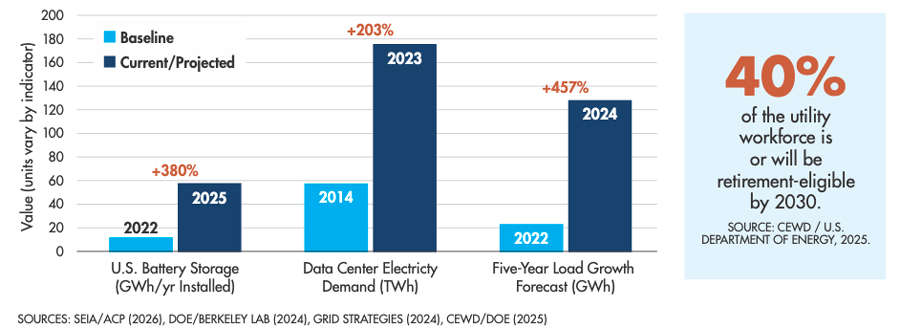
Today, that alignment no longer exists. The U.S. Energy Information Administration forecasts the strongest four-year growth in electricity demand since 2007, projecting a 3% increase in 2027 alone. The U.S. DOE reported that data center electricity consumption tripled from 58 TWh in 2014 to 176 TWh in 2023 and is projected to reach 325 to 580 TWh by 2028. According to SEIA, the U.S. energy storage industry installed a record 57.6 GWh of new capacity in 2025—nearly five times the 12 GWh installed in 2022. Grid Strategies reports that the five-year load growth forecast increased nearly fivefold in just two years—from 23 GW to 128 GW. Business models adapted: Project portfolios expanded, delivery became more fragmented and parallel, and success became defined by throughput rather than the slower maturation of systems.
At the same time, generational turnover and persistent workforce shortages reinforced this shift. The Center for Energy Workforce Development (CEWD) reports that 40% of the utility workforce is or will be retirement-eligible by 2030, while 76% of energy and utilities employers are experiencing a talent and skills gap. What did not evolve at the same pace was how projects are managed at the point of execution.
THE SCALING INFLECTION POINT: WHEN VOLUME EXCEEDS GOVERNANCE CAPACITY
The transition from the legacy delivery model to today’s environment accelerated over a relatively short period. Projects that were once executed sequentially are now executed in parallel across multiple regions. Organizations that previously managed a limited number of concurrent sites now coordinate dozens. Proposal pipelines have expanded accordingly, with estimating teams expected to respond rapidly to a growing volume of opportunities.
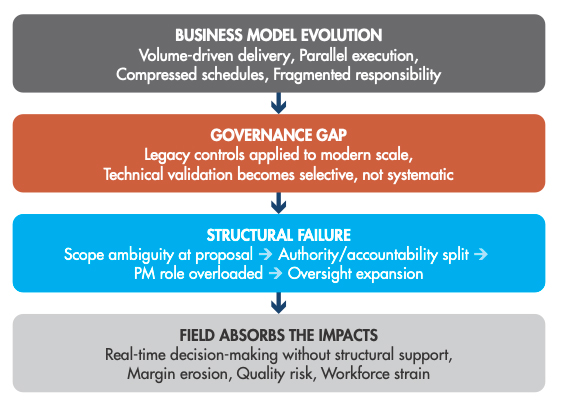
These forces collectively created what can be described as a scaling inflection point: a moment when business velocity exceeds the organization’s governance capacity. Governance capacity includes the ability to technically validate scope before pricing, maintain alignment between commercial and operational functions, define clear authority over project economics, and ensure that execution roles are supported by adequate infrastructure. In the legacy model, these functions were embedded informally within experienced teams. Under modern conditions, they require deliberate design.

When business growth outpaces this capacity, the system does not fail immediately. Instead, it adapts by compressing validation, making technical review selective rather than systematic, and carrying forward undocumented assumptions. McKinsey’s analysis of more than 300 megaprojects found that 98% incur cost overruns or delays, with average cost overruns of approximately 80%. While these figures span all capital projects, the underlying pattern—governance systems that cannot keep pace with project complexity—is directly relevant to field-intensive services such as testing and commissioning.
STRUCTURAL FAILURE PATTERNS IN MODERN PROJECT MANAGEMENT
Once the scaling inflection point is reached, the system develops consistent and repeatable failure patterns. These are not isolated operational issues. They are structural responses to misalignment between business expectations and project management architecture.
The first pattern emerges in proposal development. As volume increases and turnaround expectations compress, scope creation becomes detached from technical validation. Proposals appear complete but contain embedded ambiguity—equipment misclassified, testing requirements partially defined, specification nuances overlooked. These gaps surface during execution, when a technician encounters a condition not anticipated in scope.
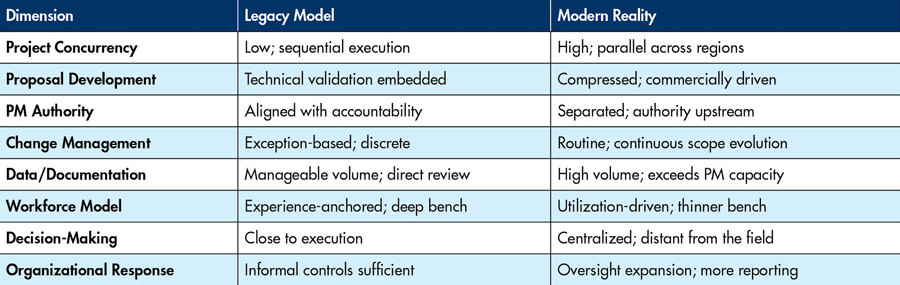
The second pattern is the separation of authority and accountability. In the legacy model, project managers operated with continuity from proposal through execution. In the scaled model, scope is defined upstream while accountability for delivery resides downstream. Change management becomes the mechanism for addressing this gap, but its structure reflects the legacy model: routing change orders back through sales functions, introducing latency into a process that increasingly requires responsiveness. Over time, smaller scope adjustments are absorbed by field teams without formal change requests, manifesting as consistent margin erosion across projects.
A third pattern develops around the project manager’s role itself. As complexity increases, the PM function expands to absorb responsibilities that were previously distributed: technical oversight, documentation flow, data review, and multi-workstream tracking. Modern testing and commissioning projects generate large volumes of documentation daily, each requiring verification against specifications. In the absence of dedicated review capacity, this burden falls on project management, narrowing the system’s margin for error. The NERC State of Reliability Report found that over 45% of electric power incidents since 2017 were linked to organizational performance issues, many attributable to inadequate oversight and management gaps.
THE ILLUSION OF CONTROL: WHY OVERSIGHT REPLACES SYSTEM DESIGN
As delivery systems come under strain, organizations rarely interpret the problem as structural. The more common response is to view variability in outcomes as a breakdown in control, leading to additional reporting requirements, expanded approval chains, and greater executive visibility into project activity. These measures increase the appearance of control without restoring coherence.
The underlying issue is not that organizations lack visibility. In many cases, they have more data than ever. What is missing is structural alignment between how decisions are made and where technical reality resides. In the legacy model, decision-making authorities sat close to execution. In the scaled model, authority shifts upward in response to perceived risk, while those closest to the work retain responsibility for outcomes. This creates a gap between responsibility and authority that cannot be closed through oversight alone.
This is the condition in which bossiness replaces leadership. Direction is given, and accountability emphasized, but without the structural support that enables effective execution. Leadership involves aligning authority, capability, and responsibility. When those elements are separated, directive management fills the gap. The system becomes increasingly dependent on individual adaptability rather than organizational design—experienced personnel navigating ambiguity, compensating for gaps, and absorbing pressure. As workforce experience levels vary and project complexity increases, this reliance becomes less reliable. The SHRM 2024 Talent Trends report found that 46% of organizations rated skilled trades positions as very difficult to fill, underscoring the fragility of depending on individual expertise to compensate for structural misalignment.
REFRAMING PROJECT MANAGEMENT AS A BUSINESS SYSTEM
These patterns are not the result of poor execution. They are the natural outcome of applying a delivery architecture designed for a different scale and pace of work. Addressing them requires reframing project management itself—not as a coordination function, but as a core component of business system design. In a high-concurrency environment, project management becomes the mechanism through which commercial intent is translated into executable reality. When this function is not structurally aligned with the business model, the entire system fragments.
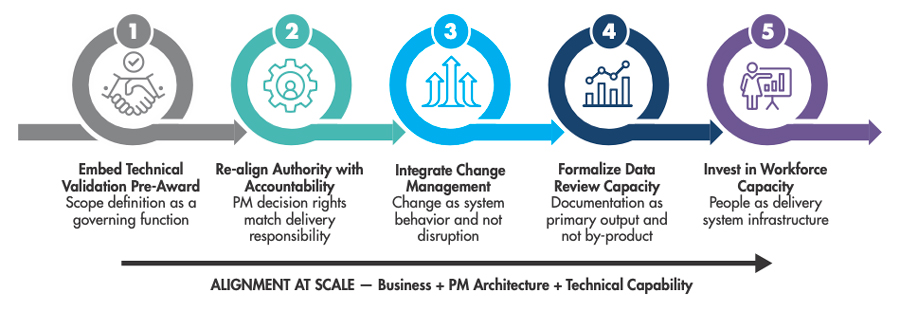
Five imperatives define this realignment.
- Technical validation can no longer remain informal; pre-award activities must be treated as part of the delivery system.
- Authority must be realigned with accountability, giving project managers decision rights commensurate with their delivery responsibility.
- Change management must be integrated as normal system behavior rather than treated as a disruption.
- Data review must be formalized as a defined organizational capability, not an implicit PM responsibility.
- Workforce development must be recognized as a central component of the delivery system—not a parallel initiative.
Organizations that treat capability as secondary will continue to rely on oversight to compensate for its absence. Brookings estimates that 32 million new workers will be needed in infrastructure and other construction-related occupations over the next decade, while the Bureau of Labor Statistics projects 73,500 annual job openings for electricians alone through 2032.
CONCLUSION: ALIGNMENT AT SCALE
The energy sector will continue to accelerate. The drivers of growth—data infrastructure, electrification, renewable generation, and grid modernization—are not temporary conditions. For organizations operating in testing and commissioning, the demands of speed, scale, and parallel execution will remain a defining feature of the work.
The legacy delivery playbook was effective because it aligned with the conditions in which it operated. As those conditions changed, the business model evolved. What has lagged is the system that translates that model into execution. The result is not a failure of effort, but a misalignment of structure. Commercial processes operate at one pace, while governance mechanisms operate at another. Authority is separated from accountability. Technical complexity increases without corresponding changes in how it is managed. The field becomes the point at which these gaps are resolved through additional effort, real-time decision-making, and, often, unrecognized cost.
What It Means for the Field to Pay the Price
Sustainable performance requires alignment at scale. Business strategy, project management architecture, and technical capability must evolve together. When they do, execution becomes more predictable, margin becomes more transparent, and risk becomes more controlled. When they do not, the system compensates through effort rather than design, and the cost continues to be absorbed in the field. The new business model is already in place. The question is whether the delivery system will be deliberately designed to support it.
Acknowledgment: The author expresses sincere appreciation to Mehrsa Aghajafari (TRC) and Denzel Clifton (PowerX) for sharing their perspectives and field-driven insights on project management in the current energy landscape. Their contributions helped ground this article in real-world experience and added depth to the discussion around modern delivery challenges.
REFERENCES
U.S. Energy Information Administration (EIA). EIA Forecasts Strongest Four-Year Growth in U.S. Electricity Demand Since 2007, January 2026.
U.S. Department of Energy (DOE). DOE Releases New Report Evaluating Increase in Electricity Demand for Data Centers, December 2024.
Solar Energy Industries Association (SEIA). “U.S. Adds 58 GWh of New Energy Storage Capacity in 2025, February 2026.
Grid Strategies LLC. National Load Growth Report, 2024.
Center for Energy Workforce Development (CEWD). Energy Workforce Fast Facts, 2025. Data sourced from U.S. Department of Energy (2025) and Manpower (2024).
McKinsey & Company. “Don’t Cancel or Coddle At-Risk Capital Projects—Challenge Them,” July 2025.
North American Electric Reliability Corporation (NERC). State of Reliability Report, 2023.
Society for Human Resource Management (SHRM). SHRM Talent Trends 2024.
Brookings Institution. “Energy and Infrastructure Workforce Projections,” 2024. As cited in CEWD Energy Workforce Fast Facts.
U.S. Bureau of Labor Statistics. Occupational Outlook Handbook: Electricians, 2024.

Morteza Talebi, PhD, SMIEEE, is Vice President of Workforce Development at PowerX. A Senior IEEE Member, he is an engineering leader with over 17 years of experience in electrical engineering, workforce strategy and training, and professional development. His work emphasizes the integration of human performance and quality principles into workforce strategies. Talebi earned an MS in electrical engineering from North Carolina Agricultural and Technical State University and a PhD in power systems from the University of Central Florida.