
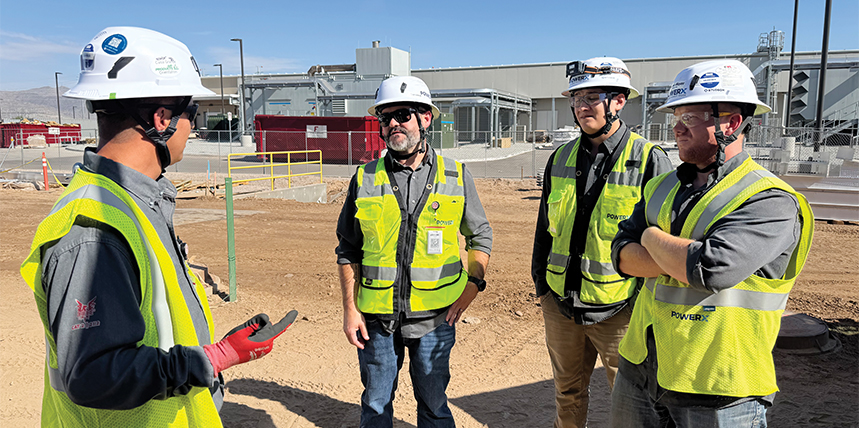
Modern power-system testing and commissioning environments are no longer static. Compressed schedules, evolving access windows, and multi-party coordination have introduced a new operational reality: Priorities shift midstream, and without deliberate control measures, safety and quality can degrade simultaneously.
THE NEW REALITY OF FIELD EXECUTION
Here’s a scenario many teams recognize: A job lead steps onto a site with a plan: cables first, then breakers and relays, then a coordinated energization window. A few days later, the sequence shifts. Access windows move, another workstream advances, and the crew is asked to pivot to a different lineup “right now.” A section that felt controlled yesterday may be energized today. The lead—often newer to the role—tries to stay responsive, says yes, and starts moving people around. That’s no longer an occasional scenario. For many testing and commissioning teams, it’s simply the operating reality of complex, multi-party project execution.
In conversations with field teams and operational leaders across the country, one theme came through clearly: Safety and quality aren’t slipping because people don’t care. They’re being challenged by an operating reality defined by tighter timelines, shifting sequences, and heavier documentation demands—while expectations remain unchanged: Execute safely, deliver consistent results, and produce defensible records. In that setting, one pattern shows up repeatedly: When the plan changes, teams must deliberately re-establish control of the work environment and of the deliverables.
THE PRESSURE IS REAL—AND IT’S QUANTIFIABLE
Electricity remains a persistent cause of workplace death. Electrical Safety Foundation International (ESFI)’s compilation of Bureau of Labor Statistics (BLS) reports 1,940 workplace fatalities involving electricity from 2011 to 2023, and notes that about 150 workplace electrical fatalities occur on average each year.[1] NFPA’s analysis of the Census of Fatal Occupational Injuries (CFOI) data indicates 142 workers died from exposure to electricity in 2023.[2]
At the same time, demand for skilled electrical labor continues to climb. BLS projects about 81,000 electrician openings per year, on average, over the decade.[3] DOE’s U.S. Energy & Employment Report 2024 also highlights accelerating clean-energy employment growth, reinforcing the broader signal: Workload, complexity, and staffing pressure are rising together.[4]
Now add the cost of getting quality wrong. A landmark Construction Industry Institute (CII) study of nine industrial projects found that deviations requiring rework, including redesign, repair, or replacement, averaged 12.4% of total installed project cost.[5] More recent CII benchmarking focused specifically on field rework shows mean values in excess of 3% of construction-phase cost for heavy industrial projects—before considering the indirect impacts that often follow.[6] Even if your organization experiences only a fraction of these levels, the takeaway holds: Quality is not paperwork—it’s schedule, margin, and credibility.
WHAT WE ARE SEEING IN THE FIELD
Safety Awareness Can Drift into “Just Execute”
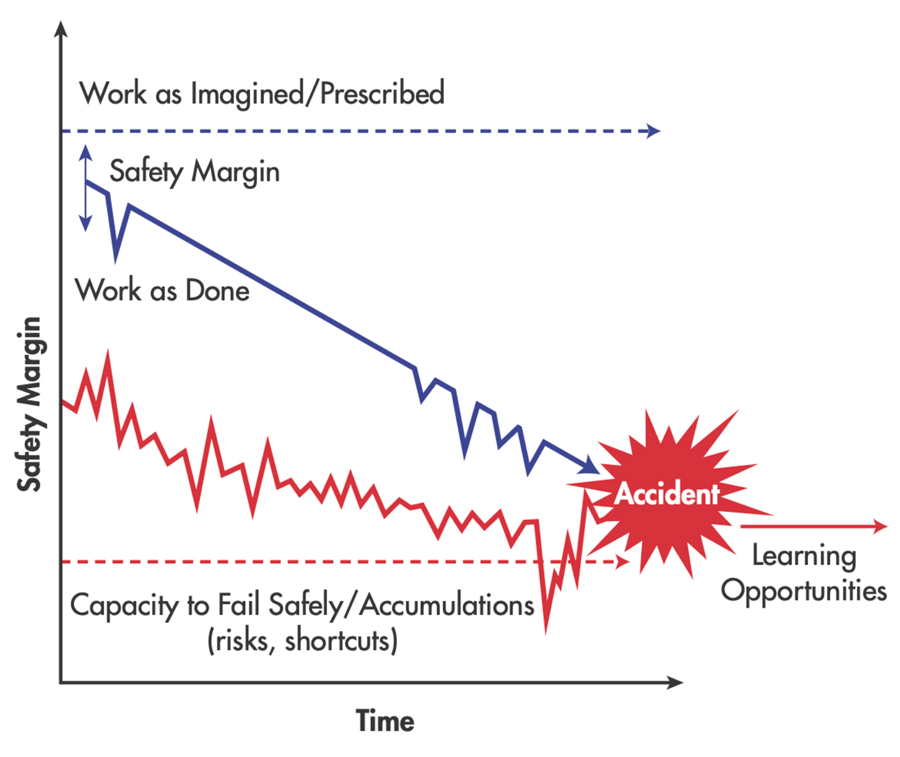
When the cultural message becomes “go do your job and come back,” awareness narrows. People focus on completing tasks rather than maintaining control of the work environment—especially when crews are moved between locations, scopes, or equipment states. This is how near-misses are born: not from ignorance, but from stale assumptions. The crew’s mental model of the job no longer matches reality.
Figure 1 illustrates how this drift can develop over time, as everyday adaptations gradually separate planned work from actual field practice, allowing risk to accumulate unless control is intentionally re-established. The concept is drawn from safety science literature, including Sidney Dekker’s work on drift into failure.[7]
Planning and Mobilization Are Inconsistent—and the Field Feels It
Planning and mobilization can look very different from one project team to the next. In some operations, internal kickoff, scope review, specification alignment, and pre-job clarification are treated as standard practice before the crew ever rolls. In other cases, that rhythm is difficult to sustain—especially when work spans multiple sites, manpower rotates frequently, and continuity is limited because no single lead owns the job from start to finish.
The same friction points tend to follow:
- The job folder may exist, but not everyone can find critical information quickly under time pressure.
- The quoted scope doesn’t always match what’s physically on site, and newer job leads may not have a reliable reference for what “good” sequencing looks like—or how much time is realistically planned per piece of equipment.
- Optional work, exclusions, and special requirements can remain unclear until they surface as conflict late in the job, when the schedule is already tight.
When planning isn’t consistent, the field naturally compensates. And that compensation often takes the form of field-solving—fast decisions made with incomplete context, where safety control and quality outcomes become harder to protect.
Real-Time Schedule Shifts Create a Decision-Making Gap for Newer Leads
One of the most repeated concerns was not technical capability; it was decision-making and communication when conditions change in real time. Schedule needs evolve midstream, commissioning teams adjust sequences, and energization windows shift. In those moments, the field lead must determine the safest and most efficient path forward: Continue as planned, realign sequencing, or route the change through the agreed escalation channel so priorities and impacts are clearly understood.
For newer job leads, especially, the natural instinct is to stay responsive and keep everyone moving. But when changes are absorbed informally—without a clear pause to re-establish control, secondary effects appear quickly. Efficiency drops as setups are torn down, repeated, or duplicated. Risk rises as work boundaries blur and the energy-state picture becomes harder to maintain. Documentation suffers as the day turns into firefighting. And scope creep can slip in without formal change control, creating downstream friction on schedule, cost, and deliverables.
Quality Failures Often Result from Basic, Repeatable Mistakes
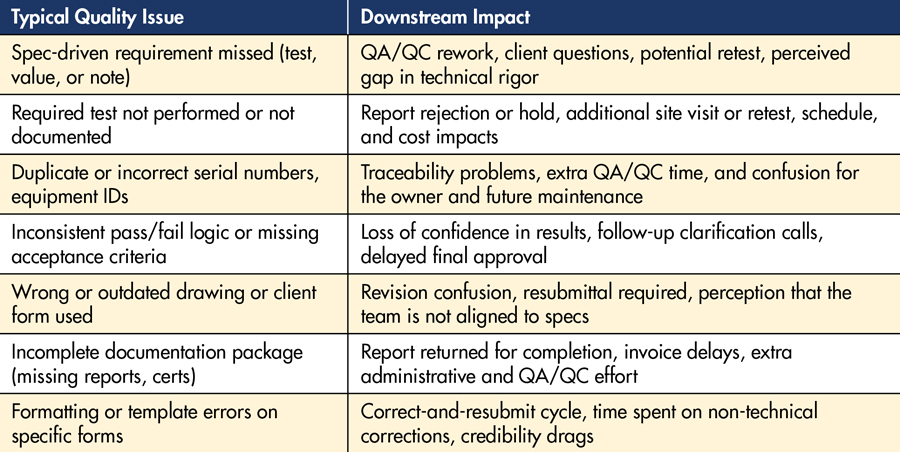
The most painful quality issues described weren’t exotic engineering problems; they were avoidable breakdowns in everyday workflow. Teams are seeing reports sent back because spec-driven requirements were missed, required tests weren’t performed or documented, serial numbers were duplicated, pass/fail logic wasn’t applied consistently, and cable IDs didn’t match drawings or field labels.
In other cases, the wrong drawings or client/vendor forms were used, or documentation packages were submitted incomplete, requiring rework to meet contract expectations. Table 1 highlights some of the most common reasons reports are returned—and the downstream impact they create for QA/QC and the client.
The deeper issue is visibility. Technicians and newer job leads often don’t see what happens after a report is rejected. Leaders want crews to understand the downstream impact—how much effort QA/QC spends reconciling gaps, what questions the owner or commissioning team asks when data doesn’t line up, and how quickly confidence can erode when deliverables aren’t right the first time.
Closeout Is the Silent Leak in the System
Even strong execution can end poorly if closeout isn’t controlled. The difference often comes down to whether the final report is truly complete, whether retests and pending work are tracked to closure, and whether the deliverable package aligns with what the contract actually requires. Just as important is taking time for a brief post-job review—capturing lessons learned while the details are still fresh—so the next crew benefits from what this crew discovered.
Without a consistent closeout mechanism, organizations end up reliving the same friction on the next job. The work may get finished, but the learning doesn’t stick because the system never captures what mattered enough to improve planning, execution, and training.
THE ROOT CAUSE ISN’T MOTIVATION—IT’S OPERATING CONDITIONS
This is the key insight from the field: Today’s operating environment is pushing teams toward reactive execution.
- Crews often rotate across multiple sites, projects may run for long durations without a dedicated lead maintaining continuity, and schedules are compressed with shifting access and energization windows.
- Priorities can change quickly as site needs evolve, while kickoff practices vary by region and project team, leaving some crews without the same level of alignment before work begins.
- When escalation pathways for field decisions aren’t clearly defined—or aren’t consistently used—job leads are left to make high-consequence calls in real time.
- At the same time, many organizations have invested heavily in technical capability, but not enough in practical decision-making training for fast-changing conditions.
These are not character flaws. They are system conditions—and system conditions require system fixes.
BEST PRACTICE: BUILDING CONTROL INTO FIELD EXECUTION
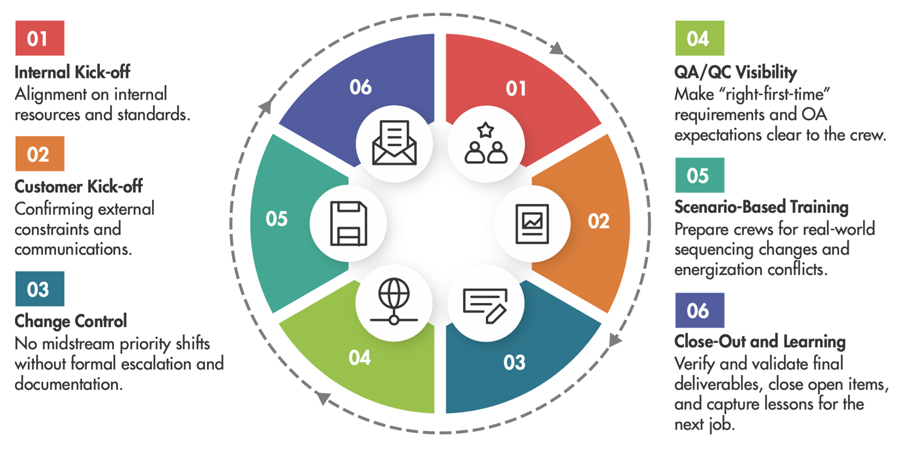
Across top-performing field operations, a clear pattern emerged: Strong performance isn’t driven by one heroic job lead or one perfect crew. It comes from a repeatable operating rhythm—a control loop—that keeps scope, safety, and deliverables aligned even when the site environment changes. It starts with an internal kickoff that quickly aligns the team on scope, specifications, resourcing, risks, sequencing, and questions that must be answered before work begins. From there, a customer kickoff confirms the practical rules of the job: chain of command, energization boundaries, access constraints, reporting expectations, and who can authorize priority changes.
Once the job is moving, the key is discipline: Priorities do not shift midstream unless they move through the agreed channel and are documented. In parallel, QA/QC expectations are made visible to the field so technicians understand what “right-first-time” actually means, why reports come back, and how small documentation errors create big downstream delays.
Finally, teams build competence through scenario practice—realistic situations involving sequencing changes, energization timing, retest requests, and scope conflicts—so the right language and escalation steps are ready when the moment arrives.
The loop closes with a structured closeout: final report completeness, pending work closure, and a short post-job review that captures lessons learned while they are still fresh. Figure 2 provides a visual representation of this control loop, highlighting how internal kickoff, customer alignment, change control, QA/QC visibility, scenario practice, and closeout connect to maintain control of the work and its deliverables.
This structure isn’t red tape. It’s the difference between work that stays controlled and work that becomes reactive. In fast-moving conditions, the organizations that consistently perform are the ones that can re-establish control of the energy state, of the plan, and of the documentation before drift sets in.
THE PRACTICAL TAKEAWAY
Safety and quality should not be treated as separate programs, because in the field they break down through the same pathways: unclear priorities, inconsistent execution routines, and loss of control when the plan changes. The strongest teams respond with an approach that feels practical and field-real—standardized kickoffs and mobilization, scenario-based preparation, visible QA expectations, disciplined change-control channels, and professional closeout that turns each project into learning, not just completion.
Because the most valuable skill in modern field testing isn’t only knowing what to test, it’s knowing how to keep the work controlled—technically, procedurally, and operationally—when everything around the work is changing.
REFERENCES
- Electrical Safety Foundation Institute. “ESFI Releases Updated Workplace Safety Statistics,” www.esfi.org, April 24, 2025.
- NFPA Research. Fatal Occupational Injuries in 2023 Caused by Exposure to Electricity or Arc Flash, www.nfpa.org, July 31, 2025.
- U.S. Bureau of Labor Statistics Publications. Bureau of Labor Statistics, U.S. Department of Labor, Occupational Outlook Handbook, Electricians, www.bls.gov, November 12, 2025.
- Department Of Energy, Secretary Jennifer M. Granholm. United States Energy & Employment Report 2024, www.energy.gov, October 1, 2024.
- Burati, James, and Farrington, Jodi. “Costs of Quality Deviations in Design and Construction,” www.construction-institute.org, August 1, 1987.
- RT-153. “The Field Rework Index: Early Warning for Field Rework and Cost Growth,” www.construction-institute.org, May 01, 2001.
- Dekker, Sidney. Drift Into Failure, 1st Edition. Routledge, February 28, 2011. ISBN-10:140942216.

Morteza Talebi, PhD, SMIEEE, is Vice President of Workforce Development at PowerX. A Senior IEEE Member, he is an engineering leader with over 17 years of experience in electrical engineering, workforce strategy and training, and professional development. His work emphasizes the integration of human performance and quality principles into workforce strategies. Talebi earned an MS in electrical engineering from North Carolina Agricultural and Technical State University and a PhD in power systems from the University of Central Florida.

Jason Greer is the CEO of PowerX, bringing more than 18 years of industry expertise and over two decades of leadership experience. Previously President of Shermco Industries, Jason has successfully led and integrated over a dozen mergers and acquisitions in the power services sector, always with a focus on people, culture, and safety first. His greatest passion is meeting with employees and customers to build long-term, value-driven partnerships.