

In today’s world, electric vehicles are advancing rapidly, fueled by breakthroughs in battery technology, increasing global awareness of environmental sustainability, and national efforts to reduce dependence on fossil fuels and lower carbon emissions. As a result, electric vehicles are becoming a key solution for the future of global transportation.
The urgency for cleaner transportation has never been greater. Rising pollution levels and the environmental impacts of conventional fuel consumption make sustainable alternatives essential. Electric vehicles offer not only a greener mode of transport but also a quieter, smoother driving experience and lower long-term operating costs, positioning them as both practical and strategic choices for modern mobility.
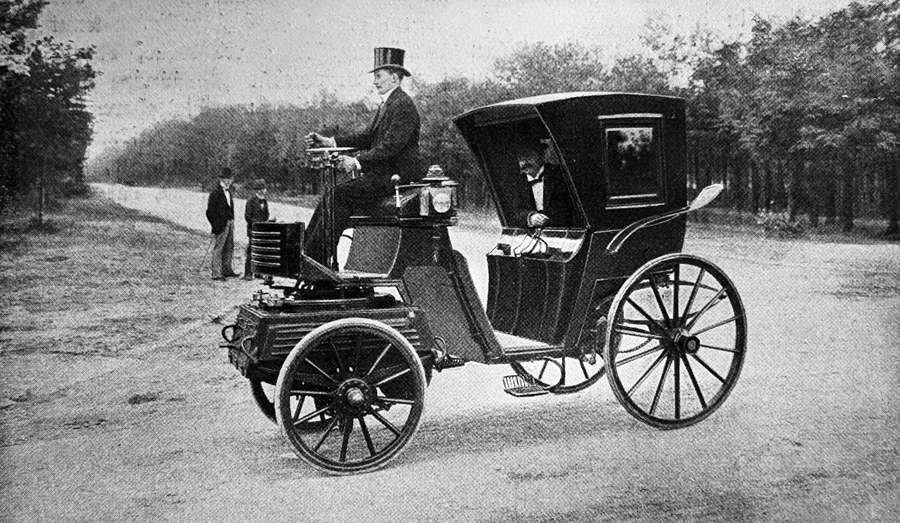
The concept of electric vehicles is not new. In 1880, British engineer Thomas Parker introduced one of the first practical electric vehicles, demonstrating that electricity could serve as a clean and efficient alternative to internal combustion engines. His pioneering work laid the foundation for the electric mobility we see today.
THE IMPORTANCE OF ELECTRIC VEHICLES
The world today is striving to reduce carbon emissions from various sectors, with the transportation sector bearing a significant responsibility in addressing this issue due to its high levels of greenhouse gas emissions. This has prompted countries to adopt sustainable solutions, primarily the expansion of electric transportation.
The importance of electric vehicles lies in their role as a key solution to the environmental challenges associated with the transportation sector. They contribute effectively to reducing carbon emissions and air pollution, in addition to their high energy efficiency compared to conventional vehicles. These vehicles also help reduce reliance on fossil fuels and support the transition to renewable energy sources, thus enhancing the long-term sustainability of transportation systems.
Low emissions are among the most prominent advantages of electric vehicles, as they produce significantly less greenhouse gases compared to gasoline or diesel cars. In Europe, studies indicate that electric vehicles emit between 17% and 30% less of these gases, which contributes to reducing the carbon footprint of the transportation sector and supports the achievement of the goal of reducing carbon dioxide emissions from cars by 55% by 2030.
In September 2023, the European Commission published a draft document outlining the impact of conventional and electric vehicles on carbon emissions. The document focuses on the potential of e-fuels to reduce greenhouse gases, noting that they currently reduce emissions by 70% compared to conventional fuels. Analysis indicates that gasoline-powered cars will emit approximately 61 grams of CO2 equivalent per kilometer by 2035, while electric vehicles will produce only about 13 grams when fully charged, making them the more environmentally friendly option.
THE MARKET FOR ELECTRIC VEHICLES
The global electric vehicle market has undergone a significant transformation in recent years, driven by a growing interest in environmentally friendly solutions and a shift away from fossil fuels. This shift is attributed to several factors, most notably technological advancements in battery systems, the expansion of charging networks, and government initiatives to support the adoption of electric vehicles. Furthermore, increased consumer awareness regarding the importance of reducing carbon emissions has prompted manufacturers to expand their electric vehicle production lines to meet rising demand.
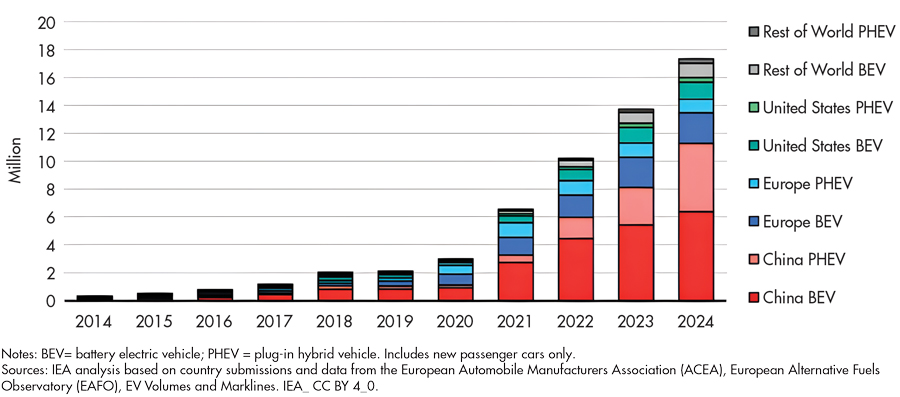
In the International Energy Agency’s 2024 annual report, global electric vehicle sales surpassed 17 million units, reflecting an increase of more than 25% compared to the previous year. Notably, the additional 3.5 million vehicles sold in 2024 alone exceeded the total global EV sales recorded in 2020.
China maintained its leadership among major markets, with sales exceeding 11 million electric vehicles, more than the total global sales just two years earlier.
In Europe, sales growth slowed slightly due to the reduction or removal of subsidies in several countries, while EU CO₂ emission targets for vehicles remained unchanged between 2023 and 2024.
Meanwhile, electric vehicle sales in the United States continued to rise, although the growth rate dropped to about a quarter of the previous year’s level.
Outside these three major markets, however, EV sales experienced strong momentum, increasing by nearly 40% to reach 1.3 million vehicles, approaching the U.S. total of 1.6 million electric vehicles.
LEADING NATIONS IN EV ADOPTION
One of the most important reasons for the increasing growth in electric vehicle adoption is the role of governments through supportive regulations and policies. These include tax incentives and the development of charging infrastructure.
Norway
Norway has achieved an unprecedented milestone in electric vehicle sales, bringing it a significant step closer to eliminating petrol and diesel cars from its new car market.
According to data from the Norwegian Traffic Information Council (OFV), electric vehicles accounted for approximately 95.9% of all new car registrations last year, with the figure rising to 98% in December alone, compared to 88.9% at the end of 2024.
Norway also set a new record for the number of new passenger cars registered, with 179,550 vehicles registered during the year, representing a 40% year-on-year increase and surpassing the previous record set in 2021. These figures reflect Norway’s position, despite being an oil-producing nation, as a global leader in sustainable transportation.
United Arab Emirates
Public policy is a key element in driving the UAE’s move towards electric mobility. The country has already converted 20% of its federal government vehicles to electric power and initially set a target of having at least 30% of public sector vehicles and 10% of all vehicles on the road be electric or hybrid by 2030. This target was supported by a range of incentives, such as free registration, free parking, and reduced charging and road tolls for electric vehicles.
In 2023, at the 28th Conference of Parties (COP28), the UAE announced that its 2050 goal is for 50% of all vehicles on the road to be electric or hybrid, along with tripling the country’s renewable energy generation capacity.
USA
The U.S. government directly supports the adoption of electric vehicles not only in the general market but also within government fleets. Through the Federal Energy Management Program (FEMP), federal agencies are provided with guidance and assistance for purchasing and installing electric vehicle charging equipment and electric vehicles, aiming to expand charging infrastructure and enhance energy efficiency in government fleets.
In the United States, the share of electric vehicles in total new car sales is still growing gradually. In 2025, electric vehicles accounted for approximately 7.9% of total sales; when considering both electric and plug-in hybrid vehicles, the share reached around 9.7%. At certain points in 2025, the share even reached 10.5% of total sales, indicating a clear increase despite strong competition from conventional vehicles.
CHALLENGES HINDERING THE SPREAD OF ELECTRIC CARS
Despite the rapid global growth of electric vehicles (EVs), several key challenges hinder their widespread adoption. A study by the Massachusetts Institute of Technology (MIT) on the challenges of expanding EV adoption identified several major obstacles. Initial purchase costs remain high compared to conventional cars, primarily due to battery prices; some consumers worry about running out of battery charge before reaching their destination, especially in areas lacking charging stations; the lack of charging infrastructure is a barrier to everyday use and long-distance travel; and technical challenges related to electricity grids, such as ensuring grid stability during peak hours and standardizing charging across different vehicles and outlets, remain.
The study indicated that overcoming these obstacles requires governments and manufacturers to expand support not only for the vehicles themselves but also for the supporting infrastructure and technologies to ensure that EVs become more accessible and appealing to consumers.
CONCLUSION
Electric vehicles are no longer a futuristic concept; they are becoming an integral part of the global transportation landscape. Technological advancements, environmental concerns, and government policies have all contributed to their rapid development and adoption. From the pioneering work of Thomas Parker in the 19th century to the modern electric mobility initiatives in countries like Norway, the UAE, China, and the United States, it is clear that innovation and supportive regulations play a crucial role in shaping the future of transportation.
Despite this growth, several challenges remain, including high initial costs, range anxiety, insufficient charging infrastructure, and technical limitations in electricity grids. Addressing these obstacles will require coordinated efforts from governments, manufacturers, and consumers, not only to expand EV adoption but also to ensure sustainable energy use and environmental benefits.
Ultimately, electric vehicles represent a strategic pathway toward reducing carbon emissions, improving air quality, and achieving a more sustainable transportation system worldwide. As countries continue to implement supportive policies and as technology evolves, the shift toward electric mobility is poised to accelerate, paving the way for a cleaner and more efficient future.
REFERENCES
- “E-fuel Cars Are Not Zero Emission,” Transport & Environment (T&E), October 5, 2023.
- Merideth, Samuel. “Norway Wraps up 2025 with 96% of its New Car Market Fully Electric, and Tesla’s Sales Are Surging There,” CNBC, January 2, 2026.
- International Energy Agency (IEA). Global EV Outlook 2025. International Energy Agency (IEA), Paris, 2025.
- Mannes, M. “Norway Zips Ahead in EV Race as Car Sales Hit 96% Electric,” Reuters, January 2, 2026.
- UAE Government. The Future Is Electric: A Strategy for EV Adoption in the UAE (2023).
- U.S. Department of Energy, Federal Energy Management Program (FEMP). “Procuring Electric Vehicle Infrastructure,” January 9, 2026.
- Knittel, C. R. and Tanaka. S. “Challenges to Expanding EV Adoption and Policy Responses,” MIT Center for Energy and Environmental Policy Research (CEEPR) Working Paper No. 2024-16).

Khaled Shadi Morshed received his BEng. degree in Electrical Engineering from Balqa’ Applied University, Jordan. He is currently working as an Electrical Engineer at Commissioning Services International (CSI), where he is involved in testing, commissioning, and power system analysis. Khaled is also a NETA Level 3 Certified Electrical Testing Technician, demonstrating his expertise in advanced electrical testing and commissioning procedures.