
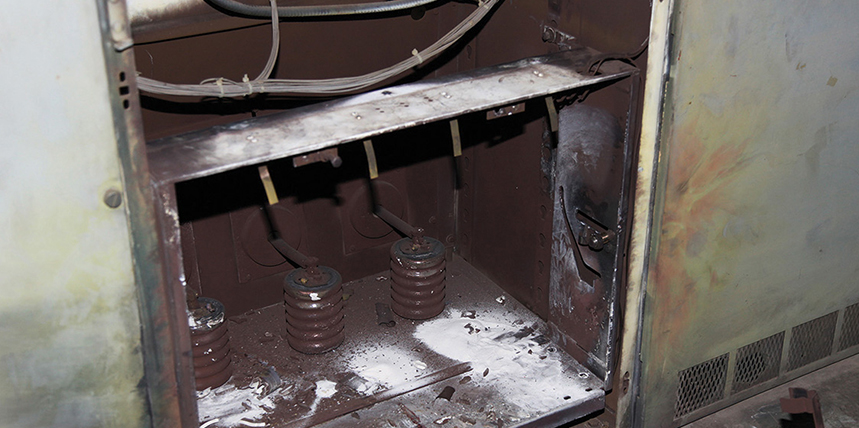
Today, we’re going to talk about electrical safety. After listening to people talk at PowerTest25, I realized that NFPA 70 E and other standards always refer to arc flash and arc blast, so we’ll start with that.
ARC FLASH
How many of you have taken an arc flash class? I’d hope everybody! How many have taken a shock class? Very few of you. How many of you have been shocked before? Don’t lie. How many of you have experienced an arc flash? A couple of you.
I’ve dealt with arc flashes on the other end, so I know that when we deal with electrical safety, we forget where the shock goes. We focus much more on the flash and the blast because everybody’s afraid of the after-effects. I’ve learned to focus on where the shock goes. There’s some information on the equipment’s shock label that tells you the voltage and the safe distance, but I’ve noticed that when people fill out their electrical safe work permits, they forget to enter the shock voltage.
Why do you think that is? It’s because you’re not scared of it anymore. It’s just part of it. I’m going to get shocked. I’m going to go back to work. That’s why I’m giving you some insights into how many shocks occur in a year and what OSHA is doing about shocks. Hopefully, you will take it back to your peers or the people that work for you or work with you.
STAYING SAFE
I got into the safety field from the medical field, where I was an EMT firefighter, and began my safety journey in the industry as a resource. That’s why I usually tell people we’re going to talk about habits with shock.
We’re all healthy individuals. I don’t eat fried foods. I don’t eat pasta. You drink no caffeine, right? You have three coffees a day—four monsters a day! We’re all in tip-top shape. We could run a marathon right now. But if you do get shocked, you’re highly encouraged to get checked out. The main reason is that your heart is one of your body’s electrical parts, and electricity is drawn to electricity. It’s always going to cross your heart. It doesn’t matter if I get shocked with my pointer finger and it goes down my pinky finger, it’s going to cross my heart because that’s the way it works. It doesn’t matter if I’m grounded or not grounded.
I’ve dealt with shock from the front end, where people get shocked and go get seen, and I’ve dealt with it when people weren’t so lucky. The definition of electrical shock is the perceptible and physical effect of an electrical current that enters the body. A major shock can burn internal and external tissues and cause organ damage.
When you get shocked, it leaves behind a little burn mark. What do you think it does to the inside of your body? It burns you from the inside out. I showed a little video in our NFPA class that shows a foot. For two or three days, it looks fine, but after about three weeks, they end up losing the foot. It burned all the tissue and all the muscles. It’s like anything else. If you get a bruise or a lump on your arm, it normally expands. It starts to swell. The same thing goes when you get a burn on your body. As the muscle tries to heal itself, it expands and expands and swells up, and sometimes you end up losing that appendage.
Figure 1 shows the path—1,000 ohms or 120 volts. Are you always grounded? Not always, but if I’m going to touch something, your foot is most likely on the ground.
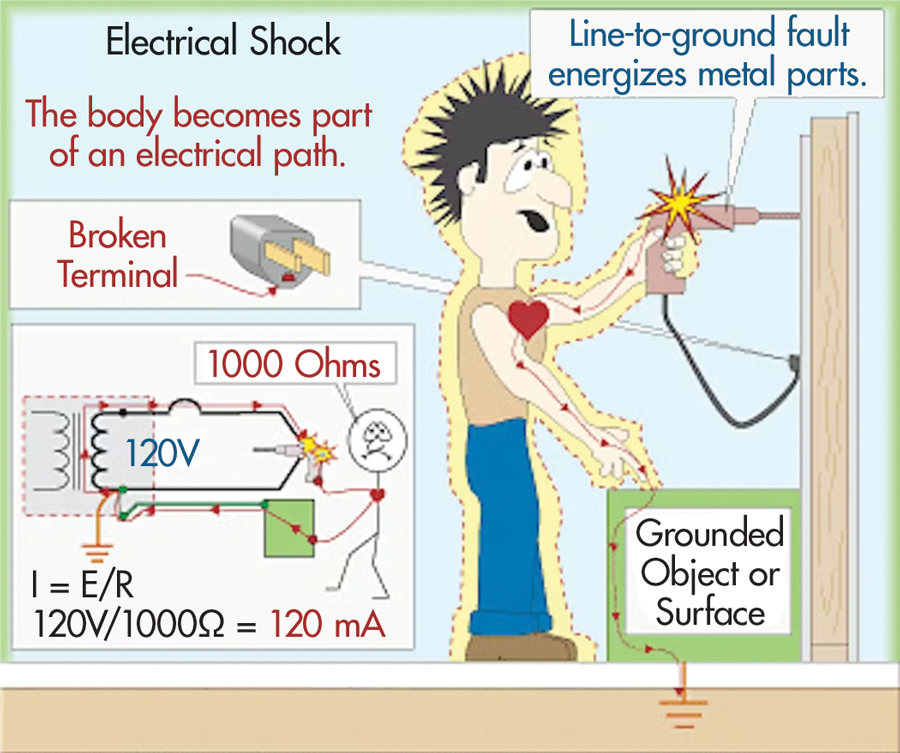
How many of you use drills at home? Do you have that old drill with a plug without a ground? How many of us take our broken tools home—things like extension cords with the ground pulled out. The safety professional says, “Hey, you can’t have those here!” But it’s a new cord, so you take it home, and it happens.

What I want to show you is that it’s going to go through your body, and it’s going to cross your heart. So I highly recommend that if you or someone in your crew gets shocked, encourage them to go see a doctor. Get an EKG, get a sonogram, get them to do something just so you don’t get a phone call the next day, and the wife says, “Hey, my husband didn’t wake up. Did something happen at work?” I’ve had stories like that where I’ve had to deal with things on the back end. Somebody gets shocked, they go home, they go to sleep. They don’t wake up the next day. Not all of our bodies can withstand it like we think.
EFFECTS OF ELECTRICAL SHOCK
How many of you have been shocked on a ladder or scaffold? You deal with conductors all the time—all sorts of various kinds of body resistance. Some people have tough leather skin. Guys who work with their hands all day long don’t use lotion, and they’ve probably built up some body resistance.
How many of you sweat profusely when you’re out working in the heat? If you’re in an electrical room, they turn the power off. You’re working on temporary power, just enough lights, so now you’re sweating. Now you’ve got another conductor on your body. How many of you wear arc-rated PPE every time you go to work? If you don’t, shame on you. If your company is not demanding it, you need to have that discussion, because OSHA came out with new 2024 rules. Maybe that will help your company provide the PPE you need.
I’m looking at 100 megaohms. If you deal with it on a daily basis, it can cause ventricular fibrillation. Does everybody know how to use the dummy-proof shock tool? It does work, but when you have 50 milliamps or even 30 milliamps, you will have difficulty breathing and muscle freezes. Have you been bit where you can’t get off of it, and somebody had to knock you off? That’s not a fun feeling.
So at 5 to 6 milliamperes, the GFCI trips. I’ve already been shocked a couple of times, and this probably already grabbed me before the GFCI kicked in. As it goes higher and higher and higher, heart paralysis, serious tissue damage, and organ burning occur.
But what do we do with low voltages? Do we pay a lot of attention to them when they are less than 50 or 120 volts? How many times have you heard electricians say, “It’s just 120, man,” but 120 can hurt. We teach a lot of electricians in our classes, and they unfortunately don’t realize that they should be wearing some gloves for most of the work they are doing. As it goes up a little bit higher, you get heart paralysis—that’s the one thing you don’t want to have paralyzed in your body.
PERSONAL PROTECTIVE EQUIPMENT
In November 2024, OSHA came out with new regulations on PPE. How many of you have been in a substation, and there’s an arc flash suit—a common suit everybody can use. Is that going to fit you properly? Do you know if it’s a layered system or if it’s the old one that weighs 100 pounds and makes you sweat? Today, they make them really light, but it’s a layered system.
OSHA is now saying, “Hey, we’ve got to protect our employees with the proper PPE,” instead of, “Hey, here’s a suit that’s an extra-large; figure it out. Here’s a size-11 glove. I hope it fits.” And men and women are built differently.
Most work fails the standard. It’s okay to work on stuff that has electricity. There are times and places for working stuff hot. There’s nothing wrong with that, but you definitely need to know what you’re doing. The 50-volt rule goes into effect despite the lack of justification and lack of PPE. Anything over 50 volts rises to 4, 6, or 8 calories. If you’re wearing the new flame-resistant (FR) Cat, that’s 8 calories. A lot of people don’t realize they’re already wearing 8 cals. You need to go put your suit on, man, even if it’s only 2 calories. Yeah, you have to get a face shield and gloves. It’s not called a balaclava now, it’s called a head protection sock or something. They changed it in the last revision of NFPA 70.
So PPE now has to fit you, and you have to make sure your employees understand the PPE is there to protect them. Did they hear, “Here’s your 8-calorie PPE; here’s how to take care of it and how you’re supposed to wear it.” I’ve been in the refinery and chemical business too long. That was just the thing you had to put Nomex on. Back in my day, they still dipped my clothes. You could only wash them five times, and then they had to take them back and redip them. Now, they are way more sophisticated.
How many times do you show up, and your best technician or your mechanical guy has a ripped shirt or pants? They say, “I don’t need anything new. I’ve been wearing this stuff for five years!” It’s probably not the proper stuff to be wearing. This is something to keep in mind because OSHA does now have a special emphasis on this.
If you do have some type of electrical incident, they are going to dig into your company’s PPE policy. They’re going to cite you because you’re probably not following what they say you need to follow. I worked for a huge electrical testing company for a long time, and up until six or seven years ago, we didn’t require FR shirts and FR pants on every job, depending on what you were doing. Now it’s become more of a standard, but I know we have guys who still wear cotton t-shirts in the substation because they get hot. You definitely need to make sure they’re protected with FR- and AR- rated clothing.
The guidance makes it clear that low voltage, including 50 volts, can sustain an arc flash and produce molten metal. They de-energize using safe work permits, using a safe work policy, and lockout/tagout. If you have read OSHA’s lockout/tagout program, it keeps getting bigger, so keep in mind is that OSHA is getting into this. They did make a change: DC 48 volts is now 50 volts.
You can’t roll it down. You have to roll it up. That was in one of the NFPA updates. OSHA says whatever NFPA 70 E says, so that’s what we’re going to go by. If OSHA ever comes into your office and starts reciting 70E to you, the law says they can do that. I highly encourage you to go through an NFPA 70E update class every three years. It will definitely help you out.
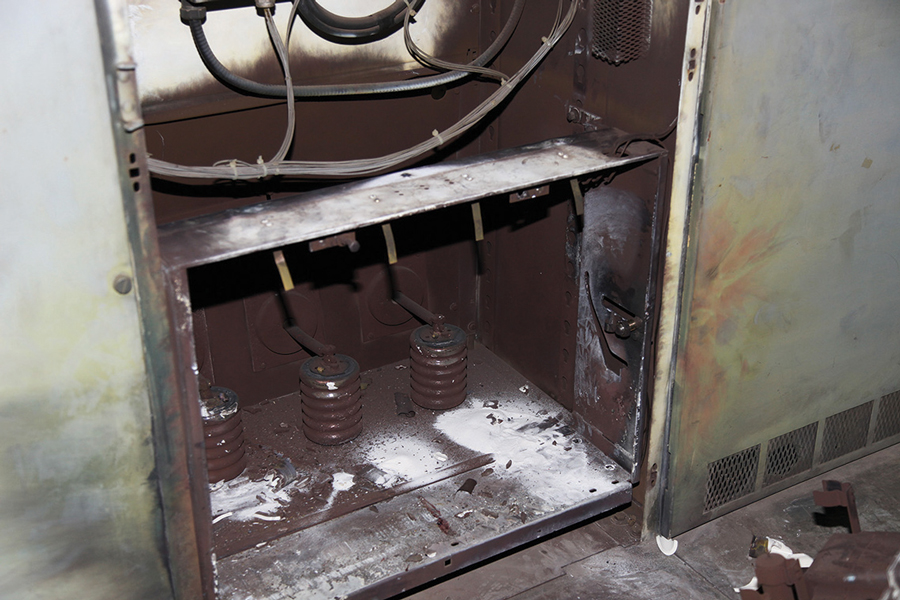
INJURY STATISTICS
Let’s talk about some of the injury statistics that occur with shock. Electricians are part of this, and unfortunately, electrical field service falls under electricians.
Does it make sense to you that you fall under electrical? They’ve bundled electricians and electrical field service all together. So let’s change our perspective. There are 3,500 arc flash events every year. Not all of them are reported. When I was with one of the larger companies, we probably only dealt with two or three a year, but that just means it happens way more.
Between 2011 and 2022, there were 1,322 workplace fatalities involving electricity, and 70% of the deaths occurred in non-electricity-related occupations. It means people who shouldn’t be dealing with electricity: plant operators, maintenance guys, people who have not had some type of electrical training, or those who watched those old 1980 movies you still have to pop in the VCR. It’s something to keep in mind because you guys are doing a great job of letting your employees know about electrical hazards, but it seems like we need to get the various aspects of electrical hazards out to the different genres. Maybe more people should be thinking about electrical fatalities.
Thirty percent of worker fatalities occurred in electrical occupations; 70% don’t. There is a 1.5% average decrease in workplace electrical fatalities year over year, so we’re trending in the right direction. We’re just not there. We still have people who don’t go home every day with all the safety training we do. How many people love safety training? We all love to sit in front of a computer for eight hours a day or do the site orientation. The only thing that changes is how fast you can go, what PPE you need to wear, and what the hazards are. But we’re hiring new people into the organization who are not from an electrical background.
KEEPING YOUR PEOPLE SAFE
How many of you have over a hundred people in your organization? Could you imagine losing 109 electrical testing technicians in a year? We already know they are few and far between now. So if we keep losing 110 workers a year, we’re eventually going to run out. That number stood out to me. I might have run into one of those 109 people; it makes me realize we deal with real hazards every day.
Do you put your electrical crews through the same training as everybody else? I would hope so! But some electrical companies don’t put them through any training. Well, how did you get to your electrical apprentice license? Aren’t you supposed to do so many safety hours a year to keep that going? Sometimes we have to re-up that with those employees, as well as painters, construction and maintenance, roofers, and truck drivers.
Why would a truck driver get shocked? How many times do they run into electrical poles? It’s an easy way for DOT to say it wasn’t an on-the-road fatality. Everybody wants to keep their fatalities down, but people run into poles and hit substations all the time.
What PPE can you wear that’ll protect you from shock? Gloves, right? Nothing else on my body is going to protect me from shock. The number-one place you get shocked is your hands. How many of your employees are out there wearing gloves that are two years old and have never been tested?
I always look at everybody’s gloves when I’m out there, simply because people forget about them. Lately, I’ve seen employees go into the restricted boundary, and they’re just wearing arc flash-rated gloves. They put their 40-cal suit on, and then they put those 40-cal gloves on, but they don’t put the rubber gloves on. I’d be more worried about a shock when I’m trying to rack a breaker rack in or out because they are typically all indoors or protected. You can protect yourself with some type of chicken-switch device or remote racking device. Let’s make sure everybody’s got the right PPE because with hands, the only thing that protects you is rubber gloves.
What are your options for the new protectors? Chemical rubber gloves over the electrical gloves? Those cut-level gloves with neoprene are already hard enough to get on your hand without putting them over another pair. How do you get it long enough to protect the longer Category 2, 3, and 4 rubber gloves? Obviously, the farther up the protector goes, the more it’s going to protect you.
EXTRA-HIGH VOLTAGE
Has anybody seen the new voltage chart? Has anybody dealt with ultra-high voltage yet? Has anybody been out to Phoenix, where they’re running these huge solar farms and all these new highlines that are 525 kV HVDC? How do you protect your employees from that?
Is there any PPE to protect them from that? Not right now. That’s a question I get asked all the time. “Hey, I’m going to have an employee go up there.” No, you’re not, because even the bucket trucks aren’t rated for that. I asked them the other day, “Hey, can a bucket truck even get up there with it?” “No.” So now we’re running power that we can’t even protect our employees from, and the highline crews can’t even protect themselves.
Back in the day, we had to carry huge OSHA books. Now you just ask Siri, “What does OSHA say on this?” Most of you have an electrical safety program, and I hope your electrical safety program is separate from your safety program. According to OSHA and NFPA 70E, it can’t be one program. You have to have separate safety programs for electricity, safe work plans, or standing work orders (SWPs). NETA puts out a lot of standards to help out with SWPs. NFPA 70E goes into more of the standards.
I recently asked AI to write a safety manual. It gives you all sorts of weird stuff. McDonald’s sells 5.6 billion burgers a year, and they’ll put that in your plan. If you do anything with AI, please read it before you send it out. NFPA 70B’s maintenance section includes a lot more on shock. IEEE also has many books.
I think we take shock for granted. We focus so much on arc flash and arc blast. A lot of things out there can shock us. Does anybody drive a Tesla or an electric car? Did you read the manual about the electrical shock hazards and how to plug it in, and ground it, and unplug it, and ground it? If you buy an EV car, you have to watch a video on how to plug your car in.
OSHA talks about having the proper PPE in arc flash hazard rooms. You must have some type of hot stick or safety hook with safety-rated gear for any work you do that has a shock hazard. You also need a rescue plan. OSHA can cite you for that.
CONCLUSION
Remember, we all work to provide for our families and hobbies, and everyone wants to go home. I like to say, “Be safety conscious all the time.”
This article is a transcript of Dyer’s PowerTest 2025 presentation titled “Electrical Safety: Where Did the Shock Go?”

Jonathan Dyer, CHST, SNS, CSSN, CSST, COSS, EMT, is Director of ECP Safety Solutions at ECP Solutions. He began his career in the emergency medical field and transitioned into occupational incident management before starting his career as a safety professional. Dyer has been part of the OSHA Voluntary Protection Program for more than 10 years, focusing on worker safety. He has helped many sites achieve the highest OSHA award of VPP Star Site. He has served on the national and regional VI VPPPA Board of Directors and was recognized in 2018 with the Charles E. (Chuck) Williams Shining Like a Diamond Annual Employee Service Award.