

Many companies in our industry are struggling with staffing projects that require qualified workers to meet industry needs as well as individual company growth initiatives. Let’s first explore why it seems more difficult to find employees to execute our projects, then dive into the process necessary to develop those employees into qualified workers.
Statistics from the U.S. Bureau of Labor Statistics (Figure 1) show that over the last quarter century (2000–2025), the annual labor growth rate has decreased by 39.4% compared to the previous 20 years (1980–2000).[1]

SOURCE: U.S. BUREAU OF LABOR STATISTICS[1]
- From 1980 to 2000, the U.S. Bureau of Labor Statistics reports that the civilian workforce grew from 107 million to 142.6 million (33.3%), an annual growth rate of 1.7%.
- From 2000 to 2025, the workforce has grown from 139.4 million to 168.1 million (20.6%), an annual growth rate of only 1.03%.
Additionally, the workforce landscape is changing. Until 2010, Boomers were the largest workforce in American history. In 2016, Millennials became the largest single generation in the labor force (Figure 2). Gen Xers and Millennials have now surpassed the Boomers, and together, they dominate our workforce (nearly a 50–50 split). The Post-Millennials, or Gen Zers (Zoomers), are now the latest generation of workers entering the workforce.[2]
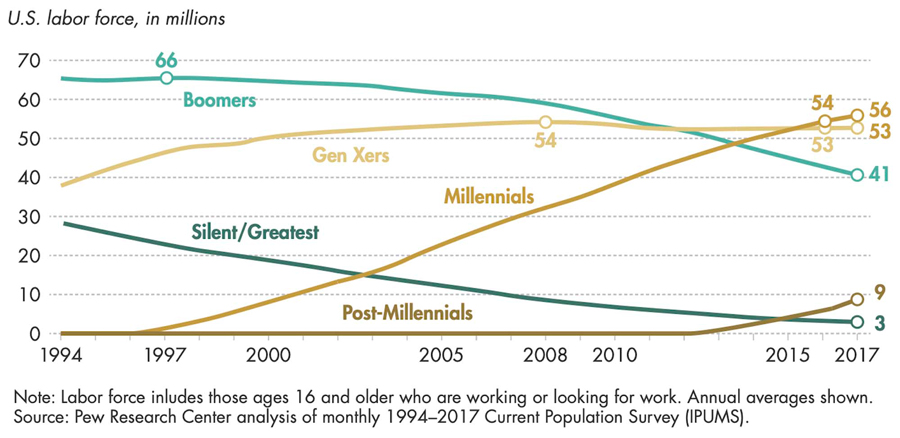
REPRINTED WITH PERMISSION FROM THE PEW RESEARCH CENTER[2]
That brings us to the challenge of today: How do we meet our workforce needs and the business demands of tomorrow?
Over the past five years, the workforce landscape has changed abruptly. The 2020 pandemic may not have been the sole cause of this shift, but it may have accelerated the imminent outcome. Remote work, increased emphasis on work-life balance, increased need for flexible work hours, and other adjustments have become top priorities for many in the newest generations of workers. This is not the world NETA testing companies live in. Our field employee, the NETA Certified Technician, lives in a world of varying work schedules, long days/weeks, work in adverse conditions, travel, and a physically demanding but rewarding job.
We’ve all felt the pain of various supply chain issues during and since the pandemic. Our supply chain crisis is our employees. The demand for talented labor that wants to work in our business is high, and the supply is limited. This has driven up the cost of labor (basic economics), increased costs to customers and job margins, and impacted the ability to meet project schedules. The field employee has become extremely valuable. This labor scarcity will continue to be a challenge unless we can find a way to expand the talent pool. If we can’t find ways to satisfy our industry’s needs, the industry will find ways to achieve its goals without us.
FIND AND DEVELOP QUALIFIED EMPLOYEES
NETA’s Qualified Electrical Maintenance Worker (QEMW) program is expected to create a paradigm shift in the way we do business. This program promotes testing companies to partner with electrical contractors that have QEMW employees and use these workers to expand our capabilities. This will allow us to utilize our highly talented test technicians to focus on high-end testing, leaving the more basic maintenance and testing, including cleaning, inspecting, insulation resistance tests (meggering), and contact resistance tests (ductoring), to the QEMWs.
Even with the advent of the QEMW program, we still need to grow our business and improve the skills and talents of our employees, and that requires an effective employee development program. If we do nothing, nothing will change. To make the necessary improvements, NETA companies will need to identify needs and goals, recruit and evaluate talent, execute a training program, and establish metrics to measure results.
Evaluate Your Needs and Goals
The first requirement is to define what you want to accomplish. Most of us want to grow our business — get a bigger piece of the pie. Growing a business is usually talked about in financial terms. How do these goals get realized? Executable plans and strategies must be put into place to accomplish these objectives.
In the testing business, we sell skilled labor. We know there is a direct correlation between revenue generation and billable heads. That means we must grow and develop our talent pool to accomplish these goals and support the business objectives. From an employee development perspective, you want to reduce the time it takes to advance the skills and knowledge of your employees from a NETA Level 1 to a NETA Level 2 and your NETA Level 2 to a NETA Level 3. Ultimately, you want a skilled team of employees who can execute a project safely and efficiently.
Developing your employees to NETA Level 3 and Level 4 is important. NETA requires NETA Level 3s and Level 4s to be a minimum of 25% of your workforce. Because of this, we often include this as a key metric. However, achieving your long-term goals of developing NETA Level 3s and Level 4s may be better served by focusing elsewhere!
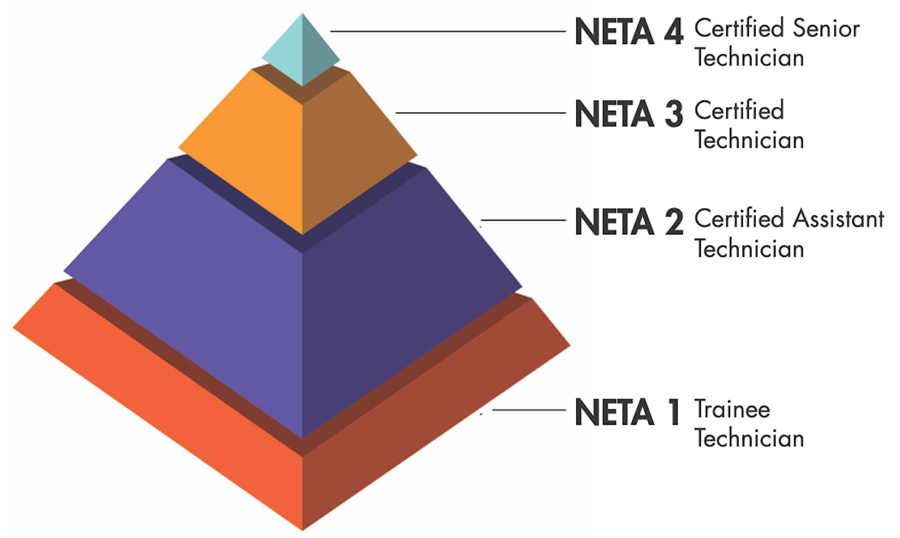
To develop more NETA Level 3s, you must first develop more NETA Level 2s. To have a progression from NETA Level 1 to NETA Level 2 requires a good pool of newly hired employees. This is where I focus most of my energy and attention. Our first focus should be on NETA Level 1s — our new hires. I envision our organization as a pyramid with NETA Level 1s at the base (Figure 3). This group is the foundation, and a strong foundation will make for a strong structure and organization.
Recruit and Evaluate Your Talent
To grow your team, you’ll need to actively find and recruit candidates you can develop. Your first responsibility is to ensure employee safety. Your employees must go through your company’s safety program, and you must provide them with the necessary PPE and tools commensurate with their skill level. This classifies your new employee as a NETA Level 1 Trainee Technician.
Initial technical training will be a combination of classroom (academics), controlled lab hands-on learning, and as a helper in the field under close supervision. Each new employee should be paired with a supervisor/coach/mentor to help them learn, track their progress, and identify their weaknesses. The employee is evaluated to determine where they fit into the overall training program. Do they need help with fundamentals (basic math, geometry, trigonometry, Ohm’s Law, basic circuit analysis, power calculations), or are they ready to tackle testing fundamentals and theory?
EXECUTE YOUR TRAINING PROGRAM
A successful employee development plan has three key components:
- Academic learning
- Hands-on skill development
- On-the-job learning (OJL) and training (OJT)
Safety Training
Safety training is paramount. Your training program must include a safety-focused course(s) focused on your safety manual, OSHA, NFPA 70E, and CPR/First Aid/AED training. Your company should also have an electrical safety qualified worker program that requires the employee to demonstrate safe work practices given various commonly encountered scenarios. Once this is completed, we can turn our attention to technical training.
Technical Training
Training includes academics (fundamentals and theory) as well as hands-on practical learning. The academics can be accomplished through a combination of instructor-led training (ILT) and virtual on-line training. Fundamentals should include math (basic math, geometry, and trigonometry), science, and electrical circuits (Ohm’s Law, circuit fundamentals, power calculations). Virtual instructor-led training (VILT) and consumable video training can be beneficial to help ensure standardized training delivery and control training costs. The biggest challenge, especially with consumable video training, is ensuring its effectiveness.
Classroom Training
Provide formal classroom instructor-led courses. We have a two-week Basic Technical Training (BTT) course for recently hired employees. Employees are scheduled for BTT 90–180 days (ideally) after their start date. This provides time to send them on jobs that expose them to real work experiences before sending them to be trained. This course includes classroom and hands-on lab activities. The classroom sessions cover the fundamentals of testing and teach them about electrical test equipment.
Lab Experience
Next, hands-on lab experience walks them through the testing and maintenance process on the equipment. For this lab activity, we use our training group instructors and supplement them with experienced field staff trainers to ensure students get a real-world experience in the lab. One advantage of these lab exercises over on-the-job training (OJT) is that there is no time pressure. The students have time to think about what they are doing and ask questions to better understand the process. We always caution our students that completing BTT does not make them qualified. To become qualified, they must complete the OJT program under the guidance of a qualified worker designated as their coach and mentor.
Formal OJT
A formal OJT program is invaluable. An OJT program should document the knowledge and skill levels expected of the employee to be successful at the current level (competence) and to reach the next level (advancement). The OJT program also allows management to set expectations and metrics, provides feedback based on the knowledge and skill advancement of each employee, and can be used to track the readiness of an employee to test for the next certification level. The OJT program should contain elements of knowledge and skill that can be evaluated by a standardized test. The skill is observed by their assigned supervisor, coach, or mentor, and the coach/mentor and the employee must sign off on the OJT tasks. This ensures the OJT record accurately reflects what the coach/mentor has witnessed, and that the employee agrees they are competent in the specific tasks. This program ensures the employee’s knowledge and skills are aligned with their certification level.
Video Calls
To supplement the core training of new employees, an instructor delivers monthly training topics via interactive video calls to all field employees. These sessions are usually scheduled for two hours, where a predetermined topic is presented and the employees answer questions and can also ask questions. This has gained a lot of popularity, and we regularly get 30–50 of our team on the calls. The call is recorded and posted in our learning management system (LMS) for future viewing by those who missed the call.
ENSURE PROGRAM SUCCESS
Many NETA companies have a similar and obvious goal: Grow the business. Our challenge is to hire and train employees to meet those goals. Ensuring the success of each employee is key.
Ensure Focus
It’s easy for a student to let a training video run and get distracted by emails, other tasks in the office, or even social media. There are three ways to help ensure the student remains connected to the training.
- Keep the modules short and focus on a specific learning topic/objective. Break more complex topics up into multiple modules.
- Create interactions where the student must perform an action. Interactions can be a question or several questions that the student needs to get right to advance. If the student can’t answer a question correctly, they must review the material again. Make this even more effective by using a bank of questions, so the student doesn’t see the same questions each time they review the material.
- The supervisor must ensure there are no work distractions. Do not expect the employee to do multiple things while they are learning. When it comes to learning, multi-tasking does not exist. They must stay focused on learning.
Establish Metrics
Now that you have plotted your course, created the tools to be successful, and evaluated your talent, you can establish the key metrics to measure your results. To set your employee development metrics, you must know what your business growth plan looks like and determine how that impacts your employee development needs. How many more employees at which skill levels are needed to achieve these goals?
We previously acknowledged a direct correlation between revenue and headcount and noted that NETA requires a minimum ratio of NETA Level 3s and Level 4s to NETA Level 1s and Level 2s. Rapidly hiring too many NETA Level 1s and Level 2s can impact your ability to maintain the 25% requirement for NETA Level 3s and Level 4s. It’s best to be proactive and grow your workforce at a manageable rate and not out of desperation. While the 25% is a NETA minimum requirement, it also makes good sense, and similar ratios are used by other trades.
If you compare the roles and responsibilities of a NETA Level 1 and NETA Level 2 to those of a NETA Level 3 and NETA Level 4, the ratio of 4:1 ensures that the less experienced testers are working with and being provided adequate supervision by a qualified tester. This also helps ensure they develop the necessary skills to perform their work safely and according to NETA testing specifications. If you need to grow your talent by 10%, you must evaluate the impact of adding 10% NETA Level 1s and Level 2s to the required ratio. However, if you proactively and methodically develop your talent, you can manage this metric and avoid dropping below the requirement.
Manage Career Progression
Actively manage employees’ career progression and identify candidates who are approaching the window of advancement in NETA certification. I track employees and urge them to begin their preparation for the NETA examination about six months before their testing window. We determine the employee’s learning needs and provide direction in preparation for the exam. In addition to the NETA requirements, we establish OJT expectations to increase the likelihood of passing the exam. After they take the exam, pass or fail, we follow up and identify topics they felt they were or were not prepared for. This not only helps us coach that employee but also helps us better prepare other employees.
Once you create a strong foundation of NETA Level 1 Trainee Technicians and tailor your program to develop their talent and transition to NETA Level 2, it’s easy to develop a similar program and strategy for transitioning to NETA Level 3 and then to NETA Level 4. While ANSI/NETA ETT, Standard for Certification of Electrical Testing Technicians, provides a framework, you will need to develop the details of the program to achieve those requirements.
Use Trainers and Mentors
An employee development program must include all the right pieces in all the right places. This includes training key senior employees as trainers, coaches, and mentors. Some people inherently make good teachers, others do not. Some see the new employee as a threat to their employment and advancement, and intentionally, but covertly, do not help the new employee learn and advance. Over the years, I have seen this too many times.
Make sure you have the right people in the right roles and paired up with the right trainees. The employees you identify as trainers must have the heart of a teacher. They must understand the knowledge that must be taught and the skills that must be developed. You must invest in these trainers so they understand how to train and how to employ adult learning methods. Many good programs that teach adult learning processes and methods are available. Ensure your trainers understand their responsibilities. Remember, the objective here is to develop the new employee into a NETA Level 2 Certified Assistant Technician.
Schedule regular meetings with trainers and mentors to get feedback about a new employee’s skills development. Identify any new employees who struggle to advance. If you’ve provided your NETA Level 1 Trainee Technicians with the needed field experience and formal training, but they are struggling, you must identify the cause of their struggles.
Are they simply poor test takers? There was a time when I thought this was just an excuse, but it’s a real thing. I’ve seen some very bright and talented individuals have difficulty passing a test they should ace. They second-guess themselves. They think the questions are trick questions. They read things into the questions. To help these employees, you will need to coach them on how to take tests. Discuss ways to examine the questions and evaluate their responses.
Practice exams are great for these individuals. To help them, I created a list of 10 things employees can do to improve their test performance, including time management skills, avoiding distractions, answer selection strategies, managing difficult or wordy questions, and when it’s OK to change an answer. Recent results indicate this has been helpful.
Provide Resources
Employees must have the necessary reference materials available to facilitate their learning. We recently created a resource center within our LMS where our technicians can access, download, and review content to learn more about various topics. This resource includes the basics of transformers, CTs, VTs, circuit breakers, grounding, EVs, relay fundamentals, and more. Short videos teach some of the more academic topics, such as basic math, geometry, trigonometry, science, circuit analysis, Ohm’s Law, power calculations, and phasors. Links to other material are available via YouTube to assist with learning and development. This has proven very beneficial to providing focused and vetted material that helps develop their knowledge. The academics help them understand the why. Working with a good teacher helps them learn and understand the how.
ANALYZE YOUR TALENT POOL
What if you have employees who don’t want to be developed? In the past, we were often satisfied with those who just wanted to be rag workers or helpers. They were not interested in enhancing their talents, taking on additional responsibilities, or climbing the ladder (literally and figuratively). They were satisfied to be told what to do and when to do it. About 10 years ago, I analyzed our company, and I was surprised to see how many career NETA Level 1s we had!
When working to improve your talent pool, being bottom-heavy with limited advancement potential can be problematic if your goal is to create a conduit for advancement. This weakens your foundation. Each of these career NETA Level 1s is someone you can’t develop or expect to become a productive tester or job lead. They are your knob turners. They are on the dumb end of the test set. They are in the way of others who want to advance. However, because they’ve been with your company for so long, they’re loyal; everybody likes them. It becomes difficult to replace them, so they continue to get rewarded for mediocre performance and, in many cases, end up getting compensated like a NETA Level 2 or NETA Level 3.
How do you resolve this challenge? You will need to schedule a career counseling session to outline your expectations for them to achieve their NETA Level 2 and Level 3 over a given period if they want to continue working for you. An alternative is to cap future raises to align their position with their compensation. What is the likely outcome? You may lose them. If you do, you have created an opportunity to fill that position with someone who has career aspirations and can benefit your company long term. The key takeaway: Don’t reward poor behavior.
You also need to know what your employees want out of their careers. Most companies have a formal and documented meeting with each employee at least once a year to discuss, at a minimum, the employee’s performance and merit increase. Instead of simply saying, “We appreciate you; here’s your raise,” take advantage of this opportunity to have a career discussion. Find out what their interests and expectations are and let them know your plan for them. Employees appreciate knowing that you have a place for them in your organization and plans for their future. These conversations are enjoyable and pleasant when their performance and expectations align with yours.
However, these conversations can be challenging and difficult when expectations don’t align. While an employee may see themselves as a rockstar, you may see them as problematic or an underperformer. Now is the time to get those issues out in the open. You must clearly communicate your expectations. When discussing the need for improved performance, use specific instances where the employee did not meet your expectations. If you believe the employee has a future with you, let them know, but also let them know what must change so you don’t have to have another conversation like this one.
For these employees, a year is too long to wait for a follow-up meeting. Set the next meeting in three months. Then, when you meet again, you can determine if you’ve seen positive change and praise them; if not, let them know what is next. This is the time to determine whether they have a future with your company. These conversations can be challenging. Always prepare for these meetings and determine what is necessary to create a win-win outcome.
FIND NEW TALENT
Another stream of future talent is to consider potential candidates coming directly out of high school. Many high school students approach graduation without knowing what they want to be when they grow up. Many years ago, I was one of them!
However, this young and inexperienced talent pool creates special challenges. How can we develop someone with no work or electrical knowledge and experience into our workforce? They will need significantly more training than someone who has already learned about electricity from a trade school or the military. They will also need more supervision. Most testing companies don’t have the time or finances to create such an extensive program or resources to invest at this level.
How can this be done timely and at a reasonable cost? That is the key question moving forward. Very few programs that focus on our industry are currently available, and in limited locations. High school graduates may not live in areas where these programs are offered, lack the finances to attend, or may not be aware of the program and the potential career that could be available should they complete such a program.
CONCLUSION
Employee development is a critical component of the growth and success of NETA testing companies. Over the past five years, we have reached critical mass in the supply and demand market of our most valuable resource: our employees. There is no short-term, quick-fix solution. The projected job market has no light at the end of the tunnel. We must invest in developing our employees and organically grow our own talent to meet the needs of tomorrow.
This won’t happen by accident or without a plan. You must identify your needs and develop a program that supports those needs. In addition to developing your employees, you must focus on the necessary actions to retain existing talent and groom them for the future.
A professional and positive work culture can go a long way in retaining valuable talent. From a financial perspective, be aware of the cost of turnover. In our business, where we use skilled workers, the cost of turnover can reach six figures when all factors are considered. Consider this cost when making business decisions that could alienate workers and increase turnover.
Don’t make promises you can’t keep just to meet the labor needs for today’s job. Every employee should be thought of as a long-term investment. Do everything possible to develop their skills to help you not only on today’s job, but also the jobs of tomorrow.
Employee development is an important topic that affects all NETA testing companies, and I hope others will offer their perspectives on the numerous additional aspects not addressed in this article.
REFERENCES
- U.S. Bureau of Labor Statistics. Civilian Employment (Seasonally Adjusted) 1980-2025.
- Fry, Richard. (2018, April 11), Millennials are the largest generation in the U.S. labor force. Pew Research Center, Short Reads.

Steve Park, PE, is Director, Training and Employee Development at Electrical Reliability Services. With over 45 years of distinguished experience in the power system industry, Park is a recognized expert in electrical systems and professional development whose comprehensive background encompasses hands-on experience as a power system maintenance lineman, electrical design engineer, and system studies expert. Park’s technical expertise includes short-circuit analysis, selective coordination, load-flow assessment, arc flash analysis and mitigation, harmonics analysis, medium- and high-voltage cable testing, and system apparatus testing and maintenance. In his current role, Park leads transformative initiatives in ERS training and employee development programs. Park is a Professional Engineer and a NETA Level 3 Certified Test Technician, and is OSHA-30 qualified. He received his BS and MS in electrical and electronics engineering from Purdue University and an MBA from Indiana Wesleyan University.