

Maintaining operations and achieving financial goals often requires shifting or reallocating both economic and non-economic resources. One of the top concerns among leaders in the electrical field service industry is the loss of human capital.
Over the last three years, I have been involved with a quantitative correlational study that examined the relationship between general job satisfaction, employee motivation, and employee turnover intentions. Participants included electrical engineers and technicians in the electrical field service industry, focusing on NETA-Certified Technicians. This article will present the findings of this study and offer insights related to today’s electrical power industry work environment.
BACKGROUND
The United States workforce, and specifically the electrical field service industry, is a collection of individuals working in various environments and industry segments with different levels of formal education and professional certifications. Electrical engineers and technicians interact on-site with individuals who may or may not have a technical understanding of what they do or their scope of work. Because of that, they must understand how to communicate with multiple levels of leadership to ensure customer satisfaction and understanding.
In recent years, we have seen electrical professionals who have been working in the field continuing to work later in life. This means that with the aging of the workforce, companies are increasingly faced with integrating multiple generations, necessitating a broader understanding of the needs and skills of each age group. Each generation grew up with different advancements in technology and forms of written and digital communication. What works for one generation may not work for another. In addition, the distinct generations differ significantly in their orientation and motivation to work and advance their careers.
Therefore, having one approach to employee management does not work for all employees. Furthermore, we cannot assume that one type of employee relates better to a particular form of communication, or that specific generations will not or cannot adapt to it.
Factors Impacting Job Satisfaction, Employee Motivation, and Turnover
Many factors impact employee retention, culture being one of the most important. The workforce is made up of cultures from around the world, yet the existence of varying norms and traditions within the different regions in the United States is often overlooked. A multicultural workforce will have different drivers and motivation factors that lead to job satisfaction and motivation. In the past, organizations often applied one approach to improving employee retention. Today, no one solution will equally impact every employee in the same manner.
The purpose of this electrical power services industry quantitative correlational study and this article is to help organizations understand the constantly changing factors driving employee retention so they can lower voluntary turnover intentions.
Benefits of Increased Employee Retention
Employee turnover increases hiring costs and reduces company profitability. Reducing voluntary turnover allows an organization to reinvest the savings into programs that directly impact and drive employee retention. Maintaining the mindset of just accepting present turnover rates means businesses have to adjust their budgets to include additional hiring costs to maintain expected financial performance.
Human resource teams are looking for answers: What is the correlation between job satisfaction, employee motivation, and turnover intentions?
As the industry has evolved, electrical field service workers’ mindset about full-time versus on-demand or gig-worker philosophy has shifted. If we unpack on-demand or gig-worker concepts, we find a changing perspective. Some workers are no longer driven by overtime pay or guaranteed hours, but rather by more time off or not working weekends or holidays. They want to dictate their schedule and choose when and if they work. This mental shift is problematic, as we know this industry lives and dies with after-hours support, holiday work, and long outages or quick turnarounds. Due to this shift in employee desires, organizational leaders need to take an active and continuous approach to identify and understand the issues leading to turnover intentions within their workforce.
Problem and Purpose
Because workforce demands are unique to the electrical field service industry, companies struggle to understand the connection between job satisfaction, employee motivation, and employee turnover intentions and appropriately create retention improvement plans.
So, what are turnover intentions? Employees generally take an active or passive approach to finding a new job. For example, an employee who is satisfied but not motivated would passively look for a job, meaning they will respond to an email or take a phone call from a recruiter or hiring manager. With an active approach to turnover, a motivated employee will actively seek a new job that fits with their career growth, financial expectations, or their stage of life.
The first step to understanding turnover intentions is to define the reasons employees are resigning:
- Seek to understand why each employee chooses to quit.
- Evaluate how employees are recognized, rewarded, and motivated.
- Consider how the work environment, culture, or workforce makeup has changed, and how this drives different desires or motivators.
ELECTRICAL SERVICE INDUSTRY QUANTITATIVE CORRELATIONAL STUDY RESULTS
The purpose of the electrical service industry quantitative correlational study was to examine the relationship between job satisfaction, employee motivation, and employee turnover intentions. The primary target of the study was electrical field service personnel working for NETA Accredited Companies. The focused group of participants resided in the United States and currently held a NETA I, II, III, or IV certification.
Defining Job Satisfaction and Employee Motivation
In exploring job satisfaction, field service personnel defined satisfaction differently based on communication styles, demographics, cultures, groups, and security risks.
The study found that employee motivation is a business topic researchers and leaders are working to understand, and they are investing in identifying ways to minimize the impact of reduced profitability and lower efficiency in productivity hours on business objectives.
Independent Variable: Job Satisfaction
The funnel (Figure 1) represents a wide range of topics that feed into job satisfaction, which is defined as a sense of fulfillment, enjoyment, or an emotional state derived from one’s job.
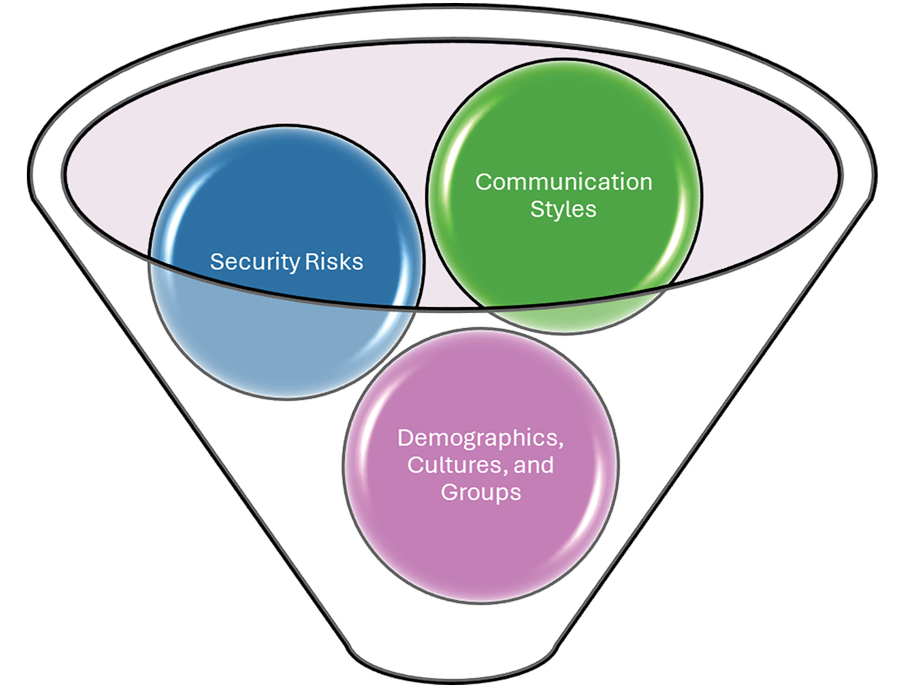
The study found that job satisfaction is made up of three parts.
- Communication styles, including types of communication, categories or classifications, and sociability versus dominance
- Security risks
- Demographics, cultures, and groups
A funnel compresses something into a small output while blending all the inputs. The circles are a fraction of what does or could make up job satisfaction. For example, job security could be a larger percentage of job satisfaction over how team members interact, but both impact the value or quality of one’s job satisfaction.
Communication Styles
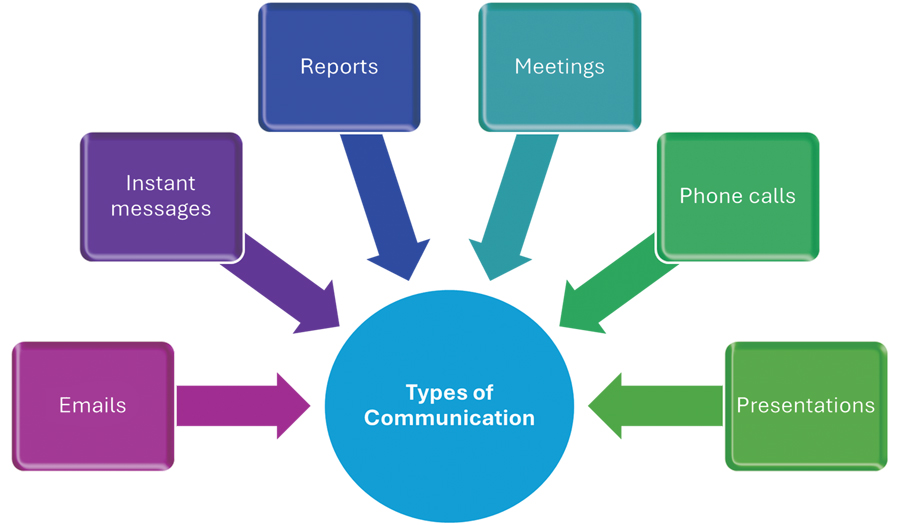
Email, instant messenger, reports, meetings, phone calls, and presentations are just a few of the formats to be considered (Figure 2). An organization should have a formal communication protocol that addresses which form of communication should be used when communicating with its workforce.
Understanding the work environment and context of different types of messages is critical to ensure clarity, timeliness, and communication satisfaction. For example, an individual working in the field or during an outage is not able to receive important or time-sensitive information via a presentation, report, or email. An instant message or a phone call could prove more beneficial. Another example is expecting a field technician to read and review reports or email communications by the end of their on-site work shift.
An organizational communication protocol will ensure that the proper or most effective form of communication is used based on an understanding of the work environment and the nature of the information being relayed. The lack of a communication protocol can adversely impact job satisfaction through unrealistic employee expectations.
Different types of messages require different methods of delivery. More complex communications — such as policy changes or major organizational announcements — are best shared via email or presentations that can be saved and referenced later. Instant messages or phone calls may omit key details or follow-up actions. For example, if employees are required to review and acknowledge a document, it should be delivered via email to ensure proper tracking.
Similarly, significant organizational changes should be communicated through a formal channel, like email or a detailed report.
However, to positively influence job satisfaction, the research shows it is most effective to personally reach out to individuals most affected by the change through phone calls, in-person meetings, or video conferences. Personal communication fosters trust and helps ensure clarity.
Equally important is understanding direct report employees’ preferred communication style and how it impacts the delivery and reception of messages.
We often get only one chance to have a first and impactful impression with the communication of information. Consider how best to communicate information and in what format.
- Deliver the details in the most effective manner.
- Communicate in a manner that fits the audience by determining tone of voice and body language.
Communication Classifications
Six categories or classifications of communication can impact job satisfaction: verbal, written, non-verbal, visual, interpersonal, and listening.
In addition to verbal, body language is a natural form of communication and is classified as non-verbal and visual. During a meeting, a loud and overbearing presenter could negatively impact job satisfaction. For example, an individual might interpret the tone and visual cues as anger or even disappointment in performance.
It is important to know your team and peers and their response to different classifications of communication. A good practice is to regularly engage in two-way interactions, following up in writing to capture key points for later discussion and follow-up. A leader’s words are important and impactful, and the style of communication directly impacts employee job satisfaction.
A practical comparison can demonstrate the importance of understanding communication classifications and nuances. Aggressive and assertive communication are similar, and individuals might not recognize the difference. Assertive communication contains an essential element of sociability or a personal approach. If an interaction is a win/win, the communication is assertive. On the other hand, if both parties win, but one party feels less open, then communication is aggressive, which can lead to decreased job satisfaction.
- Aggressive: Assigning or demanding a quota based strictly on run rates without considering the knowledge of the local team or local market.
- Assertive: Presenting the quota, staying open to direct feedback, and modifying the objective or quota based on peer feedback and insight.
Comparing passive versus assertive communication, taking a personal approach can be considered assertive or aggressive communication, while passive interaction can be seen as a lack of dominance or confidence in one’s leadership.
INDEPENDENT VARIABLE: EMPLOYEE MOTIVATION
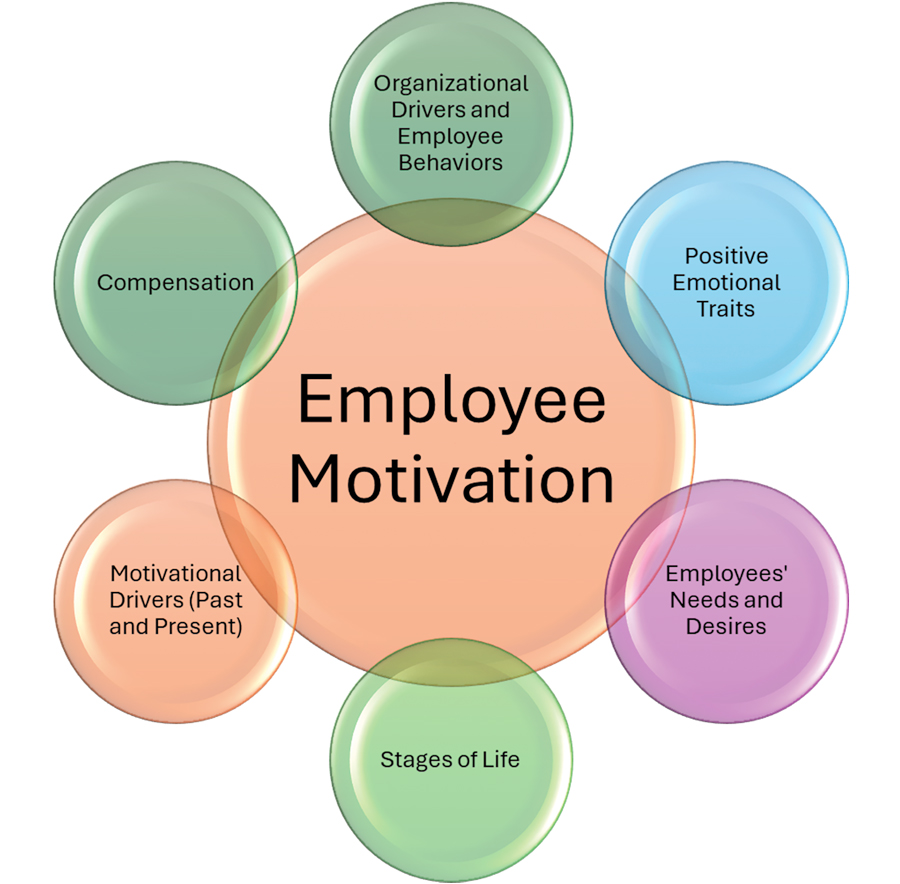
The circles in Figure 3 represent the topics that feed employee motivation and what employee motivation needs to survive. Even though the outer circles are the same size, they do not equally contribute to employee motivation, yet all are needed in different quantities and at various stages of life to ensure a strong and healthy environment.
Consider:
- What motivates your team members?
- Are managers and field engineers motivated by the same items?
- Does life stage, job stage, or career stage have a greater impact on employee motivation?
Employee motivation is made up of motivational drivers past and present, compensation, organizational drivers and employee behaviors, positive emotional traits, employees’ needs and desires, and stages of life.
Now let’s focus on the stages of life broken down by life stages, job stages, and career stages. It is vital to know which stage individual employees are in to accurately identify and implement employee motivation initiatives.
Motivation: Life Stages
Traveling through life stages (Figure 4) is often — but not always — linear. A worker might be in the advanced stage of their career or thinking about winding down, but be moved into a leadership or consulting role, only to feel like they were starting over. Or perhaps someone moves their focus to family, like having another child or being a caretaker for aging parents.
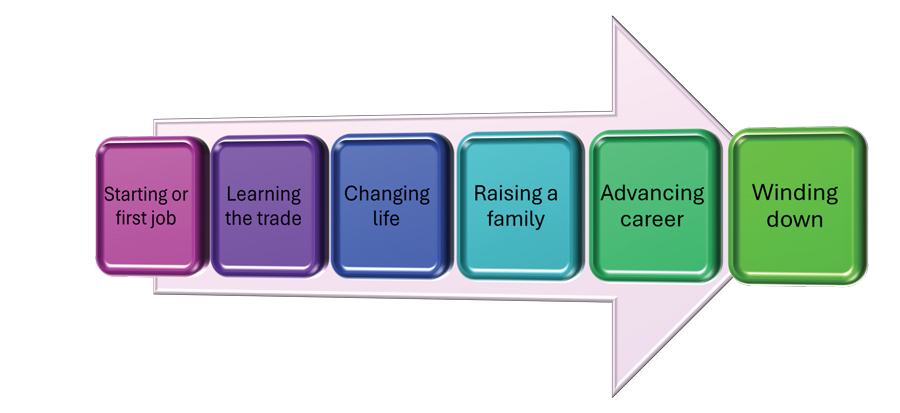
Each life stage comes with different motivating factors. When starting a career or a first job, workers are eager to perform while learning the trade. Then maybe life changes, like starting a personal relationship, and now you have more than work to focus on and nurture. For some, raising a family becomes a primary focus outside of work, while others may focus on advancing their careers. In some cases, an individual may be forced to wind down their career.
The complexity of life stages and the lack of linearity are important considerations when considering employee motivators. A keen understanding of the life stage concept will prepare organizational leadership to recognize and support employees while aiding in employee motivation.
Motivation: Job Stages
What are job stages, and how do they impact employee motivation? We break down job stages into seven parts: attraction, recruitment, onboarding, development, retention, exit, and advocacy (Figure 5).

Attraction: How to attract prospective employees to your organization.
- Offer sign-on bonuses, a customized service vehicle, or other perquisites.
- Offer perquisites for the short- or long-term.
- Offer tuition reimbursement for formal education and portray the organization’s desire to drive professional growth and career development.
- Offer professional development and outline career paths.
Retention: Why an employee chooses to stay with the company
- What is the value of retention?
- What are your costs for hiring, onboarding, and training one individual?
- If you could reduce voluntary turnover by 1%, which equals the cost of hiring two people, would you do it?
Advocacy: How an employee will speak about or portray their employer and the leadership team after they exit the organization. This is the most significant and defining part of a person’s job stage.
Motivation: Money
Money can buy short-term results, but investing in employee development returns long-term dividends with loyal people. Short-term sign-on bonuses invest in the local economy, not your business.
Long-term investment can include annual formal technical training or formal education, like college. In either case, money is invested into human capital that will pay long-term dividends with loyalty and the most technically knowledgeable team in your market.
For example, research indicates that a tuition reimbursement program increases employee motivation for all employees, even when only a few people use the program. The value and strength of peer collaboration or achievement far outweigh the cost of the program, and depending on their life stage, other employees might want tuition reimbursement in the upcoming years.
Motivation: Recruitment and Onboarding
The recruitment and hiring process can also impact employee motivation. Does the process take days, weeks, or months with numerous interviews for a decision to hire? Recruitment is more than a job posting. It directly impacts employee motivation when other employees are working longer hours without sufficient support.
Having a well-defined onboarding process is important to an employee’s first impression of a company. It sets the trajectory of a new hire’s employment. With a structured onboarding process, a manager can review and discuss the development process and programs offered, such as tuition reimbursement for formal education.
Motivation: Manage Employee Exit
When an employee resigns, they exit the organization, and the exit process is the last interaction you have with them before they become a positive or negative advocate for the organization. Whether an employee leaves voluntarily or for other reasons, it is critical to treat them with respect, dignity, and encouragement. Everyone is connected within industries, and word of mouth carries tremendous power that will impact current employee motivation, along with the potential motivation of future employees and candidates. Create a strategy to have a positive impact on departing employees to drive advocacy.
Motivation: Career Stage
The challenge: How can we in the electrical power service industry attract people to explore the amazing and ever-changing world of reliable power?
When people enter the workforce stage, they explore industries looking for the types of jobs where they can find motivation to wake up every day and go to work. Career stages include exploration, establishment, mid-career, late-career, and retirement (Figure 6). People work to make money; however, many look forward to some version of retirement.

Figure 6: Career Stages
Society may think that data centers ensure they can stream their favorite TV shows or movies. Those of us in this industry know that without our services to maintain reliable electrical infrastructures, data centers could not successfully function and deliver content. We need focused initiatives that inspire the next generation to explore electrical field service and testing as a career.
After individuals join the electrical power service industry, they begin to establish themselves through peer connections and professional development, such as NETA Technician certification. When individuals pass a technician exam, they have immediate expectations. Organizations that have a formal policy on employee advancement will be best positioned to meet those technicians’ expectations. The importance of this is realized when a technician posts their accomplishment on social media, and recruiters instantly reach out.
Moving into the mid-career stage, individuals may shift their focus from professional development to a better work-life balance. When employees achieve contributorship status, their motivation shifts from development to retention and staying at a company. Even if employees choose a state of contentment, but not complacency, it’s still important to find ways to nurture employee motivation.
For example, when organizations do not focus on employee motivation during the mid-career, they lose employees through voluntary turnover as they enter the late-career stage. At this point, it is difficult to attract individuals to come back or stay, as they are focused on winding down to retirement. Ultimately, if leaders can retain employees at the later stages of their mid-career, they have a better chance of retaining them until retirement. It is also important to remember that mid-career employees are still driving employee motivation among their peers and the next generation.
During the winding-down career phase — the retirement stage — retirees often fade into the sunset, even if they still have a desire to contribute. While their motivations are very different from their younger colleagues, organizations should develop a focused plan to keep them motivated and consider retaining them in a mentorship or training position, supporting the organization in developing the next generation or doing project management on the next major contract.
RECOMMENDATIONS
Every employee is unique, and they have various career aspirations. It takes an investment of time and resources to regularly have two-way conversations with team members to discover their needs, motivators, and career trajectory.
Successful organizations that focus on maximizing employee retention have defined objectives and programs with defined check-in periods that contain both measurable and social metrics.
Draft career paths for individuals, then support them financially and with mentoring to ensure their success.
Establish communication policies and long-term perquisites, such as tuition reimbursement programs, that can improve employee loyalty and satisfaction.
Monitor and measure the impact of your retention plan, evaluate the depth of knowledge your team gains, and how they share what they learn.
Modify your retirement plan to include matching funding and a variety of contribution options.
Finally, invest in employees through social or environmental initiatives. Corporate social responsibility (CSR) is a business model where leaders focus on activities and initiatives that directly impact society or the environment. An example is when leaders invest in social programs that help the local community. If employees participate in a social program outside of work, they show a personal attraction and appreciation for the company’s support, leading to a stronger personal connection with the company. This type of connection positively influences job satisfaction and employee motivation because employees feel that company leaders are using profits to support causes that matter to them.
An environmental initiative in CSR could focus on projects or contracts related to renewable energy or energy efficiency. Imagine if your employees had solar, wind, or battery-backup systems at home. Leaders who prioritize renewable energy projects will boost employee motivation because they have a personal and direct link to the company’s products or service offerings.
REFERENCES
- Daniels, J. M. (2024). Electrical Field Service Employees’ Intent to Stay or Leave. Publication No. 30991912, Doctoral Dissertation, Walden University-Minneapolis. ScholarWorks Dissertations and Theses Global. https://scholarworks.waldenu.edu/dissertations/15380/.
- Asante Boadi, E., He, Z., Boadi, E. K., Bosompem, J., and Avornyo, P. (2020). Consequences of corporate social responsibility on employees: The moderating role of work motivation patterns. Personnel Review, 49(1), 231–249.
- Chesney, A. J. (2022). Should I get a master’s degree? Evaluating peer effects on education investment decisions in the workplace. Economics of Education Review, 91, Article e102329.
- Guinot, J., Monfort, A., and Chiva, R. (2021). How to increase job satisfaction: The role of participative decisions and feeling trusted. Employee Relations: The International Journal, 43(6), 1397–1413.
- Marx, C. K., Reimann, M., and Diewald, M. (2021). Do work-life measures really matter? The impact of flexible working hours and home-based teleworking in preventing voluntary employee exits. Social Sciences, 10(9), 1–22.
- Miller, S. (2022). Reports filter human capital and talent access data by industry, size, region and sector. Society for Human Resource Management.
- Nagurney, A. (2021). Supply chain game theory network modeling under labor constraints: Applications to the Covid-19 pandemic. European Journal of Operational Research, 293(3), 880–891.
- Navarra, K. (2022, April 11). The real costs of recruitment. Society for Human Resource Management.
- Nwafor, O., Ma, X., Hou, J., and Johnson, N. (2022). Online communities and discontinuance of information technology-enabled on-demand workers: Impacts of informal social interactions through dual commitments. International Journal of Information Management, 66, Article e102540.
- Ozsoy, E. (2019). An empirical test of Herzberg’s two-factor motivation theory. Marketing and Management of Innovations, 1, 11–20.
- Szostak, M., & Sułkowski, Ł. (2021). Artist, creator, manager, entrepreneur, leader: How society perceive these identities? Economics & Sociology, 14(2), 209–221.
- Thome, M. J., and Greenwald, J. M. (2020). Job and community embeddedness on voluntary turnover. Journal of Business & Industrial Marketing, 35(10), 1573–1580.
- Vora, D., Martin, L., Fitzsimmons, S. R., Pekerti, A. A., Lakshman, C., and Raheem, S. (2019). Multiculturalism within individuals: A review, critique, and agenda for future research. Journal of International Business Studies, 50(4), 499–524.
- Wei, L., & Nezaj, J. (2022). Missing workers: The labor market has yet to recover from the pandemic. ADP Research Institute.

Jeffrey M. Daniels, PhD, currently works for CBIONE, supporting business growth based on his experience in hands-on fieldwork, back office and program support, local and regional leadership roles, and significant capital expense negotiations and purchases. He started his career in the Navy Nuclear Power Program as an Electrician’s Mate and joined the electrical testing industry at Electrical Reliability Services, formerly known as Electro-Test Inc., where he worked as a NETA Level 3 Certified Technician and held various leadership positions, including a director role. During that time, Jeffrey earned a BS in applied sciences and technology with an emphasis in nuclear engineering and an MBA from Thomas Edison State University. Roughly a decade later, Daniels earned a PhD in business administration (DBA) from Walden University. Daniels serves on the board of directors for the Strategic Alliance for Veteran Integration (SAVI), which supports clarifying benefits and providing customized transition solutions to veterans and organizations.