

We are in the midst of a metamorphosis of the North American grid. An energy transition is underway, leading to rapid changes in the energy resource mix. Governmental policies, changes in resource economics, and consumer
demand for clean energy are impacting the change. The challenge facing the industry now, and in the coming decade, is how to assure resource adequacy in an era with a rapidly changing resource mix,
extreme weather events, growing electricity demand due to electrification policies, and cyber and physical security concerns.
CHALLENGES
The Pace of Change
Managing the pace change in a manner that maintains reliability is our greatest challenge as the grid transforms and is increasingly:
- Decarbonized — the interconnection of variable energy generation
- Distributed — energy resources, such as rooftop solar and other resources, connected to the distribution system
- Digitized — in load management and also in grid operations
One of the biggest challenges identified in our seasonal and longer-term reliability assessments is the disorderly retirement of traditional generation, with its inherent ability to provide certain energy and essential reliability services. The pace of those retirements is outstripping the development/deployment of other forms of generation that could provide this capability, such as batteries, hydrogen, and advanced demand-side management.
Going back at least five years, NERC Reliability Assessments have noted a steady deterioration in the risk profile of the grid. We have seen a decline in traditional generation, especially coal and nuclear, creating greater dependence on natural gas, which is subject to systemic failure during cold weather events such as Winter Storm Uri in 2021.
During the same timeframe, we have also seen the expansion of asynchronous inverter-based resources, whose performance has exacerbated the impacts on the system creating an increasing number of reliability events. The most recent in West Texas barely avoided load shed (1,700 MW inverter failure along with 800 MW conventional resource).
Changing Weather Patterns
Weather and climate change are also driving factors in our current need for grid transformation. The extreme weather system events we are experiencing have three common characteristics:
- Longer duration — a real issue when relying on inventoried fuels such as oil in New England
- More extreme temperatures (hot and cold) than planned for — a key issue during Winter Storm Elliott
- Broader impacted areas — limiting the ability to rely on neighboring systems for support, which was the primary contributor to the August 2020 California load-shed event
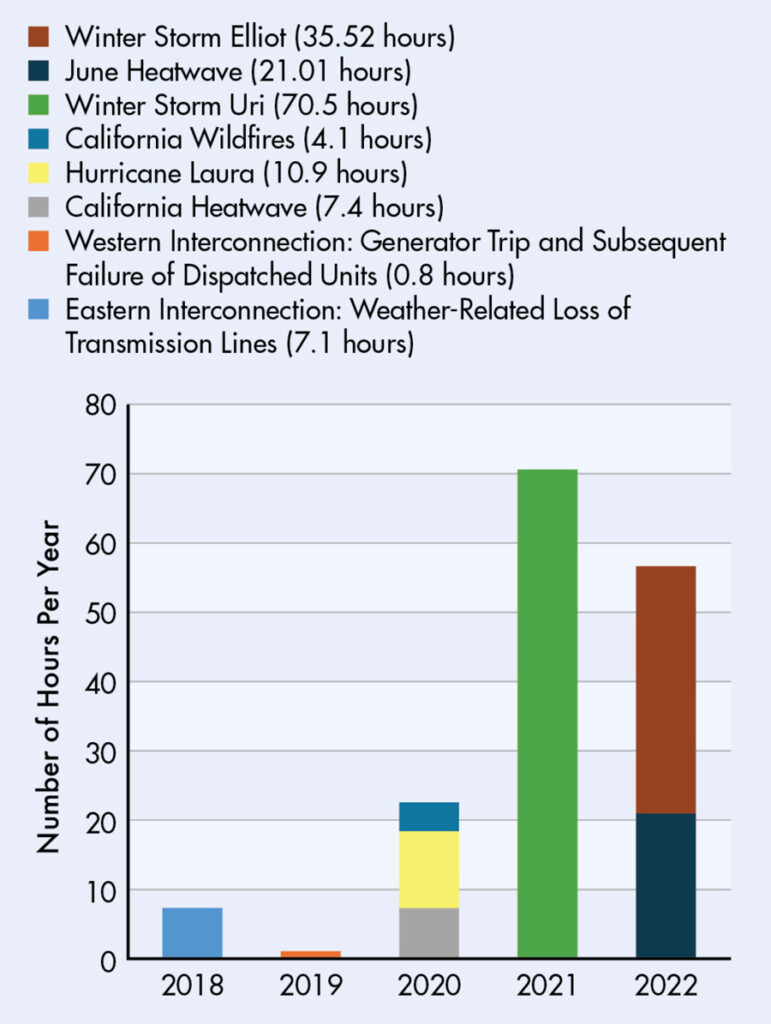
Power outages from extreme weather have doubled over the past two decades across the country, highlighting our aging grid and infrastructure (Figure 1). Vulnerable communities have disproportionally suffered during these events, often unable to evacuate from natural disasters or maintain expensive on-site generating equipment during outages.
A Changing Demand Profile
For the first time, we are seeing a net-growth forecast due to electrification policies such as those related to transportation, space heating, and the addition of large data centers. With growth comes increasing reliability expectations and new modeling uncertainties such as forecasting winter peaks (especially in heat-pump markets), or understanding how these technologies will operate during events.
Now more than ever we need to get two things right: engineering resource integration of these asynchronous resources to ensure they support grid reliability and managing the uncertainty from fuel availability.
A Paradigm Shift
Historically, analysis of the resource adequacy of the bulk power system (BPS) focused on nameplate capacity over peak time periods. Assessment of resource adequacy focused on capacity reserve levels compared to peak demand because resources were generally dispatchable and, except for unit outages and de-rates, were available when needed. Review and clarification of these traditional metrics are needed to understand their assumptions and develop additional meaningful measures and metrics that support key aspects of capacity delivery of energy and essential reliability services.
A key assumption in the previous analysis was that fuel is available when capacity is required to provide the requisite energy. With diverse, dispatchable resource technologies, capacity from other technologies could mitigate impacts if fuel for one resource type became unavailable.
But the shift in resources coupled with an increase in extreme weather presents new challenges. Fuel sources are inherently less certain. Basically, the assumption is:
Capacity > Energy and Essential Reliability Services
Capacity used to be king as it provided all that was needed to support the reliable operation of the BPS (energy and essential reliability services). But we know now that with unassured fuel, the king has no clothes. Energy and essential reliability services now require focused attention over capacity requirements.
POTENTIAL SOLUTIONS
What Will it Take to Get to a Reliability Solution?
- Manage the pace of transformation. We must have interagency coordination on policies that impact generation, especially coal, to keep reliability at the forefront of the policy table. We must accelerate the development and deployment of new technologies to create more security (e.g., long-duration batteries, small modular reactors, hydrogen).
- Create a pricing mechanism to compensate generators. Industry must find a way to compensate generators for out-of-market reliability investments to address fuel uncertainties and create similar outcomes to the obligation-to-serve model, such as firm gas contracts, fuel in inventory for reliability purposes (not economic optimization), retention of “in case of emergency, break glass” capacity, and winterization requirements.
- Restrict traditional unit retirements. Until energy, capacity, and essential reliability services are fully replaced, the pace of the retirement of traditional units must be carefully managed. This may require a new pricing construct based on insurance value so as not to distort markets.
- Ensure new resources — mostly inverter-based — to boost reliability. These resources must have ride-through capability that does not amplify minor disturbances; be correctly modeled so they don’t become black boxes; and create incentives for IBR units to provide dispatchability, synthetic frequency response, voltage support, and other essential reliability services.
- Shift focus to 24×7 energy planning, not just capacity plus a reserve margin. We must recognize that generation failures are no longer random events but are increasingly driven by common conditions — e.g., solar (cloud cover) or wind (drought). We must develop deeper operating insights into fuel availability, especially gas.
- Plan for increasingly extreme weather conditions and recognize that weather impacts demand and supply in new and unusual ways. We must now consider cold-weather demand in heat-pump markets, wind drought or too much wind, marine layer and cloud cover, and smoke.
- More investment in infrastructure. We are going to need more investment that breaks the back of the siting problem, electric transmission investments to harden the system and improve resilience, and new sources of supply to connect to load centers. We also need investments in fuel delivery infrastructure, particularly natural gas, such as:
- Transmission to create resilience and redundancy.
- Market area storage to create supply security and flexibility.
- Develop better visibility into distributed energy resources (DER). We must have better visibility into DERs as they are getting large enough to impact BPS stability and performance.
- Address known and existing risks. We need to keep our eyes on the basic engineering and operations to address existing risks (e.g., facility ratings, vegetation management).
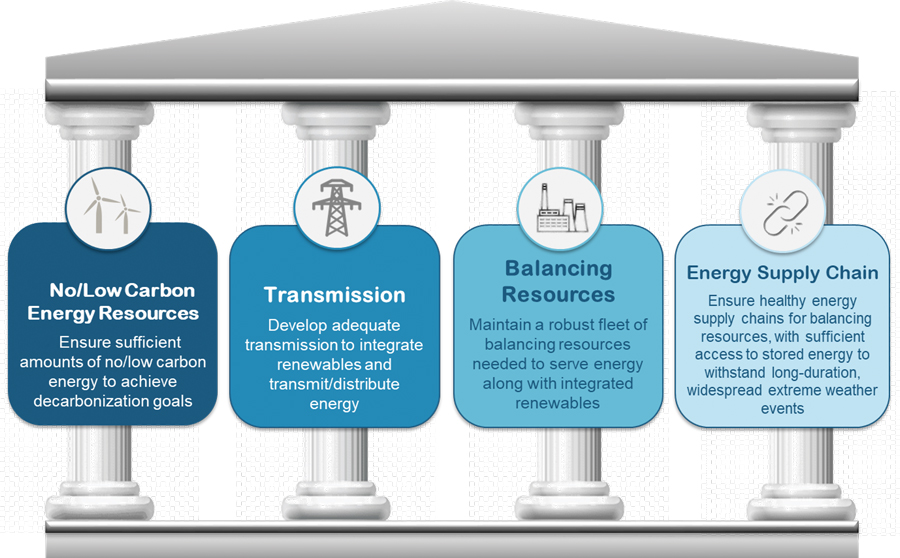
A simplified representation of the aforementioned is shown in Figure 2.
CONCLUSION
The good news about these challenges is that they present opportunities. To address the challenges of our era, policymakers, regulators, and industries across multiple jurisdictions must work together toward common goals for BPS reliability. For example, states and provincial authorities working with industry need to develop plans that manage the transformation of resources. This includes plant retirements only when replacement for their energy and essential reliability services are online.
NERC is engaging the industry in the development of reliability standards that require energy reliability assessments. These standards will provide a mechanism for developing corrective action plans that can be supported by the states, provinces, and market areas to ensure energy availability and essential
reliability services.
The investments necessary to prepare for future risks while addressing climate change create a massive opportunity to innovate and secure our grid. Not only can we implement new technologies that will produce cleaner and more affordable power, but we can also build physical and cybersecurity into the design from the beginning.
The bridge may be long, but without dispatchable resources, the grid transformation could be derailed and the cost to build back to an acceptably reliable, resilient, and secure system will be very high.

MARK LAUBY is Senior Vice President and Chief Engineer for the North American Electric Reliability (NERC), where he has held several positions, including Vice President and Director of Standards and Vice President and Director of Reliability Assessments and Performance Analysis. In 2012, he was elected to the North American Energy Standards Board and was appointed to the Department of Energy’s Electric Advisory Committee by the Secretary of Energy in 2014. Lauby has served as Chair and is a Life Member of the International Electricity Research Exchange and served as Chair of several Institute of Electrical and Electronics Engineers (IEEE) working groups. He has been recognized for his technical achievements in many technical associations, including the 1992 IEEE Walter Fee Young Engineer of the Year Award. He was named a Fellow by IEEE in November 2011; awarded the IEEE Power and Energy Society’s Roy Billinton Power System Reliability Award in 2014; elected to the National Academy of Engineering in 2020; and serves on the IEEE Power & Energy Society (PES) Executive Advisory Council. Prior to joining NERC, Lauby worked at the Electric Power Research Institute (EPRI) for 20 years, holding several senior positions. He began his electric industry career in 1979 at the Mid-Continent Area Power Pool. Lauby is the author of more than 100 technical papers on the subjects of power system reliability, expert systems, transmission system planning, and power system numerical analysis techniques. He earned his BS and MS in electrical engineering from the University of Minnesota and attended the London Business School Accelerated Development Program as well as the Executive Leadership Program at Harvard Business School.