
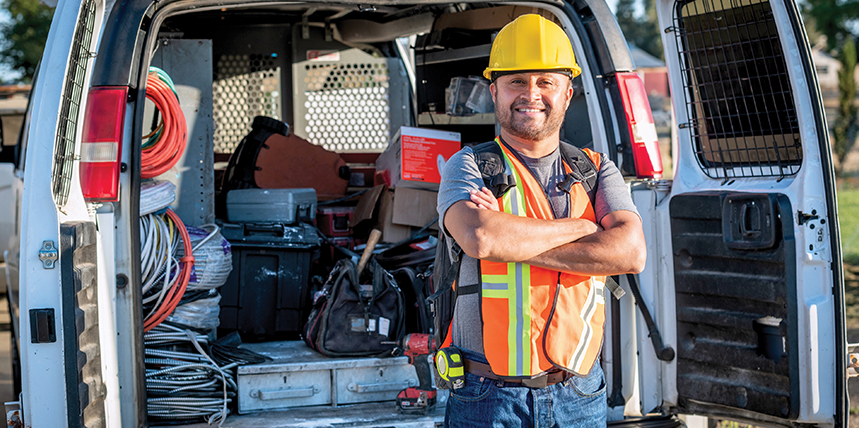
Tens of millions of people work in the skilled trades in the United States. A survey recently conducted by NFPA® sheds light on major trends across these industries, from the anticipated impact of artificial intelligence (AI) in 2026 to tradespeople’s desire for more education and training opportunities.
The survey, conducted virtually between October 27 and November 3, 2025, gathered responses from more than 500 U.S.-based workers in the skilled trades, representing industries ranging from electrical and fire protection to government and health care. In it, respondents answered questions to gauge their perceptions on AI; the importance of codes and standards; education, training, and career development; the value of professional memberships; and more.
This blog includes five key takeaways for leaders of organizations.
AI IS YOUR ALLY. EMBRACE IT, DON’T REJECT IT.
There’s no denying that a sense of fear has defined a lot of discussions around AI, with many worrying that AI has the potential to entirely replace humans across the workforce. But it doesn’t have to be that way.
Instead of thinking about AI as tech that’s going to take jobs away, organizational leaders should think about how AI can complement and even enhance workforce education and development. According to the recent NFPA skilled trades survey, nearly 40% of professionals believe that AI and other technological advancements will reduce mundane tasks in 2026, allowing for increased organizational efficiency and giving workers more opportunities to focus on and build competence in higher-skilled tasks.
Overall, over two-thirds (68%) of survey respondents said they believe AI and other tech advancements will have a tangible impact on their work this year. As organizations wrestle with technological advancements, leaders must recognize that learning to work with AI and advanced technologies is a must to stay competitive among industry peers. It’s a classic case of “get on board or get left behind.”
ENCOURAGE EMPLOYEE EDUCATION AND DEVELOPMENT
When survey respondents were asked what they hoped their organization’s priorities would be in 2026, increased trainings for a more skilled workforce emerged as the top choice, with 29% preferring this option. Additionally, more than half of respondents (54%) said they plan to take part in more trainings this year, and 38% plan to sit for more certifications.
Employee training, especially safety training, is not something organizations should take lightly. In addition to the more obvious benefits of reducing employee injuries, investing in safety training can also help organizations reduce operational disruptions, boost productivity, and ultimately increase profits. A study published in the journal Safety Science in 2024 concluded that building a culture of workplace safety, which includes ensuring workers are adequately trained, “will have a favorable impact on financial performance and corporate reputation.”
AVOID SILOS AND ASK FOR EMPLOYEE INPUT
While survey respondents expressed a desire for and plan to pursue more education and development opportunities in 2026, only 17% said they think their organizations will prioritize that for them.
It wasn’t the only area where survey results illustrated a disconnect between employee preferences and anticipated employer priorities. Over one-third (35%) of survey respondents also said they think their employer will prioritize increased technology deployment in 2026, but only 26% of employees said they preferred that as a priority.
As leaders across the skilled trades establish and evaluate priorities, it’s essential to avoid silos and ensure employee input at all levels of the organization is taken into consideration. When employees feel as though their preferences are reflected across priorities and operations, morale and retention increase.
ENCOURAGE LEARNING ABOUT THE VALUE OF CODES AND STANDARDS
Codes and standards development and compliance are cornerstones of the skilled trades. But recent legislative efforts in the U.S. have aimed to undermine the process, seeking faster and at times cheaper avenues that can compromise safety. More than one-fourth (26%) of survey respondents said they are already feeling the impact of codes and standards deregulation.
Organizational leaders can help by encouraging workers to learn more about the value of codes and standards, with the aid of campaigns like “Don’t Chance Safety.”
“We don’t imagine a world without sprinklers and smoke detectors in buildings for a reason: Safety codes and standards work, and that very truth is making it harder for the public to see why we need them—and why we should all be concerned about ongoing rollbacks,” says Lorraine Carli, vice president of Outreach and Advocacy at NFPA. “We all want to live in a safe world, which means we all need to work together to protect the codes and standards that have long protected us.”
PROFESSIONAL MEMBERSHIPS PLAY A CRITICAL ROLE
Roughly four out of five (78%) survey respondents reported being members of a professional organization or trade association. Furthermore, nearly half (43%) said they have benefited from networking opportunities with industry professionals as well as professional development and training programs because of these memberships.
Organizational leaders should encourage employees to learn more about the value a professional membership can provide and what options might be best for them.
THE RECIPE FOR SUCCESS
The skilled trades are navigating a pivotal moment in history, with an unprecedented demand for workers running up against a significant skilled worker shortage. For organizations to succeed in this challenging environment, they must start by listening to and learning from tradespeople; surveys like the one recently conducted by NFPA are a valuable starting point.
On the bright side, today’s challenges invite intelligent adaptation and the exploration of new possibilities, which is key to unlocking new levels of efficiency and safety across all industries. Organizations that support and embrace AI-driven tools, education and training opportunities for employees, the time-tested standards development process, and professional memberships can better address labor shortages and skill gaps to build a more resilient, future-ready workforce.
Be sure to download the full report summarizing the recent survey results to discover other insights and takeaways for organizational leaders and employees working in the skilled trades.
REFERENCES
Irene Bautista-Bernal, Cristina Quintana-García, Macarena Marchante-Lara. “Safety Culture, Safety Performance and Financial Performance. A longitudinal study,” Safety Science, Vol. 172, 2024, 106409, ISSN 0925-7535.
NFPA. Creating a Culture of Safety at Your Business. Access at https://www.nfpa.org/for-professionals/for-business/creating-a-culture-of-safety.
Roman, Jesse. “Tip of the Spear,” NFPA Journal, October 2025.
NFPA. “Safety Doesn’t Happen by Chance.” Video: https://www.dontchancesafety.org/.
Eaton, Kit. “The Skilled Worker Shortage May Hit Hard in 2026,” Inc. eNewsletter, December 24, 2025.
NFPA. The Standards Development Process. Access at https://www.nfpa.org/for-professionals/codes-and-standards/standards-development.
NFPA. The State of the Skilled Trades Report 2026. Access at https://www.nfpa.org/forms/Skilled-Trades-Report.

Jim Pauley is President and CEO of the National Fire Protection Association (NFPA).