

The global energy system is undergoing a fundamental shift that will reshape how electricity is generated, distributed, and managed over the coming decades. Electrification is accelerating across transportation, manufacturing, and digital infrastructure, while clean and renewable sources are rapidly expanding their share of global power generation.
For the electrical testing community, this transition is not theoretical. It is already changing the complexity, configuration, and risk profile of the systems that must be tested, commissioned, and maintained.
Ducker Carlisle’s most recent Global Energy Transition Outlook examines how the world’s energy mix is evolving under three scenarios: Net Zero Emissions, Announced Pledges, and Stated Policies. The report identifies five core findings that define the direction of travel. Together, these trends point to a future where electrical testing expertise will be more critical than ever.
ELECTRICITY’S EXPANDING ROLE IN THE GLOBAL ENERGY MIX
Today, electricity accounts for roughly 20% of global energy consumption, with the majority still coming from liquid, gaseous, and solid fuels. That balance is changing rapidly. By 2050, electricity is expected to represent at least one-third of global energy use and potentially as much as 55%, depending on policy and technology outcomes (Figure 1).
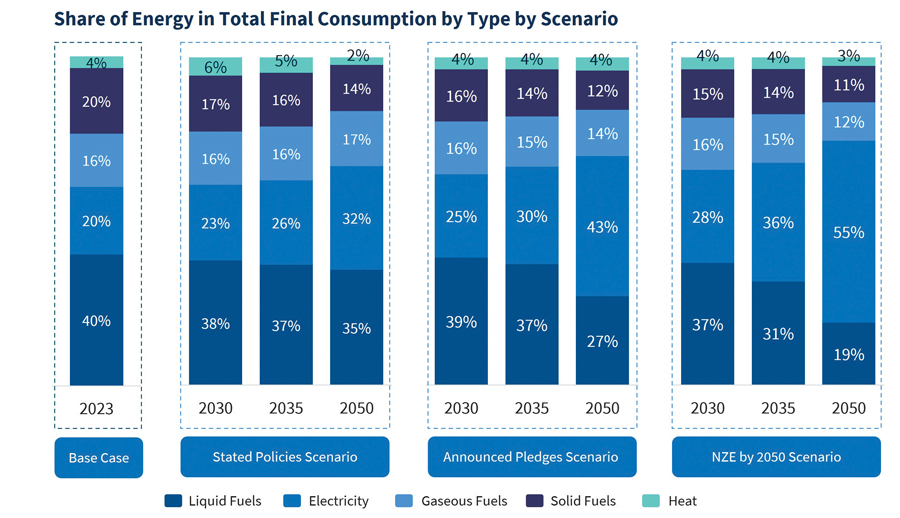
This shift reflects broad electrification across the economy. Electric vehicles, electrified industrial processes, data centers, and distributed energy systems are all contributing to rising demand. From a testing perspective, this growth places increasing pressure on generation assets, substations, protection systems, and distribution infrastructure that were not designed for today’s load profiles or operating dynamics.
CLEAN AND RENEWABLE GENERATION BECOMES THE MAJORITY
As electricity demand grows, the sources used to generate that power are also changing. Clean and renewable sources are projected to supply between 67 and 88% of global electricity by 2035, up from 38% in 2023 (Figure 2). This expansion is driven by a combination of government policy, energy security concerns, and improving economics for renewable technologies.
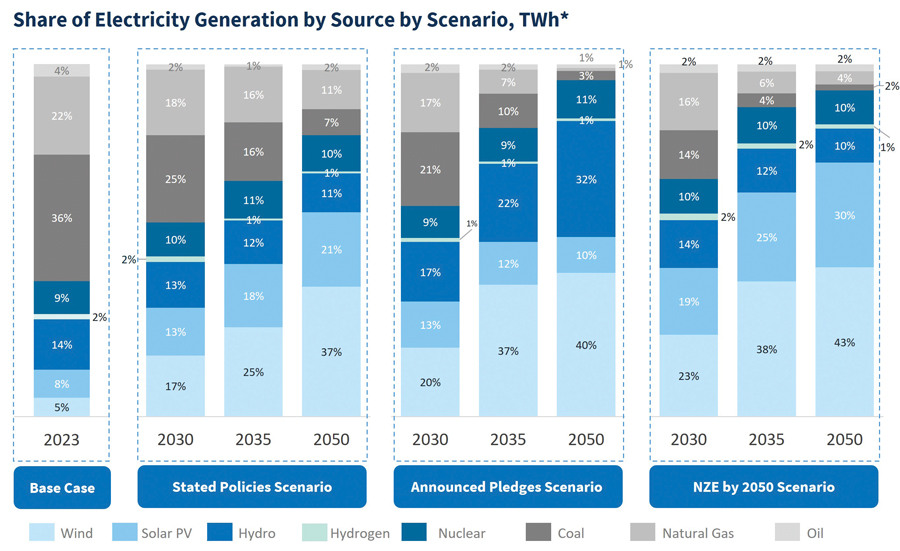
While the shift to clean power is essential, it introduces new challenges for grid stability. Variable generation from wind and solar requires more sophisticated protection, control, and coordination across the grid. For testing professionals, this means validating systems that must operate reliably under a wider range of load conditions, fault scenarios, and dynamic operating states than in traditional centralized generation models.
SOLAR AND WIND DRIVE RENEWABLE GROWTH
Solar photovoltaic (PV) will be the fastest-growing clean energy source, expanding from 14% of global clean electricity generation today to more than 30% by 2030 and nearly 50% by 2050 (Figure 3). Wind power will also grow, reaching approximately 25% of clean generation and holding relatively steady beyond that point.
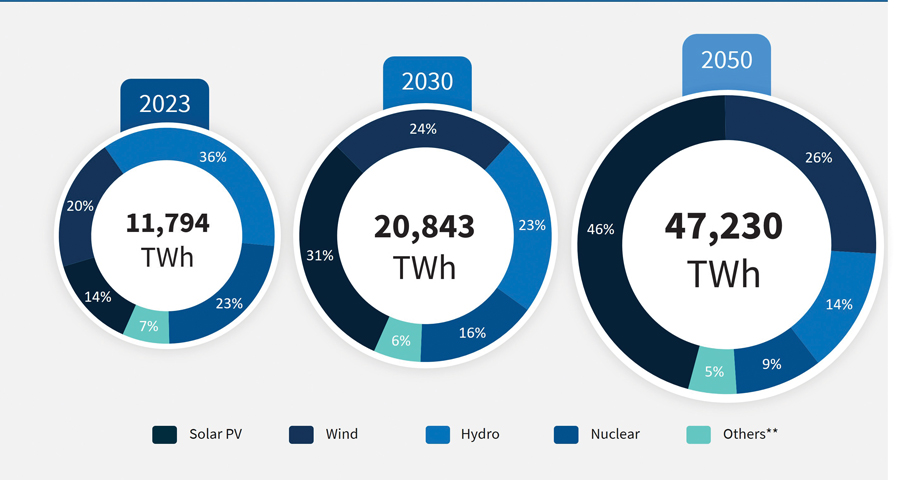
The rapid deployment of solar and wind is supported by declining costs and strong policy momentum, particularly in China and the European Union. However, these technologies are inherently intermittent. Their integration into both transmission-scale and behind-the-meter systems increases the importance of proper testing of inverters, protection schemes, grounding systems, and power quality controls.
ASIA PACIFIC LEADS CLEAN ENERGY DEVELOPMENT
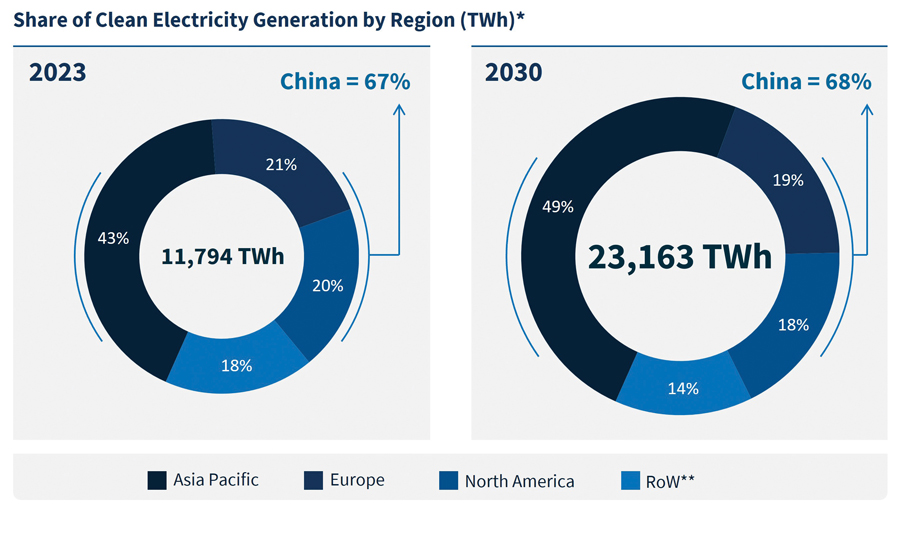
Geographically, the energy transition is not evenly distributed. By 2030, the Asia Pacific region will account for nearly half of all global clean electricity generation, with China alone representing more than two-thirds of that total (Figure 4).
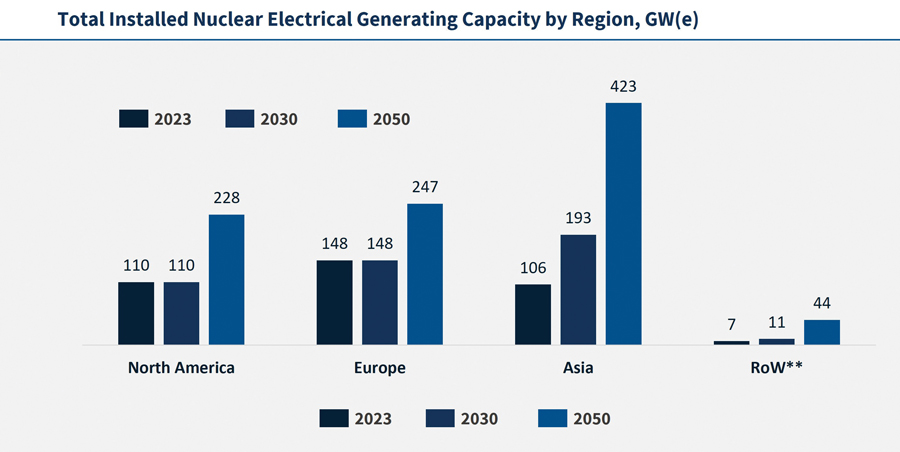
The region is also projected to have nearly double the nuclear electricity-generating capacity of Europe or North America (Figure 5).
This concentration of investment reflects aggressive industrial growth, government support, and long-term energy planning. It also underscores the global nature of equipment standards, testing methodologies, and best practices. As systems are deployed at scale in Asia and exported globally, alignment on testing rigor and performance validation becomes increasingly important.
TECHNOLOGY AND POLICY AS ENABLERS
Achieving a cleaner global energy mix will require more than generation capacity. Battery energy storage systems, advanced energy management platforms, and grid modernization are all essential enablers (Figure 6). Storage systems help manage variability, while digital controls optimize dispatch, protection, and efficiency across increasingly complex networks.
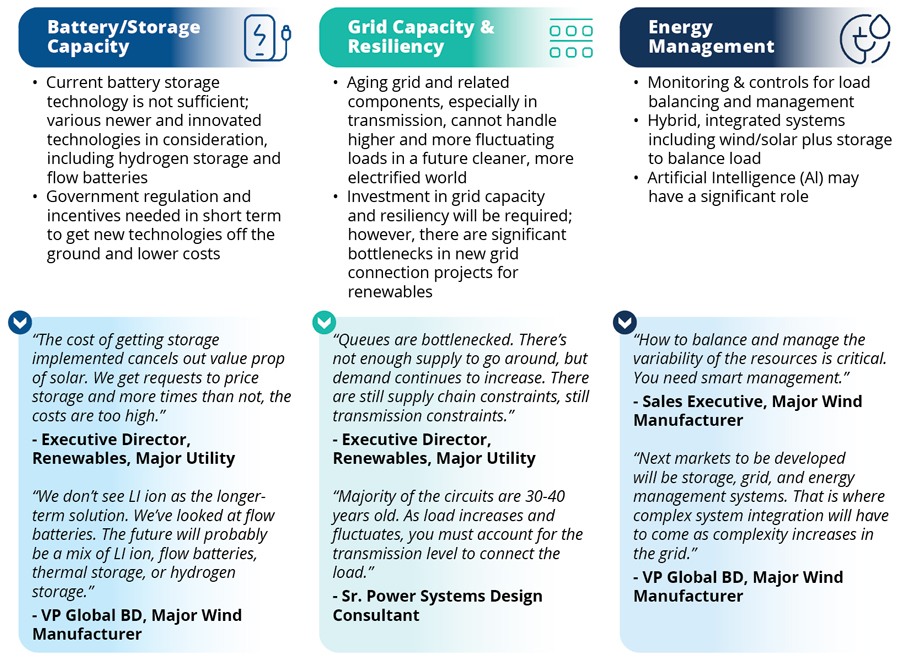
Many electrical grids remain under-invested and were not designed for high penetrations of distributed and variable generation. As a result, significant capital investment and policy support will be required. From a testing standpoint, this creates demand for new skill sets, expanded commissioning scopes, and deeper system-level understanding rather than asset-by-asset testing alone.
WHAT THIS MEANS FOR ELECTRICAL TESTING
The convergence of renewable generation, energy storage, and advanced control systems is fundamentally changing how power systems are designed and operated. These systems must function as integrated ecosystems rather than isolated components, and each configuration can be highly customized.
Behind-the-meter and microgrid installations are a clear example. As utilities work through grid constraints and connection backlogs, large electricity users—including hyperscale data centers—are increasingly deploying on-site generation and storage to meet near-term power needs.
These systems often combine natural gas generation, solar PV, battery energy storage, and sophisticated energy management software.
Testing and commissioning these hybrid systems requires expertise across multiple technologies and operating modes. Electrical testing professionals must validate not only individual assets, but also system interactions, protection coordination, control logic, and response under abnormal conditions.
CONCLUSION
As the energy transition accelerates, demand for electrical testing will continue to grow, both in volume and complexity. Firms that invest in technical capability, training, and system-level expertise will be well-positioned to support this next phase of grid evolution.

Kevin G. Sarb is Managing Director at Ducker Carlisle, leading the Industrials Practice with a focus on energy, climate technologies, and commercial excellence. With 20 years of management consulting experience, he helps industrial clients design growth strategies and build commercial capabilities that deliver measurable results. Sarb holds degrees from the University of Notre Dame, the University of Michigan, and the University of Chicago Booth School of Business.