

Electrical power systems—from data centers and hospitals to industrial plants, utilities, and commercial complexes—are the foundation of modern facilities. Because these systems serve as critical infrastructure, they must operate safely, reliably, and efficiently at startup as well as through decades of service. Ensuring long-term performance demands a lifecycle-oriented strategy, beginning with rigorous commissioning and acceptance testing of all electrical components and systems.
Standards play an essential role in this endeavor by providing objective, consistent procedures for verification, testing, and documentation. The InterNational Electrical Testing Association (NETA) defines detailed standards for acceptance and ongoing maintenance testing. Additional standards, such as NFPA 70B from the National Fire Protection Association (NFPA), provide specific guidance on maintenance programs, administrative procedures, and safety management over the system’s life.
By combining NETA’s technical rigor with complementary maintenance guidance, facility operators can feel confident that their electrical infrastructure will perform as intended from initial energization through long-term operation. Commissioning standards are typically dictated by the owner’s project requirements (OPR).
Why standards matter: Applying documented standards reduces subjectivity, ensures consistent, repeatable testing methods, and provides a traceable record, supporting safety, reliability, and long-term performance.
WHAT IS ELECTRICAL COMMISSIONING AND ACCEPTANCE TESTING?
Electrical commissioningis a systematic process of inspecting, verifying, testing, and documenting newly installed or retrofitted electrical systems to ensure they are safe, reliable, and perform as designed before going fully operational. Benefits of a well-executed commissioning process include safer and more reliable facility systems, greater efficiencies, lower cost of operation, a higher possibility of achieving construction scheduling and budget goals, and a well-planned and organized handover to the facility staff that leaves them with the knowledge and resources to successfully operate the building as intended in the design.
- Commissioning bridges the gap between construction and operation by confirming compliance with standards and operational needs.
- Acceptance testing, typically a prerequisite for commissioning, focuses on evaluating individual components and subsystems prior to initial energization. Its purpose is to confirm that each piece of equipment has been installed correctly, performs within the manufacturer’s tolerances, and meets the project’s design or contract requirements.
Together, commissioning and acceptance testing serve multiple purposes: They promote integrated system performance, document as-built conditions, and generate baseline data that serve future maintenance and lifecycle management. This combination is particularly critical for new installations, major retrofits, or system expansions where undetected installation errors or latent faults could lead to safety incidents or operational failures.
Electrical commissioning vs. acceptance testing: ECx focuses on a process that begins with reviewing the design and typically ends with integrated systems testing, while acceptance testing ensures component-level readiness for each piece of critical equipment before energization.
Commissioning and Acceptance Testing → Maintenance
The sequence of acceptance testing verified as part of the commissioning process builds confidence in the installed equipment. Once commissioning is complete and handed off, it falls on facilities to ensure ongoing operations. This is where maintenance testing ensures continued system integrity, operational reliability, and data-driven maintenance decisions.
In the commissioning process, all critical equipment undergoes thorough documentation review, physical inspections, and verification. The commissioning process typically includes the development of a commissioning plan, creation of project-specific checklists and test scripts, visual and mechanical inspections, electrical acceptance testing, and documentation of test parameters, results, and final approved settings for energization.
Acceptance testing confirms that individual equipment and subsystems—switchgear, transformers, cables, UPS units, transfer switches—are installed correctly and function properly. This step verifies compliance against manufacturer tolerances, design specifications, and standards, preventing latent defects or mis-installations from entering service.
Once the system is energized and operational, maintenance testing becomes the cornerstone of long-term system health. Maintenance testing may include periodic inspections, functional tests, thermographic surveys, partial-discharge or insulation testing on cables and switchgear, protective-device checks, and other condition-based diagnostics. These activities help identify degradation, abnormal conditions, or wear before they lead to failures or safety hazards.
The documentation and baseline data generated during commissioning and acceptance testing provide the reference point against which all future testing is measured. Having this as-built and as-energized record greatly improves the effectiveness of maintenance programs. It streamlines test interpretation, facilitates trend analysis, and supports equipment health tracking over time.
THE ROLE OF STANDARDS
A robust lifecycle-oriented approach to electrical systems involves a seamless progression from initial installation through long-term operation, each phase supported by appropriate standards and documentation.
ANSI/NETA Standards
ANSI/NETA standards provide a rigorous framework for electrical commissioning, acceptance, and maintenance.
ANSI/NETA ECS-2024, Standard for Electrical Commissioning of Electrical Power Equipment & Systems, provides guidance for verifying that newly installed or retrofitted systems meet design and performance requirements. ECS-2024 covers low-, medium-, and high-voltage systems, with an emphasis on integrated system-level performance including protective devices, interlocks, and alarms. It ensures systems are ready for energization and provides a baseline for long-term maintenance.
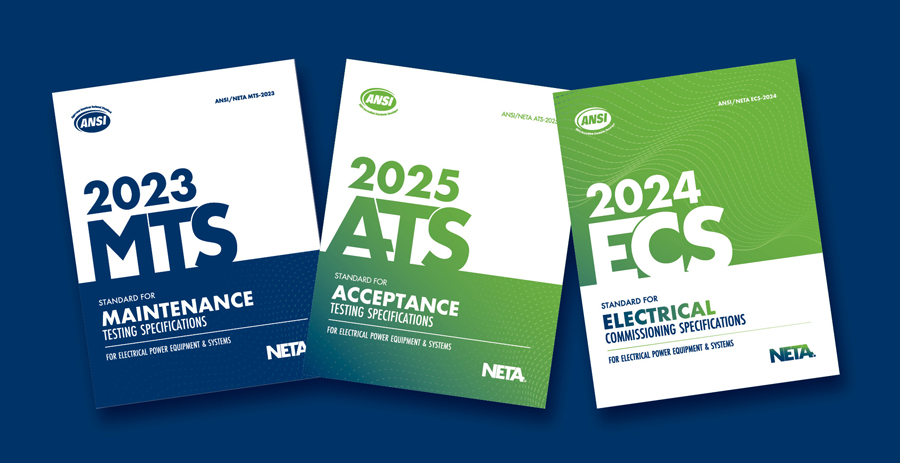
ANSI/NETA STANDARDS AT A GLANCE
- ECS–2024: Electrical Commissioning Specifications for Electrical Power Equipment and Systems
- ATS–2025: Acceptance testing; component-level verification and readiness
- MTS–2023: Maintenance testing; preventive and predictive inspections for in-service systems
- ANSI/NETA ATS-2025,Standard for Acceptance Testing Specifications for Electrical Power Equipment and Systems, specifies field tests and inspections before energization and final acceptance. It covers modern equipment such as battery energy storage systems (BESS), photovoltaic (PV) systems, uninterruptible power supplies (UPS), and medium-voltage cables. Compliance with ATS-2025 ensures each component is installed correctly, performs to specification, and is safe for operation.
- Maintenance testing, guided by ANSI/NETA MTS–2023,Standard for Maintenance Testing Specifications for Electrical Power Equipment and Systems, defines procedures for periodic in-service inspections and predictive testing. Commissioning and acceptance testing data provide a reference point for MTS-2023, enabling operators to detect degradation, identify emerging issues, and plan maintenance effectively.
Together, these standards establish a lifecycle approach linking initial verification with long-term reliability.
Complementary Guidance from NFPA 70B
While ANSI/NETA standards provide detailed technical requirements for commissioning, acceptance, and maintenance testing, facility operators receive additional guidance on maintenance program structure, administration, and long-term compliance. This is where additional standards—notably from the National Fire Protection Association (NFPA)—complement NETA’s technical scope.
For example, NFPA 70B-2026®, Standard for Electrical Equipment Maintenance®, defines the administrative and organizational aspects of an electrical maintenance program (EMP): scheduling of regular inspections, establishing written maintenance procedures, training and qualification of maintenance personnel, recordkeeping of maintenance history, and ensuring safety compliance during maintenance activities.
By combining the ANSI/NETA technical standards with an NFPA-style maintenance program structure, facility owners and operators achieve a comprehensive, standards-based approach to their electrical system maintenance. NETA addresses which tests to perform and how, while NFPA-level guidance helps define when, by whom, and under what programmatic and safety framework maintenance should occur. The result is a lifecycle-focused strategy that supports safe, reliable, and efficient operation from day one through decades of service.
Editor’s note: 70B® and Standard for Electrical Equipment Maintenance®are registered trademarks of the National Fire Protection Association, Quincy, MA.
Benefits of a Standards-Based Approach
Adopting a standards-based methodology provides multiple significant benefits for facility operators and stakeholders.
- Safety. By verifying installation integrity, protective device coordination, alarm and interlock functionality, and system compliance before energization, commissioning and acceptance testing mitigates the risk of electrical accidents, equipment failures, and latent hazards. Regular maintenance testing helps detect insulation degradation, loose connections, or other developing issues before they lead to catastrophic failures.
- Reliability. Facilities designed and tested under NETA standards and maintained under a consistent program are less likely to suffer unexpected downtime. By capturing baseline data and performing periodic assessments, operators can proactively identify wear or stress on components, make informed maintenance decisions, and avoid unplanned outages.
- Compliance and due diligence. Many regulatory bodies, insurers, and facility owners now expect documented evidence of proper commissioning, testing, and maintenance. Applying widely recognized standards like ANSI/NETA and NFPA 70B provides defensible documentation in support of safety, regulatory, and contractual obligations.
- Lifecycle cost management. Baseline data collected during initial testing and system commissioning establishes a reference point for future performance and maintenance, enabling predictive maintenance, better budgeting for repairs or replacements, and more strategic asset management. Over time, this can significantly reduce the total cost of ownership and extend the useful life of critical infrastructure.
Evolving Standards
Standards evolve to remain relevant for modern electrical systems, including BESS solutions, PV installations, UPS units, and more complex medium-voltage installations. By aligning commissioning and testing practices with current standards, facilities can accommodate modern technologies while preserving safety, reliability, and maintainability
CONCLUSION
Electrical commissioning and acceptance testing are not optional extras—they are critical foundational steps in the lifecycle management of electrical power systems. The standards published by NETA provide comprehensive, objective, technically rigorous guidance that ensures equipment and systems are installed correctly, tested thoroughly, and maintained effectively throughout their operational life.
When combined with the complementary maintenance-program guidance in NFPA 70B, this standards-based methodology delivers a holistic, lifecycle-oriented approach. It ensures that electrical systems are safe, reliable, efficient, and capable of meeting evolving demands over decades of service.
For facility owners, engineers, maintenance managers, and commissioning professionals, applying these standards is not merely a best practice; it’s foundational to achieving operational excellence, safety, and long-term value from electrical infrastructure. Ultimately, commissioning, acceptance, and maintenance testing are not isolated activities, but connected stages of a comprehensive lifecycle strategy that protects people, assets, and operations.
REFERENCES
- ANSI/NETA ECS-2024, Standard for Electrical Commissioning of Electrical Power Equipment & Systems.
- ANSI/NETA ATS-2025,Standard for Acceptance Testing Specifications for Electrical Power Equipment and Systems.
- ANSI/NETA MTS–2023,Standard for Maintenance Testing Specifications for Electrical Power Equipment and Systems
- National Fire Protection Association. NFPA 70B-2026®, Standard for Electrical Equipment Maintenance®. Editor’s note: NFPA 70B-2026 was released in November 2025.

Joel Gilley currently serves as Director of Commissioning Services at Electrical Reliability Services, Inc., where he oversees commissioning operations and delivery. Gilley is a commissioning and operations leader with over two decades of experience supporting complex mechanical and electrical systems across mission-critical and industrial environments. His work has focused on commissioning execution, operational oversight, and supporting the teams responsible for system validation and performance. Before ERS, Gilley spent 12 years at Primary Integration as a Project Manager, following earlier technical roles as a Senior Technician at TAC and a Final Test Technician at Applied Materials. His background combines hands-on technical experience with long-term leadership in commissioning and project execution.