
Correction: In the Industry Topic article “Life After 40: A Critical Look at Electrical Safety’s Most Contentious Number,” by Matthew J. Robinson, published in the Fall 2025 issue of NETA World, Sigma C Power Services LLC was twice incorrectly referred to as Sigma C. The article byline should read: By Matthew J. Robinson, Sigma C Power Services, LLC. The opening sentence in the author’s biography should appear as follows: Matt Robinson is the Director of Safety and Training at Sigma C Power Services LLC. All web and digital versions of this article have been corrected, and NETA apologizes for the error.
Life ends at 40. It’s just a fact that after 40, survivability drops to zero, and we are assured of a fiery, violent death. I am, of course, referring to incident energy calculations that indicate a value above 40 cal/cm².
It is easy to understand the origin of this misconception. In bold black letters, some analysis software indicates that above 40 cal/cm², “NO SAFE PERSONAL PROTECTIVE EQUIPMENT (PPE) EXISTS.” Some of the standards we use daily provide simple tables that stop at 40 cal/cm².
These apparent limits prompt panic and hand-wringing among facility owners and safety officers who think that a piece of equipment has effectively been removed from their ability to operate or interact with. Even more perplexing, consider the switchboard with a hazard analysis label indicating 120 cal/cm² installed next to an identical piece of equipment with a label indicating 8.7 cal/cm². A person less versed in the nuances of NFPA 70E®, Standard for Electrical Safety in the Workplace®, and its underpinning standards may see that sticker indicating 120 cal/cm² and flatly state, “There is no way to safely maintain, operate, or even look at the equipment while it is energized,” and proceed to work on the nearly identical equipment right beside it.
The reasons this number is so entrenched in our industry are based on the best of intentions and the desire to protect our fellow workers, but its use has become a point of contention. Safety always comes first; we must ensure that each and every worker makes it home safely at the end of the day. Still, this article aims to prove that there is, indeed, life after 40 cal/cm².
GREATER EMPHASIS
NFPA 70E states:
When incident energy exceeds 40 cal/cm² at the working distance, greater emphasis may be necessary concerning de-energizing before working within the limited approach boundary of the exposed electrical conductors or circuit parts.[3]
This informational note may be the source of the idea that 40 cal/cm² is a hard limit for safe work around energized equipment.
Starting with the 2000 edition, NFPA 70E has focused on providing a structured approach to selecting protective garment clothing systems up to a hazard risk category of 4. In later iterations of the standard, the use of hazard risk categories would be supplanted by the selection of garments based on calculated incident energy. For many in the industry, Table 3-3.9.3 in the 2000 edition of NFPA 70E marked the first time the hazard from an arc flash was quantified in a way that could be used to select a garment system. What had previously been a nebulous set of recommendations, calculations, and rules of thumb became fully formed tables and guidelines that provided a clear path for worker protection from Hazard Risk Category 0 through Category 4.

Reproduced with permission of NFPA from NFPA 70E®, Standard for Electrical Safety in the Workplace®, 2020 edition. Copyright© 2020, National Fire Protection Association. For a full copy of the NFPA 70E®, please go to www.nfpa.org.
This first table laid the groundwork for what would be the industry-perceived 40 cal/cm² limit. However, this first iteration of Table 3-3.9.3 defined the minimum arc thermal performance exposure value (ATPV) for clothing as selected for differing levels of hazard risk. By the next edition (2004) of NFPA 70E,[5] the note indicating a need for greater emphasis at incident energies greater than 40 cal/cm² first appeared in Annex D.8 FPN. This informational note still allowed work above 40 cal/cm² but marked a shift towards engineering analysis that would continue to shift the industry standard away from broad hazard risk categories towards discrete, calculated incident energies. By 2018,[6] this informational note was removed from 70E to reduce the confusion surrounding work above 40 cal/cm². In this author’s opinion, this change only created more chaos.
2018 was marked by the revision of IEEE STD 1584-2018, IEEE Guide for Performing Arc Flash Hazard Calculations[2]. The standard formalized the methodologies for calculating incident energies and quantifying hazards, but was a departure from the emphasis on energy impressed upon workers that was the cornerstone of the initial 2002 publication. Between the elimination of the “greater emphasis” informational note and the modified approach to incident energy calculation, the industry as a whole was left with little guidance as to hazard exposure above 40 cal/cm².
These two revisions to the de facto industry standards appear to have been the final nail in the coffin for any semblance of a life after 40. By now, it appeared that the industry was set on a feedback loop where standards did not provide a clear path to safe work above a certain threshold. Management and personnel alike sought to eliminate their work around such hazards, and garment manufacturers all but eliminated arc protective clothing with ATPV values greater than 40 cal/cm². On one hand, this enhanced overall safety in the electrical industry by pushing management and workers to advocate for elimination, substitution, and engineered controls.
Perhaps this result was the goal all along. However, some incident energy calculations cannot be engineered around, and some equipment must be accessed, even while energized. Although modern standards do not cite the need for greater emphasis, perhaps greater understanding will allow the industry to approach arc flash incident energy with a clear head.
A BRIEF HISTORY OF ARC-RATED GARMENTS
If 40 cal/cm² has become the self-reinforcing limit to arc protective garments, where did that number come from? For that matter, what is the basis for any of the arc flash incident energy thresholds commonly used today? These numbers are easily recognized in the electrical power industry, but their origins predate all but the most grizzled of veterans.
Although the 2000 edition of NFPA 70E was one of the first standards to correlate ATPV values to levels of hazard risk, research into arc-rated garments was already established. The supporting work that culminated in IEEE 1584-2002 analyzed incident energy levels of 1.2, 8, 25, 40, and 100 cal/cm², showing that there is indeed a level of consideration that can be made for incident energies in the 40–100 cal/cm² range. The actual selection of these benchmarks predates even Lee’s seminal paper, The Other Electrical Hazard: Electric Arc Blast Burns,[7] and requires a look back to the early days of OSHA.
Starting in 1971 and in response to CFR1910.132, Personal Protective Equipment,[8] which specifically targeted personal protective equipment in the petrochemical industries, a number of flash protective garments were devised. These flash garments were manufactured to protect personnel from flash fires rather than arc flashes. The standards for these garments were based on flash fires as defined by NFPA 2113®, Standard on Selection, Care, Use, and Maintenance of Flame-Resistant Garments for Protection of Industrial Personnel Against Short-Duration Thermal Exposures from Fire® (2025),[9]with a duration of three seconds and were selected to conform to Alice Stoll and Maria Chianta’s pioneering work[12] on heat resistant fabrics (the basis for the Stoll curve). This research was parlayed into arc protective clothing and carried with it the history of garment manufacture from its origins in the petrochemical industry. Indeed, full flash-fire suits were provisioned at 8, 12, 20, 25, 31, 40, 50, 55, 75, and 100 cal/cm²[10] during the initial translation of flash-fire protective garments to arc flash protective garments, and ASTM F1959, Standard Test Method for Determining the Arc Rating of Materials for Clothing[11]historically provided testing standards of these garments up to 100 cal/cm².
This list explains some of the threshold values for arc flash garments, but let’s break down each individually:
- 1.2 cal/cm². Defined as the threshold between a just curable and just incurable burn, this incident energy value was popularized by Ralph Lee’s original research into arc flashes. This level has occasionally been used to denote Hazard Risk Category 0 (before its retirement).
- 4 cal/cm². Originally published as 5 cal/cm², this was corrected in later editions to correspond to the calculated thermal performance properties of natural cotton with a density of 8 oz/yd² after updates to ASTM F1959. Otherwise known as Hazard Risk Category 1, this level has become the industry’s baseline expectation for electrically safe clothing during the performance of most activities. This benchmark was initially tested by Stoll[12] to determine the effectiveness of standard industry worker clothing, often lightweight denim or canvas coveralls.
- 8 cal/cm². Normalized for most testing according to ASTM F1959, this level comes from early garment guides for the performance of work in most conditions based on the characteristics of natural cotton with a density of 12 oz/yd². Similarly to the origins of the 4 cal/cm² threshold, this benchmark separated heavy-duty workwear from medium-duty garments and was the expected performance for workers exposed to common flash-fire hazards. For most maintenance technicians with regular exposure to arc flash hazards, this is the baseline performance of standard uniforms.[13]
- 25 cal/cm². This level of incident energy marks the first departure from what would be considered normal workwear into task-oriented garments. For arc flash clothing, this level historically indicates Hazard Risk Category 3 and requires donning a medium-weight flash suit. Strangely enough, this threshold was chosen because of work pants. Common flash-rated pants (excluding coveralls or bibs) had a rating of no greater than 25 cal/cm² because of the thickness and usability of the fabric used in their construction. This was chosen as a standard because it created a system that allowed up to a 25 cal/cm² rating by donning a jacket and hood on top of a worker’s normal wear.[14]
- 40 cal/cm². Similarly to the selection of 25 cal/cm² based on a portion of a garment system, 40 cal/cm² was historically the highest rating of a flash-fire coverall, allowing the worker to only have to don a hood to complete the garment system. Most modern work does not require constant exposure to elevated flash risk, and so modern arc flash suits are part of the layered system that allows workers to quickly achieve the desired ATPV.[15]
What appears to have been lost in the translation from flash-fire garments to arc flash garments are values above and beyond 40 cal/cm². Ultimately, research into the nature of arc flash physics and its complexities above 40 cal/cm² necessitated a cutoff, above which work can still safely be completed, but in which extant circumstances start to play a greater role.
WHAT REALLY HAPPENS AFTER 40?
After 40? Life goes on. It also gets more complicated. Consider two case studies on the impact of arc flash and its relationship to the arc blast.
Case Study 1: Low Incident Energy and Significant Blast
This fault involved a medium-voltage (13.8 kV) transformer primary switch. Due to a leak in a cable transition bulkhead directly connected to an external oil-filled switch, the insulating fluid slowly drained from the switch, exposing the phase-conducting components to air. The switch arced, creating a blast that ruptured the switch housing (1/4-inch gasketed steel) and blew the switchgear room door off its hinges (photo).
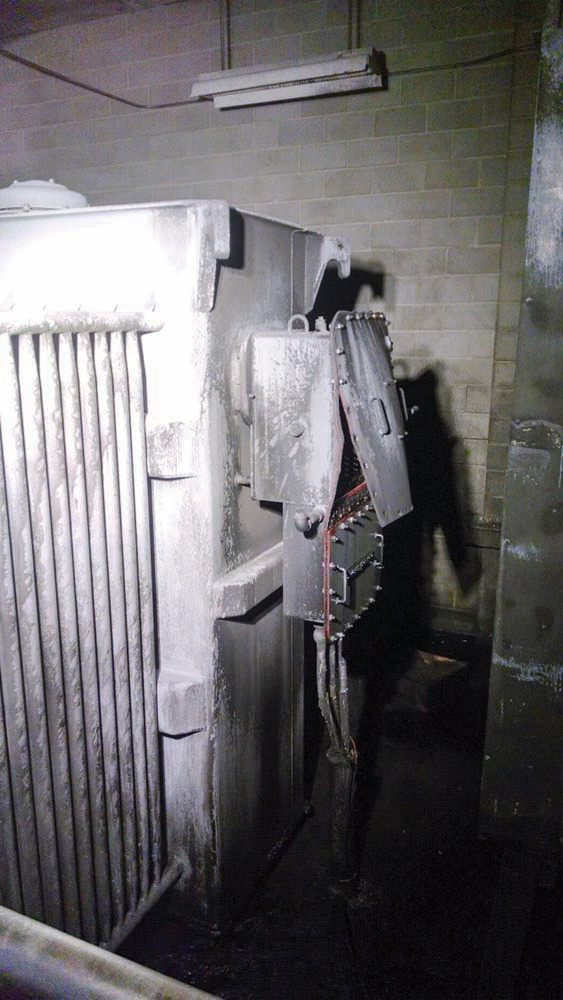
Hazard analysis of the system indicated a worst-case incident energy of approximately 12 cal/cm², a level most technicians would not associate with the raw damage the fault caused. The actual thermal energy at the calculated working distance likely would have been minimal, but the associated blast would have caused serious injury to personnel, suited or not. The small, mostly air-tight confines of the primary switch created the perfect conditions to focus and contain the flash energy, amplifying the blast and maximizing its destructive force. Analysis of the panel steel indicates a blast wavefront pressure of 30,000–70,000 PSI.
Flash incident energy and blast potential are interrelated but not correlated in such a way that one can predict the other. Above 40 cal/cm², these interacting phenomena become even more impactful, necessitating careful analysis but not necessarily preventing work, as evidenced by the next case study.
Case Study 2: Excessive Incident Energy and Minimal Blast
This fault was initiated by the failure of a potential transformer in a metering section of a customer’s main service outdoor switchgear. Due to relatively high line impedance and the miscoordination of upstream utility protection, the fault persisted for several minutes with an incident energy that could only be estimated in the thousands of cal/cm² (photo). The nature of this fault is closer to an arc furnace than a true arc flash event, but it underscores the role equipment configuration plays in a subsequent arc blast.
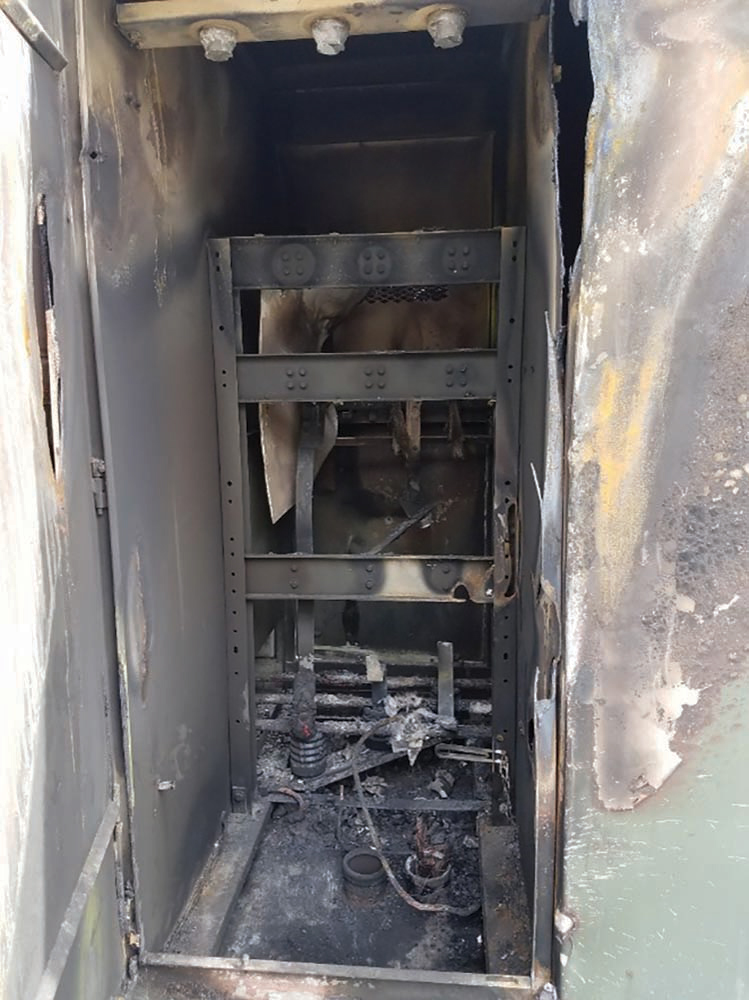
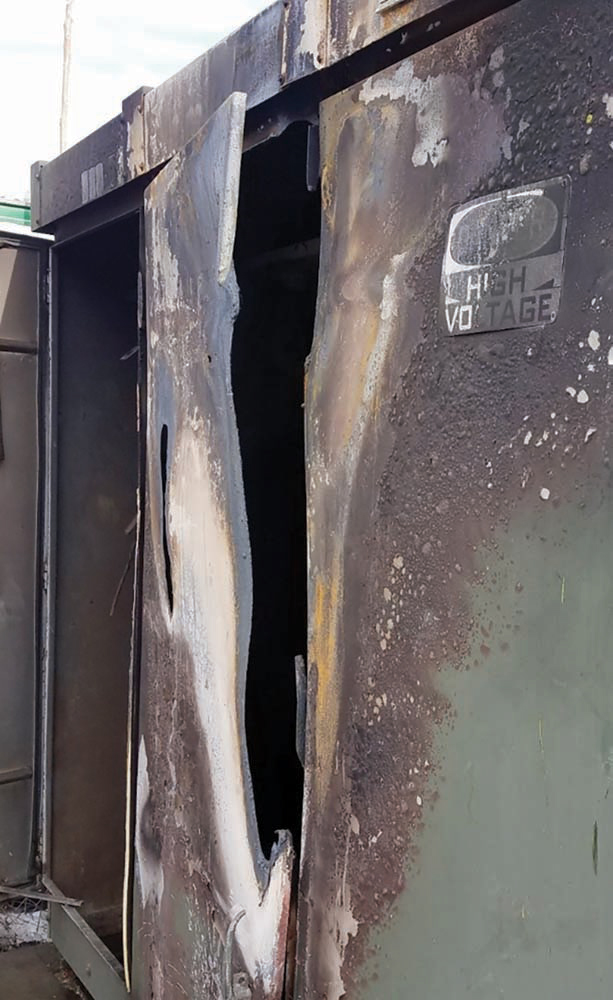
When interviewed, onsite personnel were not aware of the fault until after the smoke from the burning material was noted. The gear was vented and louvered, providing ample opportunity for the arc flash to rapidly dissipate thermal energy, creating a minimal pressure wavefront. Accident reconstruction did not indicate any damage from blast pressure, and nearby equipment that was not subject to the arcing heat showed no sign of damage. Truly, the associated blast would not have presented a hazard if there were a suit that could have withstood the inferno of plasma this fault generated.
CONCLUSION
Safety is ultimately the responsibility and the right of the individual performing the work. While some hazards may be difficult to fully articulate, we can rely on our gut to help us determine if work should be performed or if we should exercise our authority to stop work and find a better way. This article is not meant to advocate for disregarding many years of truly excellent work in the field of electrical safety. Instead, it proposes that greater emphasis be placed on understanding the inherent hazard of the work we perform and the potential impact of an arc flash.
40 cal/cm² was never designed as the absolute edge of safe work; it was instead provided as a suggested threshold above which further analysis is needed to work safely. While hazard elimination sits at the top of the NFPA 70E hierarchy of controls, substitution and engineering controls come in right underneath. This confirms that elevated levels of incident energy do not preventwork on the equipment while energized. When faced with values that exceed what some may consider safe, seek out that challenge and ensure that the hazard is not only quantified but also understood. Life goes on after 40. None of us wants to meet a premature end, but we still have to live and work. Although 40 isn’t the end, it’s definitely worth spending some time thinking about.
Editor’s note: 70E® and Standard for Electrical Safety in the Workplace® are registered trademarks of the National Fire Protection Association, Quincy, MA
REFERENCES
- IEEE STD 1584-2002, IEEE Guide for Performing Arc Flash Hazard Calculations.
- IEEE STD 1584-2018, IEEE Guide for Performing Arc Flash Hazard Calculations.
- NFPA 70E®, Standard for Electrical Safety in the Workplace®, 2015 Edition.
- NFPA 70E®, Standard for Electrical Safety in the Workplace®, 2000 Edition.
- NFPA 70E®, Standard for Electrical Safety in the Workplace®, 2004 Edition.
- NFPA 70E®, Standard for Electrical Safety in the Workplace®, 2018 Edition.
- R. Lee. “The Other Electrical Hazard: Electrical Arc Blast Burns,” IEEE Transactions on Industry Applications, Vol. 1A–18. No. 3, p. 246, May/June 1982.
- OSHA 29 CFR1910.132, Subpart I, Personal Protective Equipment.
- NFPA 2113®, 2025 Edition, Standard on Selection, Care, Use, and Maintenance of Flame-Resistant Garments for Protection of Industrial Personnel Against Short-Duration Thermal Exposures from Fire®.
- F. Selcen Kilinc, Editor. Handbook of Fire Resistant Textiles, First Edition, Woodhead Publishing, Philadelphia, Pennsylvania, USA, 2013.
- ASTM F1959, Standard Test Method for Determining the Arc Rating of Materials for Clothing.
- A.M. Stoll and M. A. Chianta. “Method and Rating System for Evaluation of Thermal Protection,” Aerospace Medicine, Vol. 40, No. 11, pp. 1323–1238, November 1969.
- S. Jamil, R. Jones, and L. McClung. “Arc and Flash Burn Hazards at Various Levels of an Electrical System,” IEEE Transactions on Industry Applications, Vol. 33, No. 2, p. 359, March/April 1997.
- T. Gammon, W.J. Lee, Z. Zhang, B. Johnson. “Arc Flash Hazards, Incident Energy, PPE Ratings, and Thermal Burn Injury — A Deeper Look,” IEEE Transactions on Industry Applications, Vol. 51, No. 5, p. 4275, September/October 2015.
- D. R. Doan, E. Hoagland IV, and T. Neal. “Update of Field Analysis of Arc Flash Incidents, PPE Protective Performance, and Related Worker Injuries,” 2010 IEEE IAS Electrical Safety Workshop. doi:10.1109/esw.2010.6164450.

Matt Robinson is the Director of Safety and Training at Sigma C Power Services LLC. He is also an adjunct professor at Worcester Polytechnic Institute and a student pursuing a PhD in electrical engineering at Penn State. Robinson’s passion lies in educating and developing the electrical power workforce, where he uses his position as an excuse to learn as much as he can from the talented folks that make up what he considers one of the most important and poorly understood industries. He holds a BS and MS in electrical engineering from Northeastern University, as well as NETA Level 4 Senior Technician and NICET III certification, is a board-certified safety professional, and serves on NETA’s Practice Exam Committee. Specific to this article, Robinson’s qualifications include being over 40.
Correction: In the article “Life After 40: A Critical Look at Electrical Safety’s Most Contentious Number,” by Matthew J. Robinson, published in the Fall 2025 issue of NETA World, Sigma C Power Services LLC was twice incorrectly referred to as Sigma C. The article byline should read: By Matthew J. Robinson, Sigma C Power Services, LLC. The opening sentence in the author’s biography should appear as follows: Matt Robinson is the Director of Safety and Training at Sigma C Power Services LLC. All web and digital versions of this article have been corrected, and NETA apologizes for the error.