

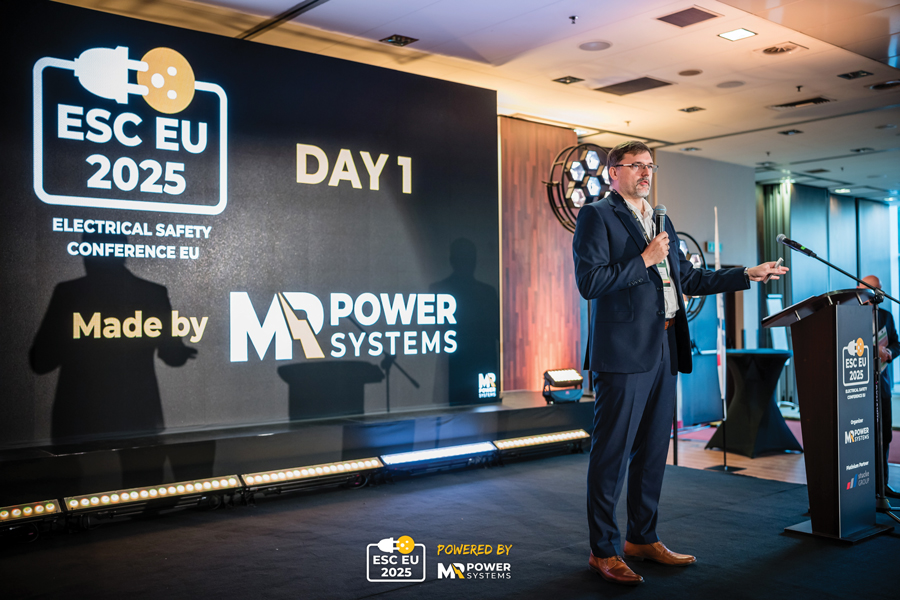
On October 23–24, 2025, more than 250 electrical safety, maintenance, and engineering professionals gathered in Kraków, Poland, for the inaugural Electrical Safety Conference Europe (ESC EU 2025). As keynote speaker, standing on that stage in front of so many specialists, the dominant feeling was that electrical safety in Europe and North America had entered a new phase: sharing, comparing, and integrating our cultures of safety managed systems, risk management, technology, best practices, and human factors.
WHY ESC EU 2025 MATTERED
The conference brought together people responsible for power generation, transmission, and distribution, industrial plants, commercial and public infrastructure, and data centers, all united by one concern: preventing electrical incidents and injuries in increasingly complex electrical systems.
Over two days, the ESC EU 2025 combined technical lectures, real‑world case studies, and a high-end electrical safety trade show to explore how arc‑flash, shock, electromagnetic fields, and emerging battery hazards can be controlled in practice, not just on paper.
SETTING THE STAGE
ESC EU 2025 took place at the Premier Kraków Hotel, a venue offering modern conference facilities and ample space for the exhibition area, where world-class electrical safety experts, manufacturers, integrators, and service providers demonstrated the latest protective devices and software tools.
The event was exceptionally well organized by electrical engineer Marcin Ruta, owner of MR Power Systems, and his outstanding team. It was positioned as a worldwide English‑language forum dedicated exclusively to electrical safety best practices.
The audience represented a broad cross-section of roles: electrical engineers and designers, maintenance leaders and supervisors, health and safety managers, contractors, and specialists from utilities and industrial sites. That diversity shaped the discussions; every topic had to span theory and field reality, from standards and calculations down to how procedures and PPE are used at 2:00 AM during a fault call‑out.
Other countries represented at ESC EU 2025 were Canada (me), Sweden, Slovenia, Poland, the UK, Austria, Ireland, Germany, and the USA.
ELECTRICAL SAFETY IS A JOURNEY, NOT A CHECKBOX
The official ESC EU 2025 description highlighted “case studies, practical answers, working solutions” and positioned the event as a “premier gathering for over 250 professionals dedicated to electrical safety focused primarily on Europe.” This was not a generic power engineering conference with one safety track; it was built around electrical safety as the main subject, with four strongly featured themes:
- Electrical safety. Practical measures, protective devices, and implementation of European and global regulations and standards.
- Electrical hazards. Arc flash, electric shock, electromagnetic fields, and battery‑related risks.
- Technical innovations. Software tools, protection and control equipment, and personal protective equipment (PPE) aimed at risk reduction and controls.
- Electrical health and safety management. Training, procedures, safety plans, human performance, and comprehensive learning from incidents.
GLOBAL THREADS
As the keynote speaker, the task was to help the audience connect these global threads into a coherent picture: electrical safety as a foundational lifecycle, not a loose collection of devices, checklists, and posters on the wall, focused only on basic standards-based compliance.
Human Performance
A central message of the keynote was the concept of human performance (HU) in electrical safety and its practical, pragmatic application in everyday job safety planning.
- Using CSA Z462-24 and NFPA 70E-24 effectively within the framework of a recognized health and safety management system, and how they interact with European best practices in electrical safety.
- Shock and arc flash risk assessment procedures as best practices to be noted.
- Studies by high-risk industries indicate that error precursors are very often the root cause of serious incidents.
- CSA Z462 Annex U Human Performance and Workplace Electrical Safety (Annex Q in NFPA 70E).
Arc-Flash Mitigation
One of the strongest technical threads across ESC EU 2025 was arc‑flash mitigation from both design and operational perspectives. The conference emphasized that, while arc‑flash calculations and labels are now familiar in many facilities, there is still significant unrealized potential in:
- Arc‑flash detection and ultra‑fast tripping or arc‑quenching solutions
- Optimized relay settings, zone‑selective interlocking, and differential protection, especially on low‑voltage and medium‑voltage systems feeding critical loads
- Rethinking single‑line diagrams and equipment layouts to limit fault energy and exposure duration by design
Mikko Manninen from Finland, representing Arcteq, for example, highlighted its arc‑flash product range and promoted a case study titled “Minimizing Arc Flash Incident Energy with Arc Quenching” as part of his participation at ESC EU 2025. This underlined a key point: The industry increasingly sees arc‑flash mitigation as a design criterion in its own right, not an afterthought following a label update.
From a keynote perspective, these concepts were framed around risk assessment and the hierarchy of risk controls: PPE is vital, but engineering controls—fast detection, current limitation, system configuration—should be pushed as high as possible on the priority list. Critically, all those things must also be developed and fully aligned within a comprehensive safety management system.
The very best information on safety-managed systems can be found in the newly released and highly recommended book by H. Landis Floyd, “Hidden Risk in Occupational Electrical Safety: Through the Lens of System Safety,” which was highlighted during the keynote.
That approach aligns with European regulatory expectations that employers eliminate or reduce risks at the source wherever reasonably practicable.
Beyond Arc Flash: The Broad Spectrum of Electrical Hazards
While arc flash often captures significant attention, ESC EU 2025 deliberately broadened the conversation to encompass the full spectrum of electrical hazards. The event description explicitly listed electric shock, electromagnetic fields, electrostatics, electrical fires, and battery hazards, in addition to arc flash. This reflected real‑world changes: more energy storage, more power electronics, and more sensitive electronic systems in critical facilities.
Technical Innovation: Hardware, Software, and Data
Exhibitors used ESC EU 2025 to highlight how newer protection, monitoring, and software tools can make safety decisions more data‑driven. Two clear trends emerged: smart protection and control devices. Manufacturers such as Stucke GROUP highlighted digital control and protection equipment for power plants and distribution networks, emphasizing reliability and functional safety, as well as sustainability, long life cycles, and support. These devices form the backbone of selective, fast-fault-clearing, and coordinated protection schemes.
Many participants discussed arc‑flash studies, short‑circuit analyses, and coordination studies, using specialized software to optimize settings and configurations rather than relying on default manufacturer parameters. The message was that software is no longer just a calculation tool; it is a platform for design and operational decisions.
My keynote positioned these innovations as enablers, not replacements, for expert judgment. Data quality, model assumptions, and configuration management remain just as critical as the sophistication of the tools.
Health and Safety Culture and Human Factors
A standout feature of ESC EU 2025 was its explicit focus on electrical health and safety culture: training, procedures, and safety plans. The event information stressed that electrical safety cannot rest solely on equipment—people, competencies, and organizational learning play a decisive role.
ESC EU 2025 marketed itself as built on case studies, practical answers, and working solutions, from the keynote perspective, encouraging participants to think of each project or incident as a learning opportunity to be captured and shared, not buried in local memory.
The key is to show how theory, standards, and technology were translated into step‑by‑step changes in field practice, and what measurable impact they had on risk levels or incident statistics.
The Role of Sustainability and Lifecycle Thinking
Stucke GROUP stressed sustainability and lifecycle aspects such as CO₂‑neutral manufacturing, long product life, and global service and spare‑parts support. At first glance, this may seem distant from electrical safety. Still, lifecycle thinking is increasingly relevant: Long‑lived, well‑supported devices reduce the temptation to make do with obsolete protective gear, unsupported firmware, or improvised repairs.
NETWORKING AND CROSS-INDUSTRY LEARNING
One of the explicit promises of ESC EU 2025 was networking: creating opportunities for people to connect and share ideas on how to prevent electrical incidents and injuries in the workplace. Coffee breaks and exhibition hours were deliberately given weight in the schedule, and post‑event comments from MR Power Systems’ Marcin Ruta underscored the extent of informal discussion around real problems and solutions.
From the keynote vantage point, those conversations are often where theory becomes actionable. A utility engineer explaining how they manage switching procedures on a live distribution network; an industrial maintenance manager sharing how they justified investment in arc‑flash mitigation to top management; a data‑center operator discussing how safety and uptime requirements are balanced—these insights are hard to capture in formal papers but invaluable for practitioners.
ESC EU 2025 AS PART OF A LONGER JOURNEY
In reflections after the conference, the organizers described ESC EU 2025 as “a journey” and hinted that the content generated would be used and shared for months and years afterward. This language matches a core theme of the keynote: Electrical safety is not solved by a single project, training session, or piece of equipment. It is a continuous improvement process within learning organizations that is shaped by:
- Evolving standards and regulations at European and national levels, and indeed within the global electrical safety village
- Technological advances in protection, monitoring, and switching
- The changing nature of electrical installations, from renewables and storage to highly digitized production lines and data centers
ESC EU 2025 showed that, across Europe, there is a critical mass of outstanding professionals who recognize this and are willing to engage beyond their own sites and sectors.
PRACTICAL TAKEAWAYS FOR READERS
For a maintenance‑focused magazine audience, it is important to end with concrete steps readers can take, inspired by the Kraków, Poland, discussions. Drawing on the themes of ESC EU 2025, you can propose, for example:
- Review arc‑flash studies and protection settings. Ensure that settings, coordination, and device capabilities are actively used to reduce incident energy where feasible, not just documented.
- Evaluate opportunities for engineering controls. Consider arc‑flash detection, fast tripping or quenching, remote switching, and design changes that eliminate the need for energized work in front of open gear.
- Integrate your shock and arc flash risk assessments. Look at electrical safety holistically across shock, arc‑flash, EMF, and fire; avoid separate, uncoordinated assessments that compete for resources.
- Upgrade training with realistic scenarios. Move beyond slide decks to practical and pragmatic exercises and simulations that reflect the actual constraints of your facilities.
- Capture and share case studies. Treat every project and every near‑miss as a source of structured learning opportunity that can be shared within your company and, where appropriate, with the broader global community.
Vitally, all of these best practices must be incorporated into a comprehensive safety management system as the foundational step to ensure safety and operational excellence.
By framing these points as lessons from ESC EU 2025, the article can serve as both a report on the conference and a roadmap for readers who could not attend this time.

Mike Doherty, President of Blue Arc Electrical Safety Technologies, Inc., is an electrical safety consultant, trainer, auditor, and speaker. He has industrial, commercial, and electrical utility experience as a scientific engineering technician, industrial instrumentation technician, licensed electrician, training professional, and safety consultant. Doherty is an IEEE Senior Member, a past Certified Utility Safety Professional (CUSP), and a former Electrical Safety Program Coordinator and Electrical Skills Instructor for Ontario Power Generation. His committee work includes the IEEE Petroleum & Chemical Industry Committee (PCIC) Emeritus; First Chairperson of CSA Z462 Technical Committee since its inception in 2006 until December 2018, and continues to serve on the TC; served 12 years as an NFPA 70E Technical Committee Member; past Technical Committee Chair of CAN/ULC S-801, Electric Utility Workplace Electrical Safety for Generation, Transmission and Distribution; and a voting member of IEEE 1584 since 2001. Doherty’s awards included the 2013 IEEE IAS Petroleum and Chemical Industry Committee (PCIC) Electrical Safety Excellence Award; the 2017 Technical Presentation Award – Best of Electrical Safety at NETA’s PowerTest Conference; and the 2019 IEEE Electrical Safety Workshops Outstanding Service Award.