

Whether the path you are forging in the electrical industry leads you to a role as an engineer, electrician, or inspector, one commonality is that your education will be based heavily on NFPA 70®, National Electrical Code® (NEC®). But does the NEC provide all that is needed to achieve comprehensive electrical safety?
Electrical safety based on NEC requirements must be the foundation for a safe electrical installation. However, in the days and years following installation, electrical systems require constant maintenance to remain safe, reliable, and functional, while also mitigating risks to the people who work on these systems. To meet all these needs, we must, of course, utilize the NEC, but we must also be educated about other codes and standards that play a critical role.
Enter the NFPA® Electrical Cycle of Safety™ (ECoS™), which incorporates the NEC; NFPA 70B®, Standard for Electrical Equipment Maintenance®; and NFPA 70E®, Standard for Electrical Safety in the Workplace® to assist in achieving holistic electrical safety. With an influx of new workers, now is the time to take the electrical industry’s next generation of workers and the installations they work on to a higher level of safety by educating them on the full ECoS.
INSTALL: NFPA 70, NATIONAL ELECTRICAL CODE (NEC)
When you start in the electrical industry, you are introduced to the NEC very early in your career. Why? Because without it, you cannot perform a safe electrical installation. You must be able to work with your hands and tools to do the job, but understanding NEC requirements and how they apply helps you do the job right.
Electrical apprenticeship programs, generally four or five years in duration, focus heavily on building the curriculum around the NEC and how it applies to the different types of theory and installations that are presented in the classroom and labs. Many electrical inspectors start as electricians who came through the ranks as apprentices, where the NEC was instilled in them. Electrical engineers must take specific courses to be able to apply NEC requirements in their designs and applications.
All of these roles play a significant part in providing a safe installation for the eventual occupants of the building, and understanding and applying the requirements of the NEC is critical to performing that role. A safe installation that is grounded in the NEC must be the initial step in achieving holistic electrical safety, but it’s only the first part of the ECoS.
MAINTAIN: NFPA 70B, STANDARD FOR ELECTRICAL EQUIPMENT MAINTENANCE
After the initial installation of an electrical system or electrical equipment, proper maintenance is required to ensure it stays functional, reliable, and safe to use and operate. If you ask the manager of ten facilities how they perform maintenance on their electrical equipment, you are likely to get ten approaches. This isn’t entirely bad because it means that some form of maintenance is indeed being done, and some of the processes and procedures are likely being done well.
But comprehensive electrical maintenance requires a level of structure that isn’t always easy to understand as we develop a specific plan. NFPA 70B provides a structure for designing a comprehensive electrical maintenance program (EMP) that includes manufacturers’ recommendations as well as specific NFPA requirements. Because the equipment, processes, and procedures within any business are unique, each EMP will be designed to the specific needs of each particular facility. A well-designed EMP with properly timed maintenance intervals allows a facility to take a proactive approach to safety by choosing when shutdowns for maintenance will occur rather than reacting to an unexpected equipment breakdown.
Reactivity can increase costs due to production downtime and difficulty finding and purchasing replacement parts. It can also increase the level of risk to employees who are working under duress to get production back up and going. How a facility addresses electrical maintenance can also directly impact the safety of its workers because working on poorly maintained equipment escalates the level of risk for employees.
PROTECT: NFPA 70E, STANDARD FOR ELECTRICAL SAFETY IN THE WORKPLACE
It’s probably a fair statement to say that before anyone can ensure the safety of others, they must first ensure their own safety. Even on airplanes, we are instructed to put our oxygen masks on before assisting others. As those in the electrical industry work diligently to provide a safe installation and ongoing maintenance, we would be remiss if we didn’t consider how we protect the hands-on workers who provide these services.
NFPA 70E requires employers to develop an electrical safety program (ESP) that helps evaluate the risk to employees who are performing electrical work and provides safe work practices to mitigate those risks. NFPA 70E is closely tied to the Occupational Safety and Health Act (OSH Act), which is administered by the Occupational Safety and Health Administration (OSHA). In essence, OSHA enforces federal regulations that tell employers what they must do to keep their employees safe, while NFPA 70E provides the safe work practices that establish how to do it.
But the onus of NFPA 70E is not only on the employer. While the employer carries the heavy load of developing an ESP that aligns with their company’s needs based on the work that they perform, the employee has the duty to follow those rules once they are established.
Through all of this, NFPA 70E provides wide protection to the business and the employee. It helps protect the business by establishing an ESP that keeps its employees safe and meets the federal regulations employers are responsible for to avoid costly OSHA citations. NFPA 70E also helps protect employees who know their limitations, can assess their risks, and follow the safe work practices required to mitigate those risks.
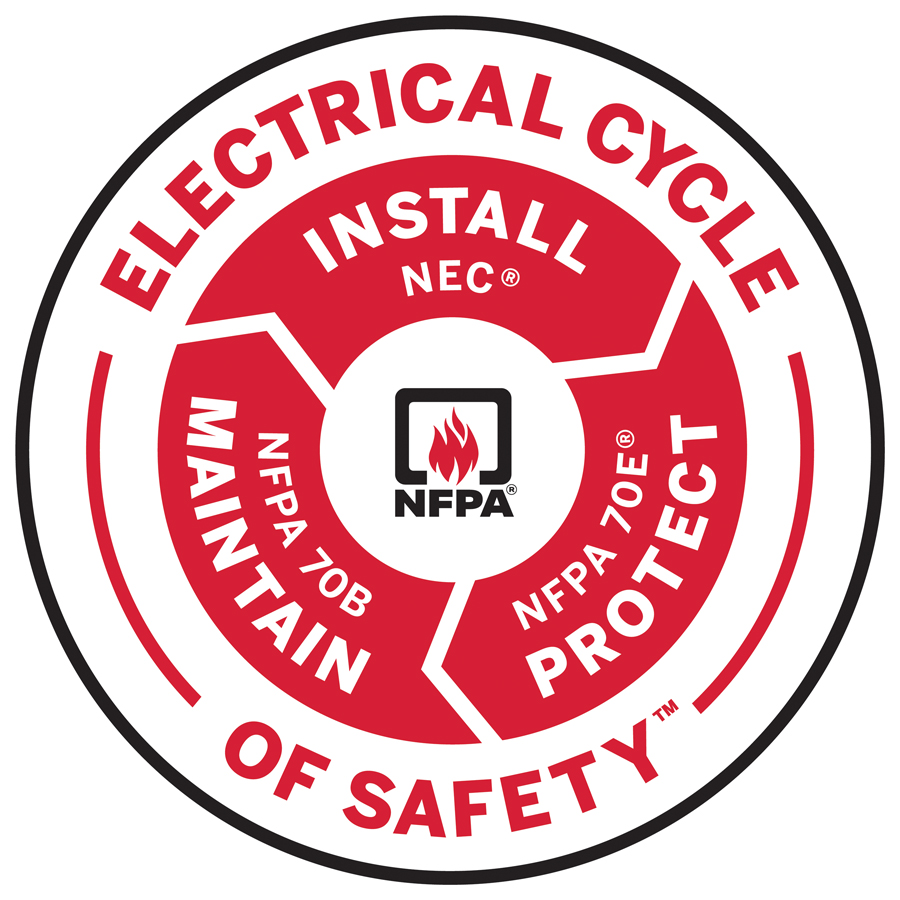
NFPA® ELECTRICAL CYCLE OF SAFETY™ (ECoS™)
After a high-level overview of the NEC, NFPA 70B, and NFPA 70E, it is easy to see how they collectively fit into the ECoS model to provide the highest level of electrical safety. Achieving the highest level of electrical safety isn’t about just installation, maintenance, or protecting business and workers; it’s about all of these things. Each component of the ECoS is as important as the next, and if even one is missing, it could result in preventable incidents that put people, property, and critical processes at risk.
Starting with a safe installation based on the requirements of the NEC is the foundation for the ECoS. What is unique about the NEC, as compared to NFPA 70B and NFPA 70E, is that it is often incorporated by reference (IBR) into state and local laws and then enforced by governmental agencies. This is where electrical inspectors act in the role of the authority having jurisdiction (AHJ) to ensure that the proper permits have been obtained for electrical work being performed within their area and that the work being done meets the NEC requirements. The NEC is enforced on some level in all 50 states. This indicates that a strong tie has been established with the installation portion of the ECoS.
NFPA 70B and NFPA 70E are a little different. They are not mandated by law, even when incorporated by reference, so enforcement takes a slightly different path. NFPA 70B spent 50 years as a recommended practice before officially becoming an enforceable standard in January 2023. Therefore, there had never been an opportunity for an IBR of this standard.
While there are no known cases of NFPA 70B being used in an IBR application during its short time as a standard, many businesses have chosen to implement and enforce the use of NFPA 70B because of the benefits they see in doing so. For example, developing and enforcing an EMP benefits a business by ensuring that electrical equipment and systems stay reliable, predictable, and functional while minimizing the opportunity for costly downtime.
NFPA 70B also allows a business to establish a defined “condition of maintenance” for each piece of electrical equipment. Here, NFPA 70B and NFPA 70E are so aligned that it makes it almost impossible to meet the requirements of NFPA 70E — which many businesses follow based on meeting OSHA regulations — without using NFPA 70B. That is because NFPA 70E requires the ESP to include elements that consider the condition of maintenance of equipment before working on it.
As expected, equipment that has had low or no maintenance can significantly increase the risk to employees who must service it. Using the procedures and records that align with an EMP developed under the requirements of NFPA 70B can provide the condition of maintenance for an employee who is following the safe work practices of NFPA 70E and evaluating the associated risk for a particular task.
While OSHA does not enforce NFPA 70E directly, it can be used to help meet OSHA electrical regulations.
CASE STUDY
Think of a scenario where a motor control center (MCC) was installed 20 years ago and has never seen regular maintenance; only specific parts have been replaced as they failed. Let’s say there is an incident where an employee is severely burned by being exposed to an arc flash while working on the MCC.
OSHA comes in to investigate the incident, and the business says they follow NFPA 70E strictly. They hand over their ESP, which states — as required by NFPA 70E — that they consider the condition of maintenance before assessing their risk and working on a piece of electrical equipment such as the MCC. OSHA’s next request is likely to see the maintenance records for the MCC involved in the incident. The trouble is, there are no known maintenance records for the MCC; we established at the beginning of this case study that regular maintenance had not been performed on the MCC for 20 years.
This road is likely to lead to OSHA citations, hospital bills, potential lawsuits, and a number with lots of zeros at the end. If the business had established an EMP with planned and documented regular maintenance, it might have prevented the incident altogether. Even if the incident still occurred, documentation would likely show that the business provided a significant effort to prevent it from happening. This example highlights how critical it is to utilize all parts of the ECoS.
ENLIGHTENING THE NEXT GENERATION ON THE ECoS
Holistic electrical safety and how the ECOS can provide it were not always taught to members of the electrical industry who are now closer to walking out the door than coming in. With the current changing of the guard and the influx of new workers to the industry, it is critical to begin enlightening them to using the ECoS.
Yes, they will learn about the NEC because they need to and always have. But they also need to know how important electrical maintenance is after the initial NEC-based installation. They need to know that working on poorly maintained equipment not only puts business processes at risk, but also puts their personal safety at risk. The next generation must understand that following the safe work practices in NFPA 70E can make the difference in whether or not they go home at the end of the day. The ECoS provides holistic electrical safety, but only if the present and future electrical industry finds a way to effectively implement it.
For more information on the NFPA® Electrical Cycle of Safety™ (ECoS™), including training opportunities, a downloadable fact sheet, and access to a free 75-minute webinar, please visit www.nfpa.org/ECoS.
Important Notice: Any opinion expressed in this column is the personal opinion of the author and does not necessarily represent the official position of NFPA or its Technical Committees. In addition, this piece is neither intended nor should it be relied upon to provide professional consultation or services.

Corey Hannahs is a Senior Electrical Content Specialist at the National Fire Protection Association (NFPA). In his current role, he serves as an electrical subject matter expert in the development of products and services that support NFPA documents and stakeholders. Hannahs is a third-generation electrician, holding licenses as a master electrician, contractor, inspector, and plan reviewer in the state of Michigan. Having held roles as an installer, owner, and executive previously, he has also provided electrical apprenticeship instruction for over 15 years. He serves on the technical committees for UL 2272, Electrical Systems for Personal E-Mobility Devices, and UL 2849, Electrical Systems for Ebikes. Hannahs was twice appointed to the State of Michigan’s Electrical Administrative Board by former Governor Rick Snyder, and he received United States Special Congressional Recognition for founding the B.O.P. (Building Opportunities for People) Program, which teaches construction skills to homeless and underprivileged individuals.