
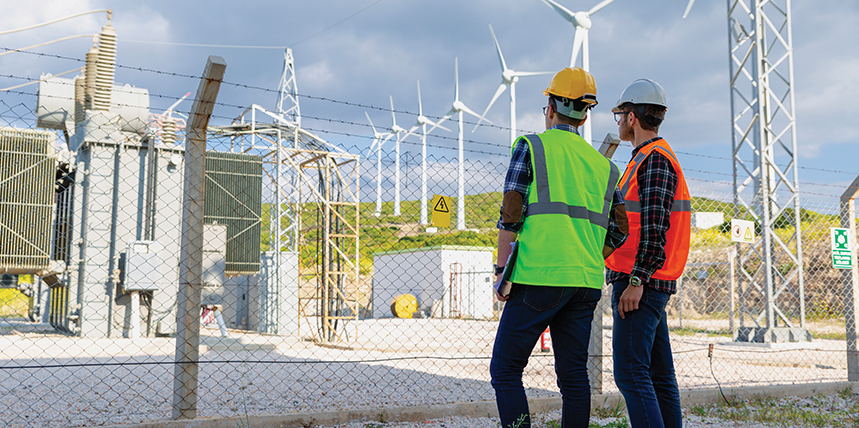
Wind turbine, solar, and battery storage — distributed energy resources (DER) — site transformers are generally excluded from dissolved gas IEEE and IEC standards for limits. The primary reason has to do with the unusually high levels of gassing that occur due to variable loads, harmonic content, resonance issues, and other conditions that are specific to DER applications. This has prompted American Clean Power (ACP), formerly American Wind Energy Association (AWEA), to task the DER standards group to develop gassing standards to assist balance-of-plant oil-filled transformer analysis. This is considered an urgent project as transformer failure rates are in the top five of major component failures on a DER site.
The first step was to combine the three internal standards groups involving wind, solar, and energy storage into a single group in 2024. The wind group is an ANSI-approved standards body with numerous best practices, notes, and standards under its belt. The other teams were recent additions with limited development. The groups were consolidated under the wind standards group, which primarily focused on such items as modification of IEC standards for structural and other similar mechanical systems, as well as some electrical.
In parallel, ACP’s Balance of Plant Committee commissioned two projects. The first was a project with Doble that focused on mineral oil-immersed transformers. The second is an ongoing project associated with EPRI on synthetic oils that is planned for completion at some point in 2025. Each of these projects is reviewing populations of each type of transformer oil, gassing levels, and as-found conditions from a survey of primarily wind and solar sites. Battery storage (BESS) is assumed to be included, as these are generally built in as part of wind and solar projects and part of the balance of plant.
This article presents the basics related to the ongoing standards development, beginning with the first in-process standard on mineral oils co-chaired by Howard Penrose of MotorDoc and ACP standards Chair Chris Petrola of Enel and Kevin Alewine of Shermco. The second standard will kick off once the EPRI project is complete and will focus on synthetic oils.
MINERAL OIL STANDARD
The proposed title for the first standard is ACP Guide for the Interpretation of Mineral Oil Gas Generation in Oil-Immersed Distributed Energy Transformers. It is based on IEEE Std. C57.104–2019 (Revision of IEEE Std. C57.104-2008), IEEE Guide for the Interpretation of Gases Generated in Mineral Oil Immersed Transformers with its scope modified for DER systems. The Doble project, Transformer Risk Assessment and Mitigation Report, was performed for ACP in 2019 based on a March 2018 contract and is owned as a work-for-hire by ACP. Due to the transition of AWEA to ACP during that period, followed by COVID, little progress was made on the transfer of the data to a best practice or standard. In 2021, work and review were re-initiated based on the apparent need following the updates of industry standards that excluded DER transformers.
Initially, the idea was to incorporate the planned study on synthetic oils as part of a complete standard. However, during the March 2025 Balance of Plant and Standards Committee meetings, it was determined to do the same as other standards bodies and produce separate mineral oil and synthetic oil standards.
The Doble study was limited as it was performed while the organization was still AWEA, and the sole focus was on wind turbine transformer oil gassing. The study included three projects and deliverables:
- Review of dissolved gas analysis (DGA) data from populations of wind turbine transformers to determine norms for condition codes, gas, and combustible gas generation
- Review of failure reports and failure information to categorize primary failure modes
- Safety practices for oils with high concentrations of combustible gas
The data analyzed for the study consisted of over 20,000 DGA results from 5,172 transformers made by 16 manufacturers. The data was statistically analyzed and compared to a power industry study also performed by Doble. It was found that wind turbine applications, based upon gas, subject the transformers to more demanding operating conditions than were found in traditional power distribution applications.
The data used was compared to failed transformers from the population, where this is defined as being unable to return to service. The defects in which the gassing was correlated included the following:
- Arcing in the main tank
- Bushing failure
- De-energized tap changer
- Defective load break switch
- Internal faults identified by the manufacturer
- High DGA concentrations
- Failed electrical testing
- Mechanical defects
- Bulging of the main tank
- Converter
- Unknown failures
- Strategic replacement due to high gassing
The prevalent gases found in the failed transformers include hydrogen, methane, ethylene, and acetylene, indicating issues such as partial discharge, high-temperature overheating of oil, and arcing conditions. It was noted that over 67% of the transformers exceeded IEEE C57.104 gas generation levels, which supports the concern that existing standards are not adequate for making DER transformer decisions based upon existing standards.
The primary causes were determined to be related to fluctuating loads, thermal cycling, harmonic conditions from tower inverters, and transient voltages. In addition, the transformers are often lightly loaded as the average USA capacity factor falls between 35%–40%. The result is that some turbine OEMs will make the transformer smaller than necessary for full load, resulting in gassing issues from overloads in addition to underloading. One significant issue is the high-order harmonics and core resonance from the inverter, whether the tower is an induction machine where the inverter is in series with the transformer or a doublyfed induction generator (DFIG) in which the inverter is in the rotor circuit.
The goal is to have the standard out for comment in early 2026 per the ACP ANSI process.
SYNTHETIC OIL PROPOSED STANDARD
Wind primarily uses mineral oils, but solar and BESS primarily use synthetic oils that have higher thermal ratings and gassing properties. The combination of oils used ranges from silicone to synthetic esters and natural esters (plant oil), each with thermal ratings well over mineral oils but with potentially drastically different gassing tendencies.
For silicone oils, IEEE C57.146, IEEE Guide for the Interpretation of Gases Generated in Silicone-Immersed Transformers, is referenced. Silicone oil exhibits unique gassing patterns with hydrogen, methane, and ethylene being the primary for electrical discharges. The generation of acetylene is less prevalent in arcing conditions.
For synthetic and natural esters, IEEE C57.155, IEEE Guide for Interpretation of Gases Generated in Natural and Synthetic Ester-Immersed Transformers, is used. Synthetic esters generally produce much lower concentrations of fault gases compared to mineral oils. However, their gas generation can vary based on the specific ester formulation and operating conditions. Natural esters, on the other hand, are primarily derived from vegetable oils and exhibit different gassing behaviors than mineral oils.
In the inverter applications associated with solar and BESS, the results are similar to wind transformers, where the gassing is different than in a standard application. The common oil as found in the EPRI work to date appears to be natural esters. Once the study is completed, a breakdown on how the results will be divided will be determined by the Standards Committee.
CONCLUSION
As DER step-up transformers are specifically excluded from industry standards for DGA purposes, it fell to the industry through ACP to develop a guide based upon industry experience. Because there are multiple oil types, similar to other utility industry transformer oils, standards are in development to provide guidance for each type based on the majority of use. The first, based on a study performed for ACP by Doble Engineering, will be mineral oils, which are primarily used in the wind industry. However, it is generally felt that the results should be considered for all mineral oil DER. The same will be developed once the EPRI study on esters and synthetics is complete. Overall, the result is expected to be a significant increase in DER step-up transformers.
REFERENCES
- IEEE Std. C57.104–2019, IEEE Guide for the Interpretation of Gases Generated in Mineral Oil Immersed Transformers.
- IEEE Std. C57.146, IEEE Guide for the Interpretation of Gases Generated in Silicone-Immersed Transformers.
- IEEE Std. C57.155, IEEE Guide for Interpretation of Gases Generated in Natural and Synthetic Ester-Immersed Transformers.

Howard W. Penrose, PhD, CMRP, CEM® CMVP, is President of MotorDoc® LLC, a veteran-owned small business. He was a U.S. Navy Electric Machine Repair/Rewind Journeyman (NEC 4619/4621) and is the 2022–2025 Chair of Standards Development at American Clean Power. Penrose is the past chair of the Society for Maintenance & Reliability Professionals (SMRP) and currently serves on the SMRP Government Affairs Team for workforce, smart grid, cybersecurity, and infrastructure, among numerous other energy/environment/ workforce programs. He is the past chair of the Chicago Section IEEE; an active member of IEEE standards committees; a past Senior Research Engineer at the University of Chicago Energy Resources Center; chair of the Committee for Wind/Solar/Energy Storage Standards for the USA through the American Clean Power Association (formerly AWEA); and the U.S. appointee to CIGRE Working Group A1 Electrical Machines for those topics. He is a five-time recipient of the UAW–GM People Make Quality Happen Award and is a leading researcher of ESA/MCSA applications. Penrose received his PhD in industrial-general engineering and is certified in data science and machine learning from Kennedy Western University, Stanford University, the University of Michigan, IBM, and AWS. He is also a Certified Maintenance and Reliability Professional through the Society for Maintenance and Reliability Professionals, and a Certified Energy Manager and Certified Measurement and Verification Professional through the Association of Energy Engineers.