Designing Adaptive Trip Logic for Large Generators

Steven Turner, ConsultantRelay Column, Fall 2026 Columns, In Every Issue

Large generators, such as coal-fired and nuclear, are grounded through a high impedance to limit fault current flowing in the stator winding during ground faults. The high impedance is a resistor located across the secondary winding of a single-phase distribution transformer connected from the machine neutral to ground.  Large generators typically have a main set for protection and a backup …

On Surge Arresters and Power Factor

Michael Labeit, ASRC EnergyIn Every Issue, Fall 2026 Columns, In the Field

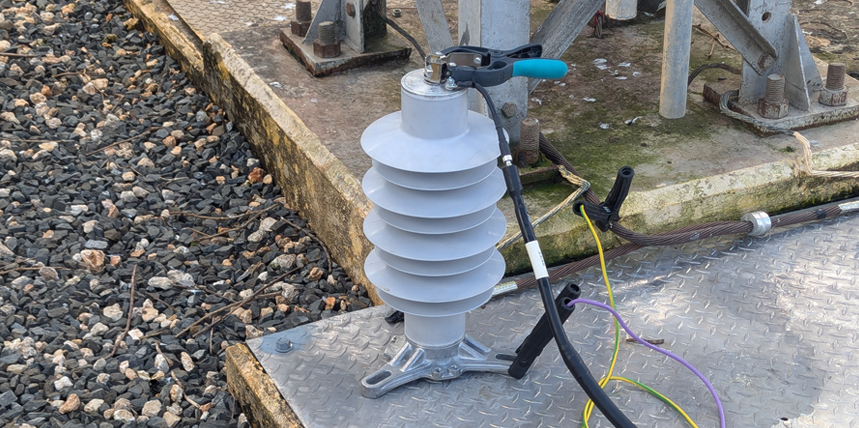
If you’ve done power factor testing, you will have noticed that while said testing yields multiple valuable parameters—e.g., watts loss, capacitance, total current, etc.—power factor itself gets the most attention. Indeed, power factor is a critical indicator of electrical equipment performance. However, an important exception to this claim exists, and it exists for surge arresters.  Power factor is the ratio …

History Does Not Repeat Itself, But It Rhymes

Ron Widup, Vector PowerIn Every Issue, Fall 2026 Columns, NFPA 70E and NETA

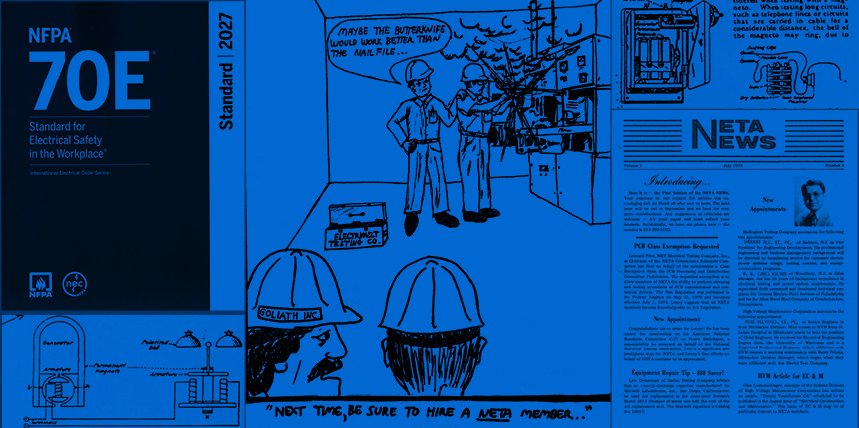
Often attributed* to Mark Twain, the phrase “History does not repeat itself, but it rhymes” seemed appropriate as we look back on our electrical journeys. The 2027 edition of NFPA 70E was recently approved, with an effective date of May 6, 2026, and we are excited about the improvements and enhancements to this very important electrical safety work practices standard.  …

Meeting the Challenges of a Changing Power Landscape

Dan Hook, CBS Field Services, NETA PresidentIn Every Issue, Fall 2026 Columns, President's Desk

The electrical industry is in the midst of its most significant transformation in a generation. The rapid growth of EV charging infrastructure, the integration of renewable energy resources, the proliferation of data centers, and the increasing complexity of the modern grid are all reshaping the environment in which our members work every day. This issue of NETA World addresses that …

Data Center Ground Testing

Lee Howard and Jacob Rioux, Hood Patterson & DewarIn Every Issue, Summer 2026 Columns, Tech Tips

The fall of potential (FoP) test to measure the ground impedance of a data center building or substation is commonly specified as part of start-up and commissioning testing. This test procedure is spelled out in IEEE Std. 81, IEEE Guide for Measuring Earth Resistivity, Ground Impedance, and  Earth Surface Potentials of a Ground System. To obtain good data,a properly executed …

Presence of Voltage

Morgan Gieni, Magna IV EngineeringIn Every Issue, Summer 2026 Columns, Tech Quiz

Electrical safety standards exist to help us work safely on or around electrical equipment. One key element in avoiding electrical hazards is identifying energized parts. NETA Certified Technicians must do everything possible to eliminate their exposure. 1. What is the best information source for selecting isolation points when preparing an isolation plan?a. Schematic diagramb. Single-line diagramc. Visual inspectionsd. Process and …

CPR: The First Link in the Chain of Survival

Charlie Simpson, Asplundh Engineering ServicesIn Every Issue, Safety Corner, Summer 2026 Columns

In October 2025, the American Heart Association (AHA) released the first full revision of its Guidelines for Cardiopulmonary Resuscitation (CPR) and Emergency Cardiovascular Care (ECC) since 2020. The AHA maintains that cardiac arrest claims more lives globally than colorectal cancer, breast cancer, prostate cancer, influenza, pneumonia, auto accidents, HIV, firearms, and house fires combined.  Cardiac arrest is an immediate occurrence, …

Using AI to Do an Engineer’s Work

Steven Turner, ConsultantIn Every Issue, Relay Column, Summer 2026 Columns

Recently, I challenged a proprietary AI platform to solve a simple protection problem: Use a CO-9 overcurrent relay to provide backup protection for a 150 MVA transformer; the high-side voltage is 230 kV. Plot the characteristic of the CO-9 versus the transformer damage curve. This was not an especially difficult problem to solve. I wanted to see if it would …

On Voltage Dividers: Applications and Hazards

Michael Labeit, RESA PowerIn Every Issue, In the Field, Summer 2026 Columns

Voltage dividers are simple devices consisting of series circuits that produce two or more lower voltages from a single source voltage via resistances. This is possible because of this mathematical fact: Given a series circuit with multiple resistances, the sum of the absolute values of all voltage drops across each resistance will equal the source voltage.  This fact is illustrated …

Mascots and Electrical Safety Culture Engagement: Are You Reddy and Willie(ing)?

Ron Widup, Vector PowerIn Every Issue, NFPA 70E and NETA, Summer 2026 Columns

OK, let’s be honest. When you pull NFPA 70E off the shelf, it’s not exactly something you look forward to reading for entertainment. Yes, it matters. (It matters a lot!) But it’s not built to grab your attention or stick with you. And that’s not a knock on the standard. Consensus standards like NFPA 70E serve a clear purpose: to …